Watching the sun set at Cape Sounion's Temple of Poseidon
There are sunsets, and then there are the ones that make you stop mid-sentence and simply watch. The sunset from Cape Sounion, where the Temple of Poseidon stands at the edge of a white limestone cliff 60 kilometres south of Athens, belongs firmly in the second category. I’d seen photographs. I wasn’t fully prepared for the real thing.
| Where | Cape Sounion, ~70km south of Athens |
| Cost | Around €10 site entry; tours typically €40–70/person |
| Time needed | Half a day round trip (roughly 4–5 hours from leaving Athens) |
| Getting there | Guided small-group tour, self-drive, or public bus |
| Best time | Arrive at least an hour before sunset; check seasonal times |
Getting there
The cape sits at the southernmost tip of the Attica peninsula, about 70 kilometres from central Athens. In July, the drive takes around 90 minutes — longer on a summer Friday afternoon when half of Athens has the same idea. The coastal road, particularly the last 20 kilometres hugging the cliffs above the Aegean, is one of the better drives in greater Greece. The sea appears and disappears around each headland. Small beaches dot the coves below.
I’d read enough about timing to know that arriving independently and trying to catch the sunset on your own schedule was logistically complicated — you’d either need to hire a car, negotiate taxis for the return, or take the public bus and accept that the schedule wouldn’t align with the light. I booked a small-group sunset tour from Athens instead. The group was eight people, which is the ideal size for something like this — you don’t feel alone, but you don’t feel herded either.
We left Athens in the late afternoon and arrived at the site with about an hour before the sun touched the horizon. That timing matters.
The first sight of the temple
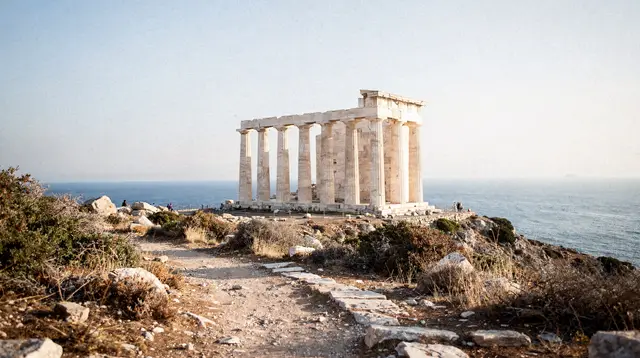
You see it from the road before you reach the car park — white marble columns rising above the cliff against the blue sky. The image is startlingly classical, like a postcard you’ve seen so many times it doesn’t feel real. And then you walk up the path and it resolves into three dimensions, and the scale becomes apparent, and the wind comes in off the sea, and it feels entirely real.
The Temple of Poseidon was built in 444 BCE, at roughly the same time as the Parthenon, under the direction of Pericles. It stood at the edge of the Attic world, visible to ships for miles as they rounded the cape — a statement of Athenian wealth and confidence carved into the southernmost point of the peninsula. The columns are Doric, unfluted for the first several feet to protect against the salt wind. There’s a marble block near the entrance where someone has scratched the name “Byron” — Lord Byron, apparently, though this attribution is disputed by scholars with more scruples than the poet himself had.
In July, the site is busy. I won’t pretend otherwise. The afternoon bus from Athens delivers plenty of visitors, and the terrace around the temple fills up about 30 minutes before sunset. But the cape is wide enough and the view is large enough that it doesn’t feel oppressive.
The light changes everything
The sunset itself unfolds in stages, and each one is worth attention.
About 45 minutes before dusk, the white marble begins to warm. It moves from the cool grey of midday through cream and into a faint gold that gradually deepens. The sea below — a hundred metres or more of vertical cliff dropping to the water — shifts from bright Mediterranean blue to something deeper and more complex. A few fishing boats moved across the water while I watched, and the way they caught the light made them look like they were lit from underneath.
Twenty minutes before the sun reached the horizon, the temple columns were fully golden. The sky behind them was layered — pale gold directly above the sun, shading to orange, then a deep russet toward the horizon where the light was thickest. The sea picked up every one of those colours and scattered them.
The moment the sun hit the water, everything went quiet. I don’t mean that literally — there were people around me, the wind hadn’t stopped, a boat engine droned somewhere below. But the ambient noise seemed to recede. People stopped moving and just watched.
The sun takes about three minutes to drop fully below the horizon at this latitude in July. It felt shorter. In the last seconds, the columns were almost orange, and the shadow they threw across the limestone platform was long and sharp.
After the sunset
This is where an organised tour earns its value. Independent visitors have to find their own way back to Athens after the light fades — the last public bus leaves at a time that forces a choice between missing the best of the sunset or scrambling for the return. On the small-group tour, the minibus waited, and we drove back along the coast road as the sky finished its slow shift from orange to violet to dark blue.
If you have a car and want to do the drive yourself, the coastal road south from Athens toward Sounion — the scenic route through Vouliagmeni and Varkiza rather than the inland motorway — is worth doing in daylight on the way down, even if it adds time. On the return, the coastal road in the dark has its own appeal, the lights of small restaurants and beach bars strung out along the water.
When to go for the best light
Sunset time at Sounion shifts by hours across the year, and it changes both the crowd and the drive:
| Month | Approx. sunset | What to expect |
|---|---|---|
| December–January | ~5:15–5:30 pm | Coolest light, thinnest crowds, cold wind on the cliff |
| March–April | ~7:00–7:45 pm | Mild, good visibility, moderate crowds |
| June–August | ~8:30–8:50 pm | Warmest colours, busiest terrace, book ahead |
| September–October | ~7:00–7:30 pm | Good balance of light and lighter crowds |
Summer gives the longest, most dramatic colour show but also the fullest terrace — arrive the full hour ahead if you’re going in July or August. Shoulder-season visits (April–May, late September–October) trade a little drama for a much calmer viewing spot and an easier drive down.
The practical basics
- The site opens daily; ticket prices in 2023 were €10 full, less for EU citizens under 25.
- Sunset times vary: mid-July, the sun drops around 8:40–8:50 pm local time. Arrive at least an hour before.
- There’s a café at the site entrance but the food is unremarkable — eat in Athens before you leave.
- The cape is exposed and the wind can be strong even in summer; bring a light layer.
- Byron’s alleged inscription is near the entrance on your left — look for the section of marble with graffiti at eye level.
Worth it?
Yes, genuinely, without qualification. In a summer in Greece, there are many good sunsets: from Santorini, from Oia, from the ferries between islands. But the Sounion sunset has something the others don’t — a man-made object of enormous age and beauty that channels the light and gives the moment a frame. The temple doesn’t compete with the view. It completes it.
It’s one of the better day trips from Athens, and easily combined with a swim at one of the beaches near Lavrio on the way back. The whole excursion — leaving Athens at 4 pm, swimming, arriving at the temple for sunset, returning by 11 pm — makes for a satisfying alternative to a third full day in the city.
The context that makes the site meaningful
The Temple of Poseidon at Sounion is not just a beautiful ruin on a scenic cliff. It had a specific function in the geography of ancient Athenian life. Cape Sounion marked the southern boundary of Attica — the territory of Athens — and the temple was the last and first sight of home for Athenian sailors. Ships heading to the Black Sea, to Egypt, to the eastern Mediterranean, to Sicily would see the temple as they rounded the cape. Ships returning from those voyages would see it again as the first sign of Athenian territory.
There’s a passage in Plato’s dialogue Republic that imagines Socrates walking down to the Piraeus to witness the festival of the Thracian goddess Bendis. Sounion was the opposite pole — the southern edge of the same world. The temple was actively in use until at least the first century BCE, tended and supplied by the Athenian state as a working religious site. The architecture itself reflects this investment: the temple uses the same Doric order as the Parthenon but scaled to a headland setting rather than a hill, with columns spaced to maximise visibility from the sea.
Lord Byron’s name on the marble is a piece of 19th-century vandalism that no one would be permitted to repeat today. But it also marks the beginning of the modern fascination with this site — Byron, like many Romantic travellers, saw in the ancient ruins of Greece something that northern European cities couldn’t offer: a direct encounter with the origin point of Western civilisation. He wrote about Sounion in “Don Juan,” and the name he carved became, despite its irreverence, part of the site’s history.
What to eat and drink nearby
The small town of Sounio, immediately before the cape, has a handful of tavernas and cafés. The fish at the waterfront tavernas is consistently good — the proximity to the sea shows in the freshness. If you’re on the sunset tour, you’ll typically have time for a drink at one of the cliff-edge cafés before the guided visit begins.
If you’re driving independently and want a better meal, Lavrio — the small port town about 10 kilometres north of the cape — has a genuinely good waterfront restaurant scene that serves the local fishing boats and the ferry traffic to the islands. Meze plates, grilled fish, local wine: it’s the kind of meal that rewards stopping.
Read more about day trips from Athens if you’re deciding between Sounion, Delphi, Meteora, and the other options radiating from the city.
Tour or self-drive?
If you don’t have a car, a small-group sunset tour solves the return-journey problem outright — you’re not left calculating bus timetables against a sunset that doesn’t care about schedules. If you do have a car and don’t mind a night drive back along the coast, going independently gives you the freedom to stop at Vouliagmeni or Varkiza on the way down and linger as long as you like once the colour has faded. Either way, don’t try to combine Sounion with a full day of central Athens sightseeing on the same afternoon — the drive alone takes a real bite out of the day, and rushing the ancient sights beforehand undercuts both halves of the trip.
If a shared minibus isn’t your style, a private sunset transfer with a guide lets you set the pace and linger at the terrace without watching the clock. And if you’d rather see the cape from the water, a sunset cruise along the Athens Riviera to the cape shows the temple from below, perched on its cliff exactly as ancient sailors saw it.
Making the most of the rest of the trip
A Sounion evening sits well alongside the other pieces of an Athens stay. If you are still shaping your plans, the Cape Sounion sunset trip guide covers the practical side of the evening, and the Athens in 2 days and Athens in 3 days itineraries show where a half-day away from the city can fit without crowding the rest.
Since the sunset is the point, it helps to spend the morning on something gentle. A slow walk through Plaka or the Acropolis early in the day, as described in acropolis morning vs evening, leaves you rested for the drive south. Anyone keen on more golden-hour views can compare this with sunset photography at the Acropolis or the best rooftops with an Acropolis view.
If you are travelling in high summer, the advice in Athens in summer and the August heat survival story applies doubly to an exposed cliff-top. For a seaside alternative closer to the city, the Athens Riviera and its sunset sail give a different take on the same evening light. Travellers without a car can also look at day trips from Athens without a car, and anyone weighing the cost of getting around can check the Athens taxi guide and renting a car in Athens.
Frequently asked questions about Watching the sun set at Cape Sounion’s Temple of Poseidon
Do I need to book the Cape Sounion sunset tour in advance? Yes, especially from June through August. The best tours are small-group and cap numbers, and sunset timing means every departure on a given evening runs the same route at the same hour — popular dates sell out days ahead in peak summer.
Is Cape Sounion worth visiting if I can’t make it for sunset? It’s a good site at any time of day, but the sunset is genuinely the reason to go this far — the temple and the light together are what make it memorable rather than just another set of columns. If sunset doesn’t fit your schedule, a Delphi or Meteora day trip may be a better use of a full day than a daytime-only Sounion visit.
Cape Sounion day trips on GetYourGuide
Verified deep-linked GetYourGuide tours. Book through these links and we earn a small commission at no cost to you.
GetYourGuide does not provide product photos: on its activity cards, the picture illustrates the type of experience and is not the operator's own photo.