
Kid-friendly day trips from Athens: the best options for families
What are the best day trips from Athens with kids?
The best day trips from Athens with kids are Aegina by fast ferry (45 min, beach + ruins), Cape Sounion (1 hr drive, dramatic temple + beach), and Nafplio (2 hrs, medieval castle + beach). All suit children from age 5 up. Delphi works well for children aged 8 and older.
Why day trips make Athens family trips better
Athens is a genuinely exciting city for children, but three or four days of ruins and museums can exhaust even the most enthusiastic young traveller. Day trips inject variety — a ferry crossing, a medieval castle, a swim in clear water, a horse-drawn carriage ride in a car-free village. They also break the heat: coastal day trips naturally push the agenda toward beaches and outdoor activities in ways that are harder to sustain in the city in July and August.
The day trips below are selected specifically for child appeal, manageable travel times, and practical logistics. Each is rated by age suitability and given honest assessments of what works and what doesn’t for families.
If you are still shaping the wider trip, the Athens with kids guide and the 4-day Athens itinerary with kids show where a day trip fits between city days. For the full range of options beyond the family shortlist, see the best day trips from Athens.
| Where | Aegina, Cape Sounion, Nafplio, Delphi, Ancient Corinth |
| Cost | Varies by trip; roughly €30–80 per adult for organised options |
| Time needed | Half day (Sounion) to full day (Delphi, Nafplio) |
| Getting there | Ferry (Aegina) or car/bus/organised transfer (the rest) |
| Best time | April–October for beach combinations |
Aegina — best overall family day trip
Travel time: 35 minutes by high-speed catamaran, 80 minutes by conventional ferry from Piraeus
Best for ages: 4 and up
Season: Year-round, best April–October
Aegina is the easiest Saronic island day trip from Athens and arguably the best single family day trip in the region. The island has a car-free waterfront, excellent beaches, a well-preserved ancient temple (the Temple of Aphaia), pistachio farms, and a compact old town that children can explore independently.
What works for children: The ferry crossing itself — 35–80 minutes on a vessel with open deck space — is exciting for most children. On the island, horse-drawn carriages (the main transport in the old town) delight young visitors. Aegina Town’s waterfront fish market is visually arresting. The beaches at Agia Marina on the east coast have shallow, calm water and organised sunlounger facilities.
The Temple of Aphaia (10 km from Aegina Town) is smaller and better-preserved than many mainland ruins, and the hilltop setting gives children a genuine sense of a sacred mountaintop. A local bus from the port takes 20 minutes.
Logistics: Take the high-speed catamaran (Flying Dolphin or Hellenic Seaways) from Piraeus Gate E8 or E9. Piraeus is reachable from Athens on Metro Line 1 (Piraeus station). Book ferry tickets online or at the port kiosk. Return ferries run until 9 pm in summer.
An organised Saronic cruise visiting Aegina, Poros, and Hydra covers more ground but gives less time on each island — better for children aged 8 and up with longer attention spans.
For more on the island itself, the Aegina island guide and the Aegina destination page cover the town, beaches, and temple in more detail. The Piraeus to ferry guide explains how the port works, which is worth reading before you arrive with children and bags.
Cape Sounion — dramatic and beautiful
Travel time: 1 hour by car or organised transfer; 2 hours by KTEL bus
Best for ages: 5 and up
Season: April–October for beach combination; year-round for the temple
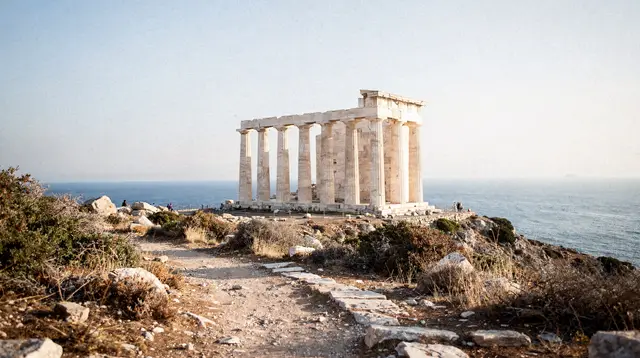
Cape Sounion is one of the most dramatic coastal settings in Greece: a sheer 60-metre limestone cliff at the southern tip of Attica, topped by the marble columns of the Temple of Poseidon. The cliff drops almost vertically into clear blue water. If you want one image to explain why ancient Greeks believed the gods lived in places of impossible beauty, this is it.
What works for children: The visual impact is immediate and requires no historical preparation. Children aged 5 and up are struck by the view. Older children (8+) respond to the story — Byron carved his name in the marble here in 1810, and it is still visible. The Temple of Poseidon is dedicated to the god of the sea, whose domain you can see from every direction.
Beach combination: The cove below the cape has clear, clean water. Sounion Beach (east side) is sandy and shallow; the western cove is more secluded. Combining the temple visit (45 minutes) with a 2-hour beach swim makes an excellent full-day excursion.
Logistics: KTEL Attica buses depart from the terminal on Pedion Areos park, near Victoria Metro station, roughly every 90 minutes (2-hour journey). An organised day trip from Athens handles transfers and adds guide context at the temple. Driving independently gives flexibility to stop at Lavrio harbour for fresh fish.
If you would rather not drive or manage buses with children, a guided option such as a half-day trip to the Temple of Poseidon keeps the logistics simple and leaves you free to focus on the children and the view.
Families who like the idea of an evening visit can read the Cape Sounion sunset trip guide, though a late return can be a lot for younger children.
Nafplio and the Argolis — for older children and teenagers
Travel time: 2 hours by car or bus (KTEL Nafpliou from Kifissos terminal)
Best for ages: 7 and up; best with children 10+
Season: Year-round, best April–October
Nafplio is one of the most beautiful small towns in Greece — a Venetian-era port at the head of the Argolic Gulf, overlooked by two massive fortresses (Palamidi and Acronafplia). It was Greece’s first capital after independence (1828–1834) and has the architectural coherence of a planned historic town: neoclassical houses, Venetian walls, and a harbour that children can walk around in under an hour.
What works for children: Palamidi fortress above the town has 999 steps (the actual number is debated) — a challenge that older children and teenagers take up enthusiastically. The views from the top are extraordinary. The Nafplio harbour has ice cream shops, horse-drawn carriages, and excellent seafood restaurants.
Combine with Epidaurus (40 km east): The ancient theatre of Epidaurus has near-perfect acoustics. Drop a coin on the stage from the top row and children in the upper seats can hear it clearly. The ancient sanctuary below the theatre is engaging for children who have heard about ancient medicine and healing.
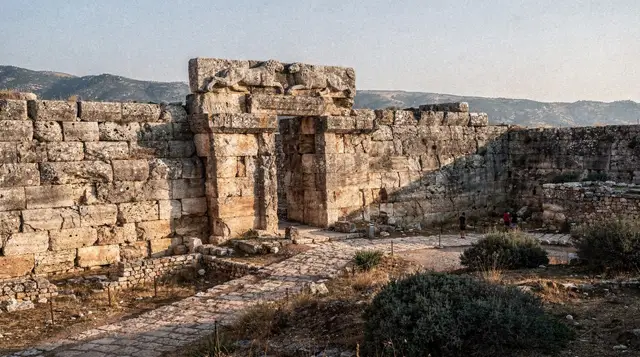
Combine with Mycenae (30 km north): The Lion Gate at Mycenae is genuinely impressive — massive stone lintel carved with heraldic lions — and the ruins are accessible enough for children. The Treasury of Atreus (a beehive tomb) is dark, cool, and cavernous in a way that children find exciting.
Because the stops are spread out, many families prefer a private day tour through Corinth, Epidaurus, Mycenae and Nafplio, where the pace and the breaks can be adjusted to the children rather than to a fixed schedule.
For a full itinerary, see the Argolis day trip guide. The destination pages for Nafplio, Mycenae, and Epidaurus go deeper on each stop if you want to choose between them.
Delphi — for mythology-minded families
Travel time: 2.5–3 hours from Athens by car or bus
Best for ages: 8 and up
Season: April–October (closed in heavy snow/winter conditions at altitude)
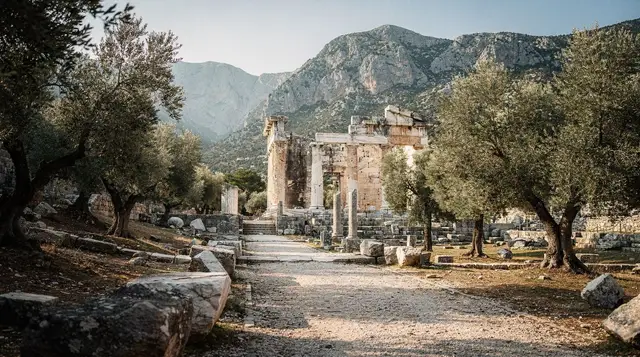
Delphi sits at 600 metres elevation on the slopes of Mount Parnassus, overlooking the Phocian plain and the Gulf of Corinth. The ancient sanctuary of Apollo was the spiritual centre of the Greek world — rulers consulted the Oracle before battles, athletes dedicated victories here, and philosophers debated the meaning of “Know thyself” inscribed at the entrance.
What works for children aged 8+: The story of the Oracle is genuinely compelling — a priestess who breathed volcanic fumes and uttered prophecies that changed the course of history. The theatre and stadium above the main sanctuary are well-preserved and allow children to run, shout, and test the acoustics. The Delphi Museum has excellent exhibits including the bronze Charioteer, one of the finest surviving ancient bronzes.
What doesn’t work for younger children: The site is large (2–3 km of walking up steep slopes), the mountain air is cooler than Athens even in summer, and the historical content requires some background knowledge. Children under 7 or 8 find it tiring and confusing. For this age group, Aegina or Cape Sounion are better choices.
Logistics: KTEL Fokidas buses depart from Liossion terminal in Athens, roughly 5 buses per day. Journey time 2.5–3 hours. Organised day trips from Athens handle logistics and add guide commentary that is essential for understanding the site.
To prepare children for the visit, the Delphi destination page, the Delphi day trip guide, and the story of the Oracle of Delphi give the mythology in a form you can retell in the car or on the bus.
Ancient Corinth — closer and underrated
Travel time: 1 hour 20 minutes by car; 2 hours by suburban rail (proastiakos) to Corinth station + local bus
Best for ages: 6 and up
Season: Year-round
Ancient Corinth is significantly less visited than Delphi or the Argolis, which makes it an excellent family choice for children who find crowds overwhelming. The ruins cover a large area at the base of the massive Acrocorinth fortress — a limestone rock rising 575 metres above the plain, topped by Byzantine, Frankish, and Ottoman walls that are intact enough to walk along.
What works for children: Acrocorinth is a proper castle in every sense — multiple concentric walls, towers, a moat, and a gatehouse sequence that children can understand as a real fortification rather than a ruined building. The Temple of Apollo at the base (7 standing Doric columns) is photogenic and compact. The archaeological museum has excellent mosaics.
Practical advantage: Because Corinth is less famous, sites are significantly less crowded than the Acropolis or Mycenae, even in peak summer. Children get access without queuing, can run between the ruins, and have space to explore without being in anyone’s way.
See the Ancient Corinth day trip guide for full details.
Poros — the quieter alternative to Aegina
Travel time: Around 1 hour by high-speed ferry from Piraeus
Best for ages: 4 and up
Season: April–October
If Aegina feels too busy for your family’s taste, Poros is a calmer alternative with a similarly easy ferry crossing. The town sits on a small peninsula facing the Peloponnese mainland across a narrow channel, and the short water-taxi crossing to Galatas (about 2 minutes, roughly €1) is an easy, low-stakes adventure that younger children enjoy repeating. The waterfront is flat and manageable for buggies, and the swimming from the quayside is calm and shallow in several spots. It has fewer organised child-specific attractions than Aegina (no horse-drawn carriages, less shopping) but makes up for it with a slower pace and noticeably thinner crowds even in August.
Athens private family tour (half-day) — if day trips feel too ambitious
For families with very young children or limited stamina, a private half-day Athens city tour covers more than a day trip with less logistical complexity. A good private guide with 4 hours in Athens can combine the Acropolis, Acropolis Museum, Plaka, and a mythology walk in a sequence calibrated to your children’s ages and energy levels.
Private Athens family tour (4 hours) — expert guide, child-friendly paceChoosing the right day trip for your family
| Destination | Travel time | Best age | Transport |
|---|---|---|---|
| Aegina | 35–80 min | 4+ | Ferry from Piraeus |
| Cape Sounion | 1 hr | 5+ | Car, bus, or organised trip |
| Nafplio + Mycenae | 2 hrs | 7+ | Car or bus |
| Ancient Corinth | 1h20 | 6+ | Car or train |
| Delphi | 2.5 hrs | 8+ | Car or bus |
General rules: ferry day trips (Aegina, Saronic islands) suit the youngest children because the journey itself is entertainment. Temple and ruin sites require children old enough to understand a narrative — roughly 6–8 depending on the child. Mountain sites (Delphi, Meteora) require children who can walk for 2+ hours on uneven terrain.
For more on what to do with families in the city, see family-friendly Athens activities and the things to do with kids hub.
Frequently asked questions about day trips from Athens with kids
What is the easiest day trip from Athens with toddlers?
Aegina by fast ferry is the easiest option with toddlers: short crossing, car-free waterfront for buggy walking, a beach with shallow water, and excellent Greek food. The horse-drawn carriages in Aegina Town are a particular hit with young children.
Are organised day trips worth it for families?
Usually yes. Organised tours handle the logistics (ferry tickets, transport to sites, lunch reservations) and add a guide who can pitch the narrative to children. They also eliminate the stress of navigating unfamiliar Greek public transport systems with young children. The premium over DIY is typically €40–60 per adult and usually worth it.
Is Poros or Aegina the better choice for families with young children?
Both work well, and the choice comes down to pace. Aegina has more organised child appeal — horse-drawn carriages, a proper ancient temple, easy shopping — and suits families who want a fuller day of activity. Poros is calmer and less crowded, with an easy water-taxi crossing that toddlers find endlessly entertaining, and suits families who want a more relaxed beach-and-wander day. If you’re torn, Aegina edges it for a first visit; Poros is the better choice for a repeat trip or for families who found Aegina’s crowds too much.
Can we do Cape Sounion without a car?
Yes. KTEL Attica buses run from Pedion Areos park (near Victoria Metro station) roughly every 90 minutes. Journey time is about 2 hours each way. The bus stop is at the bottom of the access road to the temple, about 400 metres from the entrance. An organised day trip is more comfortable but not strictly necessary.
How far in advance should I book island ferry tickets?
For summer weekends (June–August), book at least a week ahead — Aegina ferries sell out on Friday afternoons and Sunday evenings. Weekdays and spring/autumn trips can usually be booked 24–48 hours in advance. Book at Ferries.gr or directly with Hellenic Seaways.
Is Delphi too much walking for children?
The main archaeological site at Delphi involves about 2 km of walking on steep paths with significant elevation gain. Children aged 8 and up who are reasonably active manage it comfortably. The reward — theatre, stadium, panoramic views — is worth the effort for this age group. Under 7s find it genuinely difficult and often lose interest before the best sections.
What should we pack for a family day trip from Athens?
Sun hats and reef-safe sunscreen for any beach or coastal stop, comfortable closed shoes for ruins with uneven ground, a refillable water bottle per person, snacks for the journey (options can be limited at rural sites), and a light change of clothes if swimming is on the agenda. For ferry day trips, motion sickness tablets are worth having on hand for children prone to seasickness, even on calm Saronic Gulf crossings.
Best day trips from Athens on GetYourGuide
Verified deep-linked GetYourGuide tours. Book through these links and we earn a small commission at no cost to you.
GetYourGuide does not provide product photos: on its activity cards, the picture illustrates the type of experience and is not the operator's own photo.
More tours on Viator
Top-rated experiences with verified reviews, bookable on Viator (a Tripadvisor company).

