Santorini vs Mykonos: which island for your first trip?
Every first-time visitor to Greece faces this question at some point during planning: Santorini or Mykonos? The dilemma is real because both islands have outsized reputations, significant price tags, and fierce partisans on either side. Here’s the honest breakdown.
| Distance from Piraeus | Santorini ~5–7 hrs by ferry; Mykonos ~2–5 hrs |
| Flight time | 45 minutes to either, from Athens International |
| Cost | Both expensive; Santorini edges ahead at the high end |
| Best for | Santorini: views and romance; Mykonos: beaches and nightlife |
| Best time | May, June, September, October at both |
What Santorini actually is
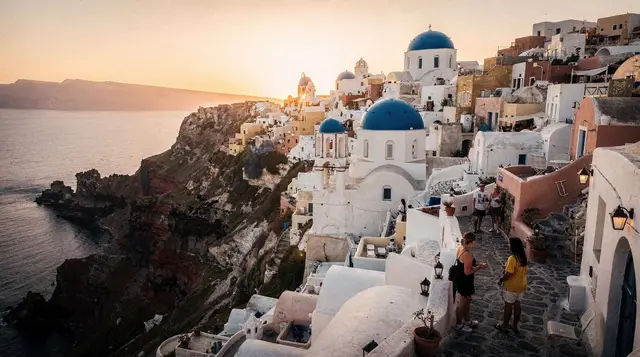
Santorini is a volcanic caldera — an ancient crater that collapsed into the sea, leaving a crescent of cliff-edged islands around a flooded centre. The main island, Thira, has its towns perched on those cliffs, with the caldera dropping 300 metres to the water below. Oia, at the northern tip, is the village in every Santorini photograph: whitewashed cubic buildings, blue domes, narrow paths, flowers spilling over walls, the caldera stretching away to the horizon.
The experience Santorini sells is essentially romantic drama. The views are genuinely among the most striking anywhere in Europe. Sunset from Oia draws crowds that have become something of a spectacle in themselves — hundreds of people gathered on the castle ruins and every available wall, watching the sun drop into the caldera. Even with the crowds, it’s worth experiencing.
What Santorini lacks, relative to Mykonos: genuinely good beaches (the volcanic beaches are striking but not the soft-sand coves of the Aegean), a younger-skewing nightlife scene, and the combination of a sacred ancient site with modern party culture that Mykonos uniquely offers.
What it has in abundance: the caldera views, very good volcanic wines, exceptional high-end restaurants with caldera-view terraces, and a particular kind of pictorial beauty that no other Greek island matches.
For a first trip, the Santorini highlights tour with wine tasting and Oia sunset covers the main points efficiently if you only have a day or two. If you’re staying longer, the sunset sailing cruise in the caldera is the most cinematic way to experience the island’s volcanic geography from the water.
What Mykonos actually is
Mykonos is a wind-swept, granite island in the central Cyclades, famous for its whitewashed chora with narrow paths deliberately designed to confuse the wind (and also, historically, pirates), its iconic windmills, and its position as the party capital of the Aegean.
The Mykonos of legend — the beautiful people, the open-air clubs, the boats, the excess — is real. But it coexists with a genuinely charming town whose labyrinthine streets are fun to navigate regardless of age or interest in nightlife. The beaches at Paradise and Super Paradise have the music and the scene; the beaches at Elia and Agios Sostis are quieter and more beautiful.
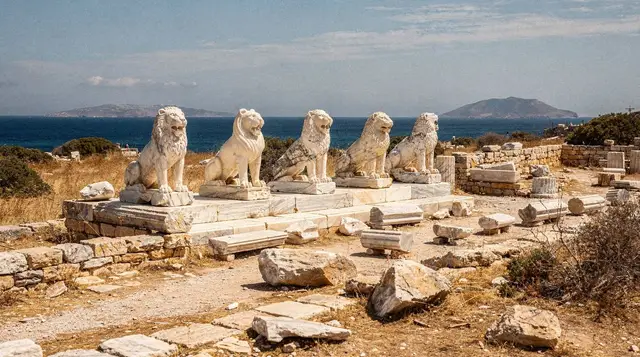
The overlooked element of Mykonos is Delos. The sacred uninhabited island directly across the channel from Mykonos was, in antiquity, one of the most important religious sites in the Greek world — the legendary birthplace of Apollo and Artemis, a pan-Hellenic sanctuary and trading hub. The archaeological site covers an entire island and is genuinely extraordinary. The Mykonos to Delos guided day trip is one of the best ancient-world experiences in the Aegean. Most people visiting Mykonos skip it. Most people are wrong.
The direct comparison
Scenery: Santorini wins on the caldera views, which are unique in the world. Mykonos has the charming chora and good beaches; it doesn’t have anything that generates the same reaction.
Beaches: Mykonos wins. Santorini’s beaches are dramatic — red volcanic sand, black pebbles — but not the ideal swimming beach. Mykonos has a range of excellent beaches for different moods.
Food: Santorini has the edge for fine dining; the local specialities (tomatokeftedes, fava from the local yellow split peas, fresh fish with caldera views) are all excellent. Mykonos is good but not as distinctive.
Wine: Santorini, by a significant margin. The local Assyrtiko grape, grown in basket-shaped vines on volcanic soil, produces one of the most characterful white wines in Greece. It’s worth visiting Santorini partly just to drink Assyrtiko where it’s grown.
Nightlife: Mykonos wins definitively. Santorini has good bars and some late-night options; Mykonos has an internationally famous club scene that starts after midnight and runs until dawn.
Culture: Mykonos wins, specifically because of Delos. Nothing on Santorini matches the ancient site on Delos for historical depth.
Crowds: Both are extremely crowded in July and August. Santorini’s Oia crowds at sunset can feel genuinely unmanageable. Both are significantly more pleasant in May, June, September, and October.
Cost: Both are expensive. Santorini has the edge in very high-end accommodation (infinity-pool cliffside hotels that command premium prices); Mykonos’s highest-end hotels are comparable. Mid-range options are available on both islands but book fast.
Who should choose Santorini
- Couples on a romantic trip, anniversary, or honeymoon
- Anyone for whom the caldera view and the Oia sunset are non-negotiable experiences
- Wine lovers who want to drink Assyrtiko in its home terroir
- Visitors who prioritise views over beaches
Who should choose Mykonos
- Anyone who wants good swimming beaches alongside the island atmosphere
- Younger travellers who want nightlife as part of the experience
- History and archaeology enthusiasts (for Delos)
- Anyone who finds the Instagram-famous Santorini scene off-putting
Can you do both?
If your trip allows for it, yes — and many visitors combine Athens with both islands, either flying between them or taking the ferry. The Greek islands from Athens guide outlines the logistics. The islands are only about 100 km apart and are easy to link by ferry or a short flight.
Read the full Santorini vs Mykonos comparison guide for a detailed breakdown including accommodation areas, transport options, and suggested itineraries for each. Both islands reward visitors who arrive with a plan; both punish those who show up in high season without reservations and expect to improvise.
Practical differences that matter
Accommodation strategy: On Santorini, the caldera-view hotels in Fira and Oia command a significant premium — and the view genuinely justifies it, but budget travellers can find good accommodation in the village of Imerovigli or the town of Pyrgos at significantly lower prices, with the caldera view preserved from public terraces. On Mykonos, the old town (chora) is the most atmospheric place to stay but also expensive; the beach areas (Ornos, Agios Ioannis) are cheaper and quieter.
Getting around: Santorini has a public bus network (ATE buses) that connects the main villages adequately. The donkey-and-stair access in Oia and parts of Fira means car or ATV hire is useful for reaching vineyards and the south of the island (the caldera beaches at Kamari and Perissa). On Mykonos, a scooter or ATV is essentially necessary to reach beaches beyond the port area — the distances are manageable and the roads are generally good.
Season sensitivity: Santorini’s Oia in July and August is deeply crowded at sunset — the castle area fills with hundreds of people an hour before the sun drops. The experience is still worthwhile but nothing like the quiet, golden emptiness of the same spot in late September or October. Mykonos is similarly season-dependent: the nightlife, beach clubs, and overall atmosphere are a summer phenomenon; the island in November is closed, quiet, and charming in a completely different way.
When to go for a first visit: May, early June, September, and October offer significantly better conditions at both islands — mild weather, lower prices, smaller crowds, the Acropolis of Santorini (the ancient site on the southeast ridge) accessible without midday heat. If you must go in July or August, book everything months in advance.
What a first-timer regrets most on each island
On Santorini, the most common regret is booking a hotel without a caldera view to save money, then spending the trip walking to public viewpoints to get the experience anyway — if the view matters to you at all, it’s usually worth paying for it directly rather than chasing it around town. The second most common regret is skipping the villages beyond Fira and Oia entirely; Pyrgos and Imerovigli give a calmer, cheaper, still-beautiful alternative base.
On Mykonos, the most common regret is staying exclusively in the old town chora without renting a scooter or ATV, then discovering that the best beaches are 20–30 minutes away and taxis are expensive and hard to book in peak season. The second is skipping Delos because it “sounds like homework” — travellers who do go almost universally rate it as a trip highlight, not a chore.
The honest summary
Read the full Santorini vs Mykonos comparison guide for the detailed breakdown, accommodation zones, and seasonal timing. And check the Greek islands from Athens guide for the ferry logistics that connect either island to your Athens base.
The honest answer to “which one first”: Santorini if the view is why you’re going to Greece; Mykonos if you want a more rounded island experience with history, good beaches, and the option of a serious night out. Neither choice is wrong. Both are significantly better with two nights than one.
One more consideration: the ferry vs flight question
Getting from Athens to either island involves a choice between the ferry from Piraeus (5–7 hours to Santorini, 2–5 hours to Mykonos depending on the service) and a domestic flight from Athens International (45 minutes to either). In summer, flights book out quickly and cost more, but they preserve your island time. The ferry costs less and is an experience in itself — the open Aegean, the other islands appearing and disappearing on the horizon — but the journey is long enough that it can represent a significant chunk of a short island stay.
A useful hybrid for a first-time visit: fly one way and ferry the other. Flying into Santorini gives you maximum island time; taking the high-speed ferry back to Piraeus at the end gives you the sea journey experience and the gradual transition back to the mainland. Or vice versa with Mykonos.
Read the Greek islands from Athens guide for the specific booking logistics — which ferry operators serve each route, how far in advance to book in high season, and what to expect at Piraeus port before your first departure.
Frequently asked questions about Santorini vs Mykonos
Which island is better for a honeymoon: Santorini or Mykonos? Santorini, for most couples — the caldera views, the sunset, and the quieter romantic atmosphere suit a honeymoon better than Mykonos’s louder, party-oriented energy. Mykonos can still work well for couples who want beaches and nightlife alongside the romance, but it’s a different kind of trip.
Is one island significantly cheaper than the other? Not dramatically. Both are among the most expensive Greek islands. Santorini’s very top end (infinity-pool caldera hotels) commands a slight premium over Mykonos’s equivalent tier, but mid-range accommodation and food costs are broadly comparable on both islands.
Greek island adventures on GetYourGuide
Verified deep-linked GetYourGuide tours. Book through these links and we earn a small commission at no cost to you.
GetYourGuide does not provide product photos: on its activity cards, the picture illustrates the type of experience and is not the operator's own photo.