
Greek islands from Athens: which island and how to choose
Which Greek islands can you visit from Athens?
The closest are the Saronic islands — Aegina (1 hr), Poros (2.5 hrs), Hydra (2 hrs by high-speed) — all easy day trips. Santorini and Mykonos take 5–8 hrs by ferry or 45 min by flight and suit 2–3 night stays. Crete is best reached by overnight ferry (9 hrs) or a 45-min flight.
How to think about Greek islands from Athens
Athens sits at the geographic heart of the Aegean, which means an extraordinary range of islands is within reach — some in under an hour, others needing an overnight ferry. The mistake most visitors make is treating all Greek islands as equivalent and defaulting to Santorini or Mykonos simply because those names are familiar. In practice, the right island depends on three things: how much time you have, what kind of experience you want, and how much you’re willing to spend.
| Where | Saronic Gulf (1–2.5hrs) to Crete (overnight ferry or 45-min flight) |
| Cost | €10 (Aegina ferry) to €130 (Santorini/Crete flight) |
| Time needed | Day trip (Saronic) to 4–7 days (Crete) |
| Getting there | Ferry from Piraeus, or flight from Athens International Airport |
| Best time | Late May, June, September for warm seas and manageable crowds |
This guide walks through the realistic options from Athens, grouped by how far they are and what they offer, with honest 2026 transport information.
The Saronic islands: day trips from Athens
The Saronic Gulf islands — Aegina, Poros, and Hydra — are the least-discussed but most practical choices for visitors with limited time. Ferries depart from Piraeus, which is 40 minutes from central Athens on the metro (green line, end of the line at Piraeus station).
Aegina is the closest at roughly 1 hour on a fast ferry (Flying Dolphin) or 1.5–2 hours on a slow ferry. Fares start at around €10 one way on conventional ferries and €14–18 on high-speed hydrofoils. The island has a proper town with a good fish market, the magnificent Temple of Aphaia (better preserved than anything on the Acropolis), and pistachio groves that produce some of Greece’s best nuts. It’s a full day trip, not a half-day. See the full Aegina island guide.
Poros is small and calm, roughly 2.5 hours from Piraeus by Flying Dolphin. The channel between Poros and the Peloponnese mainland is only 200 metres wide, creating a dramatic harbour view. Good for swimming, wandering, and lunch, though not for ancient sites. See the Poros island guide.
Hydra is the most atmospheric of the three. No motor vehicles, no scooters — only donkeys, bicycles, and feet. The harbour is genuinely beautiful and the architecture is unusually well-preserved. A high-speed ferry from Piraeus takes about 2 hours and costs around €25–30 one way. You can combine Hydra and Poros in a single day on an organised cruise. Read the Hydra island guide.
For those who want all three Saronic islands in a day without the logistics, an organised cruise from Athens covers Hydra, Poros, and Aegina with transfers and lunch included.
One-day Saronic islands cruise from Athens with lunchSantorini: the iconic choice
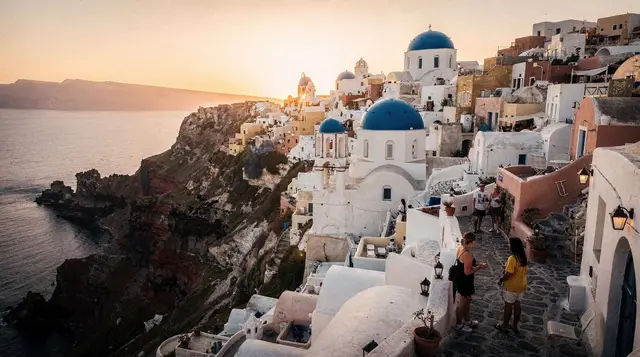
Santorini is the island most non-Greek visitors picture when they imagine Greece. The caldera views, the white-and-blue architecture of Oia and Fira, the sunsets — they are genuinely as good as the photographs suggest. The issue is logistics.
By fast ferry from Piraeus, the journey takes roughly 5 hours and costs €50–80 one way depending on season and class. By conventional ferry (overnight), it takes 9 hours. The 45-minute flight from Athens International Airport (Eleftherios Venizelos) costs €60–130 one way and is the sensible option if you’re staying 2+ nights. Santorini is not a day trip from Athens — the travel alone would consume the day.
Budget at least two nights in Santorini to see Oia at sunrise (before the crowds), swim in the caldera, and do a sunset catamaran cruise. The island rewards slow travel more than almost anywhere else in the Aegean.
Santorini caldera catamaran cruise with meal and open barFull guide: Santorini from Athens.
Mykonos: for nightlife and beaches
Mykonos has a different personality from Santorini — more nightlife-focused, louder, more international. The beaches on the south coast (Paradise, Super Paradise) are famous for beach clubs and daytime parties. The old town (Chora) has genuinely pretty windmills and labyrinthine lanes, though it gets uncomfortably crowded in July and August.
The ferry from Piraeus takes 3.5–5 hours depending on vessel. A fast ferry (Hellenic Seaways, Golden Star Ferries) takes around 3.5 hours and costs €50–80. Flying takes 45 minutes and costs €60–120.
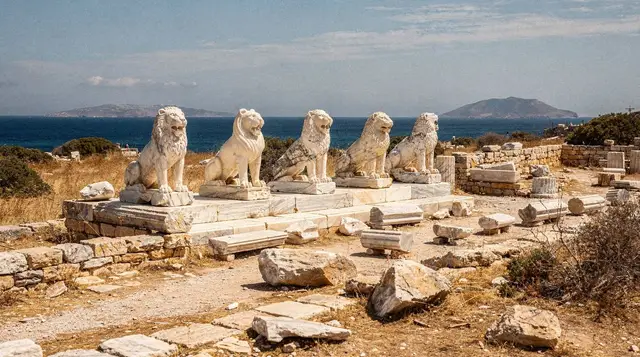
The great advantage of Mykonos for history enthusiasts: Delos, one of the most important ancient sites in the Aegean, is a 30-minute ferry ride away. The island is uninhabited but contains the ruins of a complete ancient city including mosaics, temples, and a famous row of lion sculptures. It’s possible to combine Delos and a sailing cruise around Rhenia in a single day from Mykonos.
Full guide: Mykonos from Athens.
Crete: for a proper island break
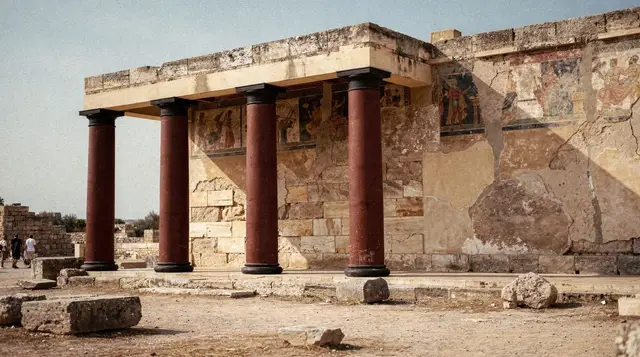
Crete is Greece’s largest island and operates more like a small country than a day-trip destination. It has its own cuisine, dialect, landscape (the Samaria Gorge, the White Mountains), and ancient history that predates classical Greece by a millennium. The Minoan palace at Knossos, outside Heraklion, is one of the most significant Bronze Age sites in Europe.
You need at least three nights on Crete for a meaningful visit. The overnight ferry from Piraeus departs around 21:00 and arrives in Heraklion or Chania around 06:00, which saves a night’s hotel cost. Fares start at €45 in a reclining seat, €60–80 in a cabin. Flying takes 45 minutes and costs €40–100.
The west of Crete (Chania, Rethymno, Balos lagoon) is more scenic. The east (Heraklion, Knossos, Spinalonga) is more historically dense. Ideally, see both. Full guide: Crete from Athens.
Which island is right for you?
Use this as a quick-reference framework:
- Only 1 day: Aegina or Hydra (Saronic islands — ferry from Piraeus, easy logistics)
- 2–3 days, romance/views: Santorini (fly or fast ferry, book accommodation early)
- 2–3 days, beaches/nightlife: Mykonos (fast ferry or fly, add a Delos day trip)
- 4–7 days, culture/hiking/food: Crete (fly or overnight ferry, rent a car)
- History + sailing in one day: Mykonos + Delos or a Saronic Gulf cruise
- Car-free, photogenic: Hydra (no vehicles allowed)
Island comparison at a glance
| Island | Travel time from Athens | Best for | Minimum stay |
|---|---|---|---|
| Aegina | ~1 hr fast ferry | Day trip, temple, pistachios | Half/full day |
| Poros | ~2.5 hrs fast ferry | Calm swimming, easy wandering | Full day |
| Hydra | ~2 hrs fast ferry | Car-free charm, photography | Full day or 1 night |
| Mykonos | 3.5–5 hrs ferry / 45 min flight | Nightlife, beaches, Delos day trip | 2–3 nights |
| Santorini | 5–9 hrs ferry / 45 min flight | Caldera views, sunsets, romance | 2–3 nights |
| Crete | 9 hrs overnight ferry / 45 min flight | Culture, hiking, food, beaches | 4–7 nights |
Choosing between Santorini and Mykonos
These two get compared constantly, and the honest answer depends on what kind of island trip you want. Santorini suits couples and slower travel — caldera views, sunset, fewer late-night crowds outside peak season. Mykonos suits groups wanting beach clubs, nightlife, and the option of a Delos day trip for a dose of ancient history. If you can’t decide, the Santorini vs Mykonos guide breaks down the trade-offs in more detail than the summary above.
How to book ferries from Piraeus
The main booking platforms in 2026 are Ferryhopper and Directferries, both of which aggregate all operators and show real-time availability. Book at least two weeks ahead for Santorini and Mykonos departures in June–August — high-speed ferries sell out. The Athens island ferry vs flight tool helps you compare options side by side.
Piraeus port has multiple gates (E1–E12) and they are not all adjacent. Check your gate the night before and budget 20 minutes to walk from the metro to your gate. See getting around Athens for metro and port logistics.
Planning island hopping
If you want to visit more than one island, timing and ferry routes matter more than most guides admit. Not every island pair has a direct connection — you often return to Piraeus between islands rather than going island to island. The main exception is the Cyclades cluster, where Santorini, Mykonos, Paros, and Naxos are well connected to each other by fast ferry. Read the full island hopping from Athens guide before booking.
The islands hub lists all day trips and sailing experiences available from Athens for each destination.
Building a longer island itinerary
If you have 7–10 days rather than a single island stop, sequencing matters. The Athens Mykonos Santorini 10-day itinerary shows how to combine city time with two islands without excessive backtracking, and the Athens Crete 7-day itinerary does the same for a culture-and-hiking-focused trip. Both rely on the same principle as the framework above: pick islands that are well-connected to each other rather than assuming every pair has a direct ferry.
Frequently asked questions about Greek islands from Athens
Can you do Santorini as a day trip from Athens?
Not realistically. The fast ferry takes 5 hours each way — you’d spend 10 hours travelling for perhaps 3 hours on the island. Flying takes 45 minutes each way, which makes a technically possible but extremely rushed day trip. Two nights minimum is the practical recommendation.
Is it cheaper to fly or take the ferry to the Greek islands?
For Santorini and Mykonos, budget airlines (Aegean, Sky Express, Ryanair on some routes) often match or beat the fast ferry cost, and save 3–4 hours each way. For the Saronic islands (Aegina, Poros, Hydra), ferry is the only option and prices are very reasonable — €10–30 one way.
When is the best time to visit the Greek islands from Athens?
Late May, June, and September offer the best balance: warm sea temperatures, manageable crowds, and reasonable accommodation prices. July and August are peak season — boats and popular restaurants are fully booked weeks in advance and prices are at their highest. October remains pleasant for Saronic island day trips.
Do I need to book ferry tickets in advance?
For Saronic island day trips (Aegina, Poros, Hydra), you can often buy tickets on the day at the port, though booking online saves queuing time. For Santorini and Mykonos in summer, book high-speed ferry tickets 4–8 weeks ahead or accept that you may only find space on slow, overnight ferries.
What’s the best island for families with children?
Aegina is excellent for families — calm sea crossing, a beach town, a fascinating temple, and pistachio ice cream. Poros is similarly calm. Santorini’s landscape is dramatic but not beach-focused (most beaches are black volcanic sand reached by cable car or steep steps). Crete has the best range of family-friendly beaches and activities.
Can I bring a car on the ferry to the Greek islands?
Yes, most large ferries to Santorini, Mykonos, and Crete take vehicles. Book the car space separately from your passenger ticket and well in advance in summer. The Saronic islands have car ferries too, but Hydra famously prohibits private vehicles entirely — leave the car in Piraeus.
Which island should first-timers pick if they can only choose one?
For most first-time visitors with limited time, Santorini or Mykonos deliver the postcard version of Greece most efficiently by flight. If your priority is easy logistics and a genuine day trip without an overnight, Aegina or Hydra are the honest, low-effort alternative that still feels like “a Greek island” without the flight or long ferry commitment.
Greek island adventures on GetYourGuide
Verified deep-linked GetYourGuide tours. Book through these links and we earn a small commission at no cost to you.
GetYourGuide does not provide product photos: on its activity cards, the picture illustrates the type of experience and is not the operator's own photo.
More tours on Viator
Top-rated experiences with verified reviews, bookable on Viator (a Tripadvisor company).
 Viator
Santorini Catamaran Cruise with Swim-Stops, Greek Meal and Sunset
FromEUR 150Check availability → Viator
Sailing trip to the Top Coasts of Crete, Daily/Multi-day
FromEUR 990Check availability → Viator
Private Overview of Santorini: Full-Day Customizable Experience!
FromEUR 200Check availability → Viator