
Santorini from Athens: ferry, flight, and what to do there
How do you get from Athens to Santorini?
Fly from Athens International Airport in 45 minutes (€60–130 one way) or take a fast ferry from Piraeus in about 5 hours (€50–80). Flying is faster and often similarly priced in summer. Overnight slow ferries take 9 hours and are best for saving a night's accommodation.
Getting to Santorini from Athens
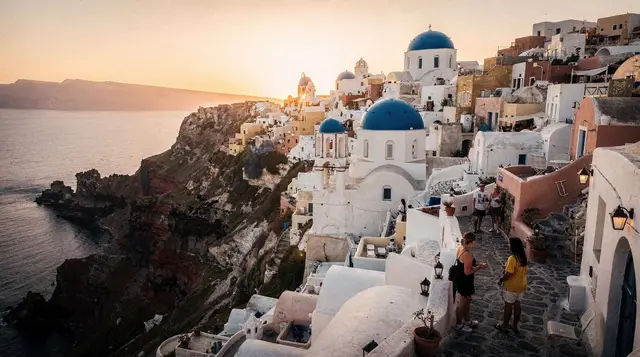
Santorini is Greece’s most photographed island — the crescent of cliffs around the caldera, the whitewashed villages of Oia and Fira, the deep blue domes. It is also, unambiguously, one of the most visited places in all of Europe in summer. Understanding the logistics before you go makes the difference between a memorable trip and a frustrating one.
| Where | Cyclades, ~250km southeast of Athens |
| Cost | Flight €60–130, fast ferry €50–80 |
| Time needed | 45 min flying, ~5 hrs fast ferry |
| Stay length | 2–3 nights is the realistic minimum |
| Best time | June or September for warm sea and fewer crowds |
There are three realistic ways to travel from Athens to Santorini.
Option 1: fly from Athens (recommended for most visitors)
The flight from Athens Eleftherios Venizelos Airport (ATH) to Santorini (JTR) takes 45 minutes. Aegean Airlines and Sky Express operate the route daily, with Sky Express adding extra capacity in summer. Prices range from €60 to €130 one way depending on season and how far in advance you book. In July and August, seats sell out — book at minimum six weeks ahead.
Santorini’s airport is small and handled passenger numbers near its limit in 2025. The taxi queue from the airport can be 45 minutes in peak season. Pre-book a transfer or use the public bus (KTEL) to Fira, which costs around €2.80 and runs every 30–40 minutes.
Flying is the better choice if you’re arriving from outside Greece and Santorini is your first stop, or if you’re staying only 2–3 nights and every hour matters.
Option 2: fast ferry from Piraeus
The high-speed ferry from Piraeus takes approximately 5 hours and costs €50–80 one way in economy. Operators in 2026 include Hellenic Seaways (Superjet), Golden Star Ferries, and SeaJets. These vessels are modern, air-conditioned catamarans with café service and outdoor decks.
The ferry journey passes through the Cyclades chain and gives you views of Paros and Naxos en route — a genuinely scenic crossing. The downside is that 5 hours is a significant time commitment each way. In rough seas (common November–March), high-speed ferries are occasionally cancelled.
Tickets sell out on peak summer routes. Book via Ferryhopper or Directferries at least three to four weeks ahead for July/August departures. Use the Athens island ferry vs flight tool to compare current prices and departure times side by side.
Option 3: overnight slow ferry
The conventional (slow) ferry from Piraeus departs around 21:00 and arrives in Santorini at approximately 06:00 the following morning. Fares start at €45 in a reclining aircraft-style seat and €65–90 in a two- or four-berth cabin.
The logic for this option is clear: you save a night’s hotel cost and wake up already on the island. The downside is that the sea can be rough and the experience is more functional than comfortable. It works well on the outbound journey (you sleep, arrive fresh) and less well on the return (you lose an evening).
What to do in Santorini
Two nights is the realistic minimum to see Santorini properly. Three nights is comfortable. Beyond four nights, most visitors exhaust the island’s highlights and feel the price-to-value ratio becoming unfavourable — Santorini is genuinely expensive, with accommodation and restaurant prices well above the Greek average.
Oia at sunrise and sunset
Oia’s sunset is the most famous in Greece, which means hundreds of tourists line the castle walls from 19:00 onwards in summer. The sunrise, conversely, is crowd-free and arguably more beautiful. Walk the ridge path from Fira to Oia (9 km, about 3 hours) and time your arrival for early morning.
The caldera by boat
The caldera — the collapsed volcanic crater that gives Santorini its distinctive crescent shape — is best experienced from the water. A catamaran cruise takes you past the red and white cliffs of Santorini, out to the volcanic island of Nea Kameni (where you can walk to the crater), and to the hot springs at Palea Kameni.
Santorini caldera catamaran cruise with meal and open barSunset cruises are also popular and often include dinner on board.
Santorini sunset sailing cruise on the calderaWine tasting in the vineyards
Santorini’s volcanic soil produces a distinctive white wine called Assyrtiko — dry, mineral, with high acidity. The vines are trained into basket-shaped wreaths (kouloura) to protect them from the Aegean wind. Several wineries on the south of the island offer tastings with caldera views. This combines well with a visit to the village of Pyrgos, which is far quieter than Oia and has genuine views in all directions.
Santorini highlights tour with wine tasting and Oia sunsetAkrotiri and the archaeological museum
Akrotiri is a Minoan Bronze Age settlement buried under volcanic ash around 1600 BC — Santorini’s own Pompeii. The excavation is covered by a protective roof and admission is around €12. The frescoes found here (now in the National Archaeological Museum in Athens) were among the finest in the ancient world. It’s worth two hours of your time.
Best time to visit Santorini
- April–May: cool, occasional rain, uncrowded, accommodation at 30–50% of peak prices. The caldera is clear and beautiful. Sea is cold (around 18°C).
- June: ideal — warm, sea swimmable (22°C+), not yet at maximum capacity.
- July–August: peak season. Extremely crowded in Oia and Fira, prices at their highest, outdoor restaurants noisy and rushed. The experience is still good, but requires patience.
- September–October: the best-kept secret. Crowds thin significantly after mid-September, prices drop, the sea is warmest (25°C in September), and the light is extraordinary for photography.
- November–March: many hotels and restaurants close. The island has an eerie, beautiful quiet but limited services.
Practical notes
Santorini’s villages sit on top of the caldera cliffs. Getting between Fira (the capital) and the port at Athinios involves a winding road with regular buses (€2) and shared taxis. Renting an ATV is popular for getting around the island but accidents are common on the narrow roads — if you hire one, go slowly.
Fira is the most central base. Oia is the most scenic but extremely expensive and requires a bus or car to reach other parts of the island. Perissa and Kamari on the east coast are better value and have long black-sand beaches — a useful option for families or those prioritising beach time over caldera views.
For the broader context of Greek island travel, read the Greek islands from Athens guide and the island hopping from Athens guide.
Flight vs ferry: which to choose
| Flight | Fast ferry | Overnight ferry | |
|---|---|---|---|
| Time | 45 min | ~5 hrs | ~9 hrs |
| Cost | €60–130 | €50–80 | €45–90 |
| Best for | Short stays, tight schedules | Scenic Cyclades views, moderate budget | Saving a night’s accommodation |
| Downside | Airport transfer time, baggage limits | Weather-dependent, can be cancelled | Less comfortable, loses an evening on return |
For most first-time visitors staying 2–3 nights, flying is the simplest choice. For travellers already comfortable with island-hopping logistics, or combining Santorini with Mykonos or Crete, the ferry network often works out more efficient overall than flying between each stop.
Combining Santorini with other islands
Santorini rarely works as a completely standalone trip for visitors with more than a week in Greece. The most common combinations: Mykonos for a livelier, beach-and-nightlife contrast (a short ferry hop away); Crete for a longer, more varied island with the Samaria Gorge and Minoan sites; or the Saronic islands (Hydra, Aegina) if your Athens stay bookends the trip and you want a lower-key contrast close to the capital. The Santorini vs Mykonos comparison is worth reading if you’re choosing between the two rather than doing both.
Frequently asked questions about Santorini from Athens
How far is Santorini from Athens?
By air, Athens and Santorini are roughly 250 km apart — 45 minutes flying time. By fast ferry from Piraeus, the sea route covers about 290 km and takes 5 hours. The slow overnight ferry takes 9 hours.
Is Santorini worth it despite the crowds?
Yes, for most visitors. The caldera landscape is genuinely unlike anywhere else in the world, and experiencing it at sunrise or from a sailing boat reduces the crowd problem significantly. The issue is mainly in Oia’s sunset viewpoint and in the main streets of Fira in peak hours.
What is the best neighbourhood to stay in Santorini?
Oia is the most photographed and most expensive. Fira is the most convenient for restaurants and transport. Imerovigli has some of the best caldera views and is slightly quieter. Firostefani, between Fira and Imerovigli, combines access with a caldera-edge position at more reasonable prices.
Can you visit the Santorini volcano?
Yes. From the old port below Fira (reached by cable car or on a donkey), small boats depart regularly for Nea Kameni, the active volcanic island in the centre of the caldera. You can walk to the crater rim in about 20 minutes. Most caldera cruise packages include this stop.
How many days do you need in Santorini?
Two nights (three days) covers the main highlights — Oia, Fira, Akrotiri, a caldera boat trip, and a vineyard visit. Three nights is more relaxed. More than four nights and most visitors find they’ve exhausted the main draws of this relatively small island.
Is Santorini expensive compared to other Greek islands?
Yes, significantly. A midrange restaurant meal in Santorini costs €25–40 per person, compared to €15–25 on Crete or the Saronic islands. Cave-style caldera-view hotels can cost €400–800 per night in summer. Staying in Perissa or Kamari, away from the caldera, reduces costs by 40–60%.
Should I fly or take the ferry if I get seasick easily?
Fly. The 45-minute flight avoids the issue entirely, whereas even the fast catamaran ferries can be uncomfortable in rough Aegean conditions, particularly November through March. If you must take the ferry, choose a day with a favourable forecast and consider seasickness medication in advance.
Can I do Santorini as a day trip from Athens?
Technically possible by flying there and back the same day, but not recommended — you’d spend most of the day in transit and airport logistics for only a few hours on the island. Santorini rewards at least one overnight stay; a day trip badly undersells it.
Greek island adventures on GetYourGuide
Verified deep-linked GetYourGuide tours. Book through these links and we earn a small commission at no cost to you.
GetYourGuide does not provide product photos: on its activity cards, the picture illustrates the type of experience and is not the operator's own photo.
More tours on Viator
Top-rated experiences with verified reviews, bookable on Viator (a Tripadvisor company).
 Viator
Santorini Catamaran Cruise with Swim-Stops, Greek Meal and Sunset
FromEUR 150Check availability → Viator
Sailing trip to the Top Coasts of Crete, Daily/Multi-day
FromEUR 990Check availability → Viator
Private Overview of Santorini: Full-Day Customizable Experience!
FromEUR 200Check availability → Viator