Athens and Crete: 7-day city and island itinerary
How this itinerary works
Athens and Crete make a natural pair: both have layers of ancient and modern history that reward attention, both have serious food cultures, and both are different enough from each other to feel like two distinct holidays. Seven days splits into three in Athens and four in Crete — three days in Heraklion and Knossos and one day in Chania, either by bus along the north coast road or with a day at the extraordinary Balos lagoon. Getting there: overnight ferry from Piraeus to Heraklion (9 hours, €40–80 economy; €80–150 cabin), or a 50-minute flight from Athens (€40–100). This itinerary uses the ferry outward (night crossing, arrive fresh) and the plane back (quick, easy).
| Where | Athens (3 nights) + Heraklion/Knossos (3 nights) + Chania day trip |
| Getting there | Overnight ferry Piraeus–Heraklion (9hrs, €40–150) or 50-min flight (€40–100) |
| Cost | Around €550–800pp for 7 days incl. ferry/flight, entries and meals (excl. main hotel nights) |
| Best time | April–June or September–October |
| Book ahead | Overnight ferry cabins 4–6 weeks ahead for summer |
| Days | Focus | Base |
|---|---|---|
| 1–3 | Acropolis, food & neighbourhoods, Kerameikos, overnight ferry | Athens |
| 4 | Arrive Heraklion, Knossos, Archaeological Museum | Heraklion |
| 5 | Heraklion market, Cretan food, beach afternoon | Heraklion |
| 6 | Chania old town and Balos lagoon | Chania/Heraklion |
| 7 | Flight back to Athens | — |
Days 1–3: Athens
Day 1 — Acropolis and the ancient city
Start with the Acropolis at 07:30. In three days in Athens the Acropolis is the non-negotiable priority: the Parthenon, Erechtheion, Temple of Athena Nike, and the panoramic view of the city and sea. Pre-book entry and go early:
Pre-booked Acropolis ticket — skip the queueFor a guided visit with archaeological context:
Guided Acropolis tour with skip-the-line accessAcropolis Museum (75 minutes, ~€15) after the hill — the top-floor Parthenon Gallery is essential. See our Acropolis Museum guide. Afternoon in Plaka and Monastiraki. Evening in Psyrri. Full day-by-day breakdown in our Acropolis tickets.
Day 2 — Food, neighbourhoods, and Lycabettus
Athens Central Market breakfast, then the city’s food culture explored with a local guide:
Original Athens food tour — markets, mezze, and producersSyntagma and National Garden at midday. Kolonaki for coffee and a browse of the Cycladic Art Museum (€12). Afternoon funicular to Lycabettus Hill (€7 return) for the full Attic panorama. Benaki Museum (€12) on the way back down. Evening: cook a Greek dinner at a hands-on class:
Athens cooking class with dinnerDay 3 — Kerameikos and night walking tour
Morning at the Kerameikos archaeological site (entry ~€8) — Athens’s ancient cemetery and ceramics quarter, reliably uncrowded and deeply atmospheric. The funerary stelae and the Sacred Gate are more moving in their quietness than the Acropolis is in its scale. Walk through Thissio and along the pedestrianised Apostolou Pavlou promenade with its Acropolis view.
Afternoon: National Archaeological Museum (entry €15, allow 2 hours) — the Mask of Agamemnon, the Poseidon of Artemision, the Cycladic figurines. The museum prepares you for Knossos and Cretan prehistory far better than any guidebook.
Evening: night walking tour before taking the overnight ferry:
Athens night walking tour — the ancient city after darkBoard the overnight ferry to Heraklion at 21:00–22:00. Minoan Lines and ANEK/Superfast Ferries depart Piraeus late evening, arriving Heraklion early morning. A two-berth cabin (€60–90 extra per person) is worth it for the sleep quality.
Days 4–7: Crete
Day 4 — Arrive Heraklion: Knossos and the Archaeological Museum (morning arrival)
Arrive Heraklion at 06:00–07:00. Drop your bag at the hotel reception (ask if early storage is available before check-in). Breakfast near the port: a Cretan dakos (barley rusk with tomato, feta, and olive oil) and a strong Cretan coffee costs €5–6.
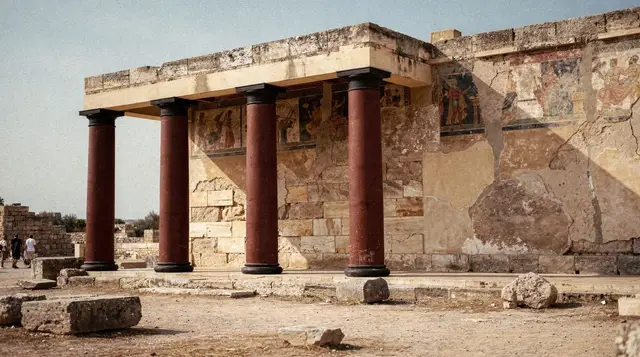
Knossos (09:00–13:00): Take the bus from the central bus terminal (Line 2, €1.50, 20 minutes) to the Palace of Knossos — the largest Bronze Age archaeological site on Crete, the centre of the Minoan civilisation (2000–1400 BC), and the legendary home of the Minotaur’s labyrinth. The site is partially reconstructed (controversially) by the British archaeologist Arthur Evans in the early 20th century, which gives it a vivid if somewhat theatrical appearance: restored frescoes (copies; the originals are in the museum), the brightly painted Throne Room, the Grand Staircase.
For a skip-the-queue guided visit:
Heraklion and Knossos skip-the-line guided tourEntry to Knossos alone ~€15; combined with the Heraklion Archaeological Museum ~€18.
Heraklion Archaeological Museum (14:00–16:30): In the centre of the city, 15 minutes from Knossos by bus. One of the great museums of the ancient world: the original Knossos frescoes (Minoan bull-leaping, the Lily Prince, the Ladies in Blue), the gold Bee Pendant from Malia, the Phaestos Disc (undeciphered bronze-age script, 1700 BC), and the complete suite of Minoan pottery from 3000–1100 BC. Allow 2 hours. Entry included in the Knossos combo ticket.
Walk Heraklion’s old town in the late afternoon: the Venetian Loggia (17th-century administrative building), the Morosini Fountain, and the massive Rocca al Mare Venetian fortress on the harbour breakwater (entry ~€4; the view from the ramparts over the old harbour and the mountains of central Crete is excellent).
Dinner in Heraklion: Cretan food is the best regional cuisine in Greece. Order kalitsounia (Cretan herb pies), staka (sheep’s butter with eggs), ntakos salad, and grilled lamb with stamnagathi (local wild greens). A full meal for two with Cretan wine costs €35–50.
Day 5 — Heraklion free day and Cretan food culture
Heraklion’s Eleftherios Venizelos market (the covered market on 1866 Street) sells every Cretan food product worth taking home: thyme honey, aged graviera cheese, Cretan olive oil, dried herbs, raki (Cretan spirit), and carob products. Arrive at 08:00 for the most activity. Budget €30–50 for a good selection of food gifts.
The Museum of Cretan Ethnology (Vori village, 45 km south by taxi — optional) holds the finest collection of Cretan folk objects; or stay in the city and visit the Museum of Natural History (east of the city centre) which has an excellent geology section on the island’s formation.
Afternoon: beach at Amnissos or Karteros (10 km east of Heraklion, bus from the city centre, €2), two sandy beaches popular with locals and much less touristic than the beach resorts of the north-east coast.
Day 6 — Chania and Balos lagoon
The bus from Heraklion to Chania (KTEL, €16 one way, 2.5 hours) runs hourly along the north coast highway. Arrive by 10:30.
Chania old town (10:30–13:00): Chania’s Venetian harbour — 14th-century stone warehouses, the domed Turkish lighthouse, fishing boats bobbing in the water — is the most beautiful harbour town in Crete and one of the most beautiful in the entire Mediterranean. Walk the harbour front, then duck into the lanes of the old town: the Splantzia quarter is a mix of Venetian and Ottoman architecture, old plane trees, and quiet cafés.
Balos lagoon (14:00–18:00): The Balos lagoon — on the north-west tip of Crete — is one of the most extraordinary natural landscapes in Greece: a shallow turquoise lagoon behind a white sandbar, with the island of Gramvousa and its Venetian fortress rising from the water. Access is by boat excursion from Kissamos port (40 minutes west of Chania, bus €5):
Chania: Balos and Gramvousa full-day boat excursionThe excursion typically includes a stop at the Gramvousa island fortress before anchoring at Balos for 2–3 hours of swimming. The water is a shade of turquoise that seems digitally enhanced until you are standing in it. Return to Kissamos by 17:30, bus back to Chania.
Dinner in Chania old town: the best seafood in Crete is in the old harbour restaurants (the prices reflect the view, but the fish is genuinely excellent). Budget €40–60 for two. Overnight in Chania (optional — if returning to Heraklion, the last bus is 21:00).
Day 7 — Return to Athens
If overnight in Chania: bus to Heraklion airport (3 hours; allow 4 hours for morning departures) or taxi directly (€120–140, 2 hours). Flight from Heraklion (HER) to Athens (ATH): 45 minutes, multiple daily departures (Aegean/Olympic, €40–80).
If still in Heraklion: airport is 5 km east of the city (taxi €15, bus €1.50). Morning flight gives you an afternoon back in Athens for shopping, the National Garden, or a final lunch in Plaka.
Extending or shortening in Crete
If you have an extra day, Rethymno’s Venetian harbour (between Heraklion and Chania) is worth the detour and pairs naturally with the north-coast bus route. If you have one day less, drop the Chania/Balos day and spend it in Heraklion instead — Knossos and the Archaeological Museum alone justify a Crete stop even without the west of the island. For a Crete-focused trip without the Athens portion, see our Crete from Athens guide, and compare with island alternatives in Greek islands from Athens and Best islands near Athens.
Frequently asked questions about Athens and Crete
Is the overnight ferry or the flight better for Athens to Crete? Both work well, which is why this itinerary uses one each way. The overnight ferry (9 hours) saves a hotel night and delivers a genuinely memorable arrival at dawn, but a cabin is worth the extra cost for sleep quality. The 50-minute flight is faster and simpler if you would rather not lose an evening to travel — see our Santorini from Athens guide for how the same trade-off plays out on other Greek island routes.
Do I need a rental car in Crete for this itinerary? No. The KTEL bus network covers Heraklion, Knossos, and Chania comfortably, and the Balos boat excursion is easier than the rough access track a car would require. A car only pays off if you want to explore the south coast, the Samaria Gorge, or Crete’s mountain villages independently.
Practical tips
Overnight ferry: Minoan Lines is the premium Crete ferry service — comfortable ships, good cabins, reliable. ANEK/Superfast is slightly cheaper. Book at least 4–6 weeks ahead for summer. A 4-berth economy cabin is the minimum for comfortable sleep; 2-berth is much better.
Knossos crowds: In summer, Knossos is extremely crowded from 10:00 to 14:00. The site opens at 08:00 — arrive then. The skip-the-line guided tour enters before the main queues form.
Balos: The Balos excursion from Kissamos is the easy option. A 4WD rental car can reach Balos via a rough track (45 minutes from Kissamos; the road is technically fine for standard cars but rental companies often advise against it). The boat is simpler.
Cretan food to take home: Thyme honey (the best in Greece), aged graviera cheese (vacuum-packed for travel), Cretan olive oil (smaller bottles for hand luggage), and tsikoudia (raki) if your checked luggage allows.
Getting around Crete: The KTEL bus network covers the north coast well (Heraklion–Chania–Rethymno hourly). A rental car opens up the south coast, the Samaria Gorge, and the mountain villages of the White Mountains — worth considering if you have extra time.
Extending the trip: Add a day at Rethymno (Venetian harbour, 80 km west of Heraklion, 1 hour by bus, extremely beautiful) or a hike in the Samaria Gorge (18 km, 6 hours, the longest gorge in Europe, seasonal May–October). Both are feasible from Chania as day trips.
Greek island adventures on GetYourGuide
Verified deep-linked GetYourGuide tours. Book through these links and we earn a small commission at no cost to you.
GetYourGuide does not provide product photos: on its activity cards, the picture illustrates the type of experience and is not the operator's own photo.