The long walk that holds the ancient city together
The pedestrian promenade that runs through Thissio is the civic achievement of modern Athens that gets the least credit. When it was completed in 2004 for the Olympics, the street — Apostolou Pavlou (St Paul’s Way) — was converted from a traffic-choked artery into a 3-kilometre car-free boulevard connecting Monastiraki to the east with the Filopappou Hill viewpoints to the west. The Acropolis rises directly above it on the south side for most of its length.
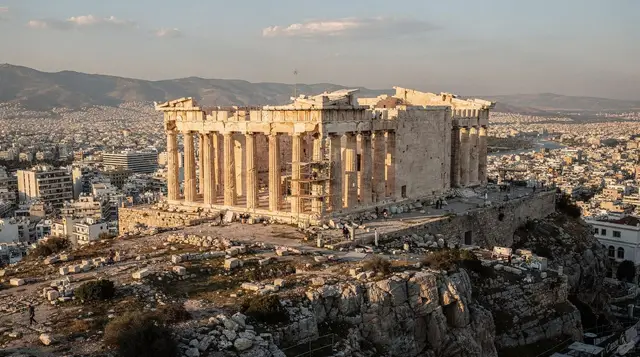
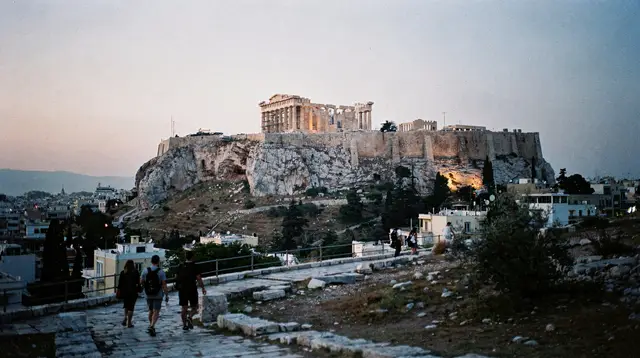
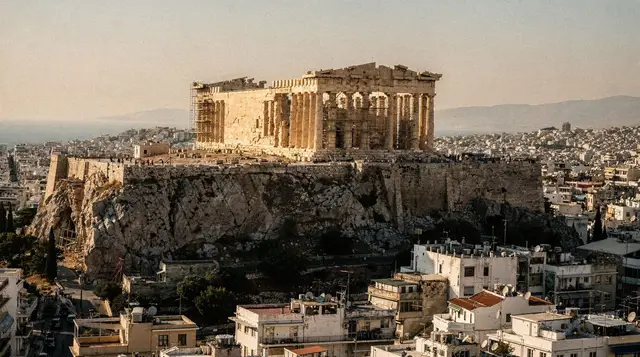
Walking it from east to west in the late afternoon, when the Parthenon catches the slant of the sun and the limestone turns from white to gold to amber as the light falls, is one of the simple pleasures Athens reliably delivers. The promenade is wide enough to accommodate the steady stream of walkers, cyclists and tourists without feeling crowded; the Ancient Agora occupies the north side of the path for its middle section, framed by iron railings through which the Hephaisteion — the best-preserved ancient temple in Greece — is clearly visible.
The Ancient Agora
The Ancient Agora — the civic heart of classical Athens — is entered from Apostolou Pavlou (one gate) or from Adrianou in Monastiraki (another gate). The site has its own ticket (€20 full price, €10 reduced), booked on the official Hellenic Heritage ticketing portal.
Most visitors underestimate the Agora relative to the Acropolis. The Acropolis is more dramatic; the Agora is more revealing. This is where Socrates taught, where the Athenian democracy held its elections, where Athenians shopped and litigated and went to the theatre. The Stoa of Attalos — a two-storey colonnade reconstructed in the 1950s using ancient materials and techniques — houses the site museum and gives a genuinely informative sense of what the agora building programme looked like.
The Temple of Hephaistos (Hephaisteion), on the hill at the Agora’s western edge, is so well preserved that it reads as almost too complete — 36 Doric columns, most of the frieze reliefs intact, roof largely original. It was converted to a church in the Byzantine period (which is why the interior survived), then became a Protestant church for Athens’ foreign residents, then an archaeological museum before the Stoa was built. Walk around it rather than just facing the standard south aspect.
The Ancient Agora audio guide provides detailed commentary at each monument and is the most convenient way to make sense of the site’s complexity without a live guide.
The promenade cafes
Apostolou Pavlou has a string of cafes with outdoor terraces on its north side, looking south across the path toward the Acropolis hill. They are open from morning to late evening; quality is adequate rather than exceptional. The point is the view, not the food. In the late afternoon, the tables looking west toward the Hephaisteion catch the direct light. In the evening, the illuminated Parthenon on the rock above is visible from most seats.
The most popular terrace stretch is around the intersection of Apostolou Pavlou and Akamantos, roughly equidistant between the Monastiraki and Thissio metro stations. Tables here fill quickly after 6 pm in summer; arrive early or accept standing at the bar inside.
Filopappou Hill
The western end of the promenade leads to Filopappou Hill (also called the Hill of the Muses), a rocky outcrop 147 metres high with the Filopappos Monument (115 AD) at its summit — a marble funerary monument to the Roman-era Athenian benefactor Gaius Julius Antiochus Philopappos. The view from the top is an excellent alternative to the Acropolis viewpoints: you look directly east at the Parthenon, with the city spread out on either side, and the Saronic Gulf visible beyond.
The 15-minute climb from the promenade is straightforward on a maintained path. It is significantly less crowded than the Acropolis and costs nothing. The view in the late afternoon rivals anything Athens offers.
The best Acropolis viewpoints compared
| Viewpoint | Cost | Crowd level | What you get |
|---|---|---|---|
| Filopappou Hill | Free | Low | Wide eastward view of the Parthenon and city, best at golden hour |
| Thissio promenade (Apostolou Pavlou) | Free | Moderate | Ground-level view across the Agora toward the rock, cafe seating |
| Acropolis itself | €30 | High, especially midday | Closest, most detailed view but no view of the Acropolis itself |
| Lycabettus Hill | Free (cable car extra) | Moderate | Highest point in the city, panoramic rather than close-up |
Thissio and Filopappou together give the two best free viewpoints in the city without a single ticket, which is worth knowing if the Acropolis itself is already ticketed for another day of the trip.
Reaching the Ancient Agora without the crowds
The Agora’s Apostolou Pavlou entrance is quieter than the Adrianou gate in Monastiraki, particularly in the first hour after opening. Arriving at opening time (usually 8 am) means walking the Stoa of Attalos and the Hephaisteion with a fraction of the midday crowd, and the light on the temple’s east front is best in the morning. For visitors combining the Agora with the Acropolis in one day, doing the Agora first — while it’s cool and quiet — then the Acropolis mid-morning, keeps the harder climb for when energy is higher.
Thissio at night
The evening crowds on Apostolou Pavlou are dense in summer — it is one of the social arteries of the city after dark. The combination of illuminated Acropolis, warm air, outdoor tables and the gentle movement of pedestrians makes the promenade feel different at night from the bright, touristy bustle of Plaka or the louder energy of Psyrri.
The Athens e-bike sunset tour covers the promenade and Filopappou Hill as part of a wider city circuit — a good way to cover more ground as the city cools in the early evening. The route takes in Thissio’s views before looping through the wider neighbourhood as the light falls.
For a combined evening that pairs sunset from Thissio with a meal, the sequence is: promenade walk west to Filopappou at 6–7 pm, back east to Monastiraki by 8 pm, dinner in Psyrri. The 2-day Athens itinerary and 3-day version both route the Thissio evening in this way.
Photographing the promenade
Thissio is one of the more reliable spots in Athens for a genuinely good Acropolis photograph without a tripod permit or a paid viewpoint. The best photo spots in Athens guide lists the exact sightlines along Apostolou Pavlou, and the Acropolis sunset photography guide covers timing for the specific light angle that works from Filopappou. For visitors trying to avoid the worst of the Acropolis site’s own crowds, the avoiding Acropolis crowds guide recommends viewing it from Thissio or Filopappou on the same day as a crowded ticketed visit, rather than trying to dodge the queues entirely.
Combining Thissio with a longer walk
Thissio sits at a natural midpoint between Monastiraki to the east and the residential calm of Koukaki to the south, on the far side of Filopappou Hill. A longer loop — Monastiraki, along the promenade past the Agora, up Filopappou, down into Koukaki for dinner — covers most of central Athens’ best walking terrain in a single afternoon and evening without repeating any street. The self-guided Athens walk includes this route as one of its core segments.
How Thissio fits into a first visit
Thissio works best as the calm counterweight to the busier parts of a first trip. A morning at the Acropolis or the Acropolis Museum is intense, and the promenade is where that intensity settles into something slower. Many travellers find that the neighbourhood explains the ancient city better than any single monument: the Agora below, the rock above, the hill behind, all within sight of one another. If you are still deciding how to divide your days, the guide to how many days to spend in Athens and the first-timers weekend itinerary show where an unhurried Thissio afternoon fits without crowding out the major sites.
The area also rewards people who do not want a fixed plan. There is no queue to join, no timed entry to catch for the promenade itself, and no wrong direction to walk. You can wander west until the path narrows toward the hill, turn back when the light changes, and still feel you have done something worthwhile. That flexibility is rare in a city where so much of the sightseeing is ticketed and scheduled.
A suggested rhythm for the day
A good Thissio day starts early and ends late, with a long pause in the middle. Begin at the Agora while it is quiet, spend the heat of the day elsewhere (a museum, a long lunch, or a rest at your hotel), then return in the late afternoon for the promenade and the hill. This pattern respects the exposed, unshaded character of the area and takes advantage of the best light, which arrives at the end of the day rather than the start.
- Morning: the Agora and the Hephaisteion, before the tour groups arrive. Take your time at the Stoa of Attalos, where the museum rewards slow looking.
- Midday: step away from the open path. The Athens in summer heat guide has practical ideas for the hottest hours, and the rainy day guide works just as well when the weather turns the other way.
- Late afternoon: the promenade walk, then up the hill for the light.
- Evening: a terrace table, then a slow walk back east.
Eating and drinking around Thissio
The terraces on the promenade are about the view, but you do not have to eat every meal there. A short walk away, the streets around Monastiraki and Psyrri offer far more variety, and the best tavernas in Athens guide is a better starting point if the meal itself matters to you. For something lighter, the Athens coffee culture guide explains how Athenians linger over a single drink, which is exactly the right attitude for a promenade terrace: order something modest, stay as long as you like, and treat the table as a front-row seat rather than a restaurant booking.
If you want to turn the evening into a proper drinks outing, the ouzo and meze guide suggests what to order, and the rooftop bars guide lists places where the Acropolis view comes with a cocktail. Those are better choices than a promenade cafe when you want something with more atmosphere than a quick coffee.
Thissio for different kinds of traveller
Couples and sunset chasers. The promenade and the hill are free, romantic without trying, and easy to combine. The Acropolis sunset photography guide is useful here even if you are only shooting on a phone.
History lovers. The Agora is the real draw, and it connects naturally to the rest of the ancient core. The Ancient Agora guide goes deeper into the monuments, and the Roman Agora and Kerameikos make good follow-ups for anyone who wants to keep going. The history lovers itinerary strings these sites together in a sensible order.
Families. The wide, car-free path is easy with children, and the hill gives younger walkers somewhere to climb. The Athens with kids guide has more ideas for keeping the day varied.
Walkers. Thissio is a natural stage in a longer route. The Philopappos Hill guide covers the paths in more detail, and the Athens self-guided walk shows how the neighbourhood links to the rest of the centre.
Practical notes
Wear comfortable shoes: the promenade is smooth, but the hill paths are rocky and the marble around the ancient sites can be slippery. Carry water, particularly in the warmer months, and bring something to cover your shoulders if the evening breeze picks up. The Athens packing list covers the details. Getting here is simple by metro, and the Athens metro guide explains how the stations connect, while the guide to getting around Athens covers the other options for reaching the area on foot or by taxi.
Finally, pick your moment rather than your checklist. Thissio is not a place to tick off quickly. An hour of sitting still, with the Acropolis in front of you and the city slowly shifting from day to night, is often the part of a trip that people remember longest.