The city’s most energetic square kilometre
Monastiraki operates at a different frequency from the rest of the historic centre. Where Plaka is atmospheric and slightly self-conscious, Monastiraki is loud, fast and commercially unapologetic. The square itself — a circular space around a small 18th-century mosque and an old train station converted to a metro stop — is in perpetual motion: vendors, tourists, students, people waiting to meet other people, people eating standing up.
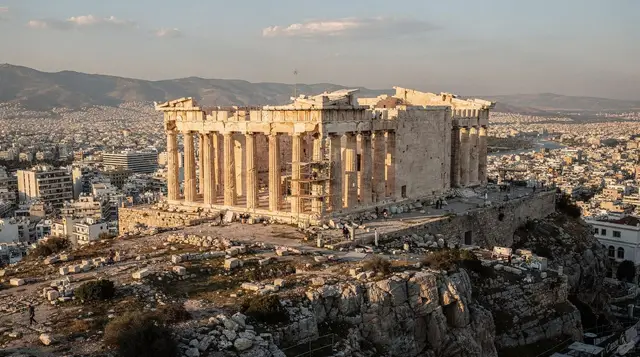
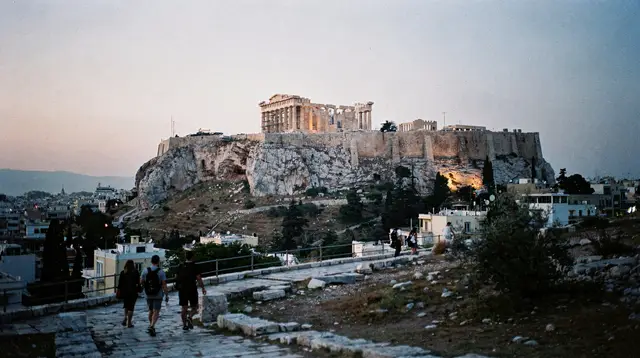
The name comes from a small Byzantine monastery (monastiraki means “little monastery”) whose church, Pantanassa, still stands on the square’s north side, looking slightly startled by its surroundings. The view from the square’s southeast corner, looking directly up toward the Parthenon, is one of the most-photographed in the city and does not disappoint in person.
| Where | Central Athens, Metro Monastiraki (Lines 1 & 3) |
| Cost | Free to explore; souvlaki €2.80–3.50; site entry €8 each |
| Time needed | 2–3 hours; longer with dinner and rooftop drinks |
| Best time | Sunday morning for the flea market; evenings for rooftops |
| Getting there | 2-minute walk from Monastiraki metro exit |
The flea market: what you find and when to go
The Monastiraki flea market is not a single institution but a cluster of permanent shops and periodic outdoor stalls concentrated on and around Ifestou street (named for Hephaestus, the blacksmith god, in tribute to the metalworkers who once dominated the street). The permanent shops deal in icons, silverware, old tools, military surplus and furniture. The quality ranges from genuinely interesting to junk; the prices are negotiable.
The Sunday market is the event that earns the reputation. From about 8 am, dealers spread along Ifestou, spill up into Avyssinias square and extend along Ermou toward Thissio. The Avyssinias square section is the most interesting: antique furniture, old radios, painted icons, vintage clothing, used books in Greek and various European languages. By 11 am it is dense; by 1 pm it begins to wind down.
The cafes and ouzeris on Avyssinias square — particularly the tables under the square’s central tree — are good for a mid-morning coffee and are cheaper than anything on the main tourist drag.
Street food: where to eat and what to order
Monastiraki-to-Mitropoleos is the best concentration of fast food in Athens. The options:
Souvlaki: the definitive Monastiraki experience is a pork or chicken souvlaki pita — meat, tomato, onion, tzatziki, paprika in a lightly grilled flatbread — from one of the established stands on Mitropoleos. Kostas, just off Syntagma on Pentelis, is often cited but the stands near the Monastiraki square end are equally good and have longer hours. Price: €2.80–3.50.
Loukoumades: fried honey-drenched dough balls from Loukoumades shops on Adrianou — a specific Athens pleasure, best eaten immediately after frying.
Gyros: slightly different from souvlaki (the meat rotates on a spit rather than grilling on skewers), gyros is denser and usually fattier. The Monastiraki stands do both; locals tend to have strong opinions on which is the better option.
The street food tour around the Acropolis and Monastiraki covers the main vendors with a guide who explains what you are eating and its context — useful for a first day when everything looks equally unfamiliar.
Rooftop bars and the Acropolis view
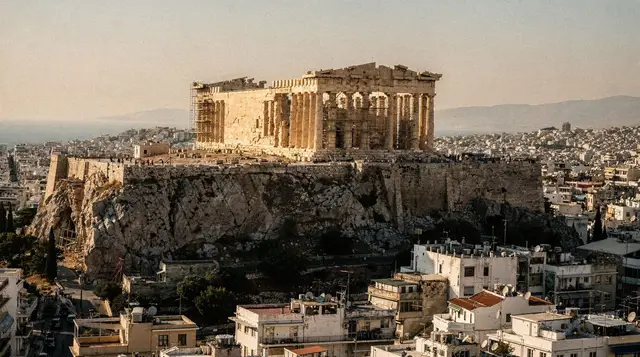
The rooftop bars around Monastiraki square deserve their reputation. Several hotels and standalone terraces on the streets immediately east of the square — particularly around Adrianou and Aiolou — have unobstructed westward views to the Acropolis. In the late afternoon, when the light is direct and golden, the Parthenon turns a warm ochre that makes every photograph work. The same terraces become bar destinations from 9 pm onward.
The twilight rooftop tastings tour moves between two or three terrace venues with wine and small plates — a efficient way to cover the best views in one evening.
The Roman Agora and Library of Hadrian
Most visitors walk straight past these two sites on their way between Monastiraki and Plaka. Each site has its own ticket, bookable on the official Hellenic Heritage ticketing portal (€8 each).
The Roman Agora — the commercial market built under Julius Caesar and Augustus — is dominated by the Tower of the Winds, an octagonal marble clocktower from the 1st century BC that served as a sundial, water clock and weather vane simultaneously. The detail on the frieze showing the eight wind deities is still sharp. It is one of the best-preserved ancient monuments in Athens and consistently underappreciated.
The Library of Hadrian is directly north of the Roman Agora on Areos street. The long west facade with its 100-column portico is the most substantial surviving structure in the Monastiraki neighbourhood. Entry is via the same gate. Both sites are covered in more depth in the dedicated Roman Agora Athens guide and Hadrian’s Library guide, and the older, larger Ancient Agora just west toward Thissio is covered separately in the Ancient Agora Athens guide if you want to extend the archaeological walk.
Monastiraki, Plaka or Psyrri: which one first?
The three neighbourhoods sit within a ten-minute walk of each other but feel distinct, and first-time visitors often ask which to prioritise if time is short.
| Neighbourhood | Character | Best for |
|---|---|---|
| Monastiraki | Loud, commercial, market energy | Flea market, souvlaki, rooftop views |
| Plaka | Quiet lanes, neoclassical houses | Slow walks, tavernas, souvenir shopping |
| Psyrri | Edgy, street art, nightlife | Bars, live rebetiko, later evenings |
A natural sequence for a first day is Monastiraki in the late morning for the market and a souvlaki lunch, Plaka in the afternoon for a quieter wander, and back through Monastiraki or into Psyrri after dark. The Athens street art tour covers the Psyrri end of this route in more detail.
Monastiraki at night
The neighbourhood transitions seamlessly into the evening. The bars and restaurants on Aiolou street and the lanes connecting to Psyrri fill from 8 pm. Monastiraki square itself stays active until late; the souvlaki stands run until 3–4 am. For a structured evening that begins in Monastiraki and moves through Psyrri, the Athens nightlife guide maps the best sequence.
The Athens highlights walking tour that covers Monastiraki and Plaka together is the single most efficient two-hour orientation for first-time visitors, connecting the square to the ancient sites in a logical circuit.
Bargaining and buying at the flea market
Prices on Ifestou and Avyssinias square are rarely fixed. A modest counter-offer — 10–20% below the asking price for anything beyond a few euros — is normal and expected, especially on antiques, silverware and vintage items where the first price is a starting point rather than a value. Cash speeds up negotiation; many stallholders prefer it and some don’t take cards at all. Genuine antiquities cannot legally leave Greece without an export permit, so anything sold openly as “ancient” on a market stall is, by definition, not: treat such claims as decorative rather than archaeological. For a broader sense of what else is worth buying around the city, see the where locals eat piece, which touches on the food-shopping side of the same streets.
How to pace a visit to Monastiraki
The square rewards a loose plan. Arrive by metro, step out into the light and give yourself a few minutes simply to stand and watch: the mosque, the church, the station and the Acropolis above them all compete for attention at once. Once you have your bearings, choose a direction rather than trying to see everything. Heading toward Ifestou street gives you the market and its workshops; heading toward Adrianou gives you terraces and loukoumades; crossing toward the ancient sites gives you the quieter, more contemplative side of the neighbourhood.
Comfortable shoes matter more here than almost anywhere else in the centre. The paving is smooth marble in places and uneven in others, and the streets around the market are crowded enough that you will stop and start constantly. Carry a bag you can wear in front of you in the thickest crowds, and keep a little cash for stalls and stands that do not take cards.
If you are building a larger plan, Monastiraki fits naturally into the Athens in one day itinerary and into the longer Athens in two days itinerary, usually as the lunch and market stop between the morning at the Acropolis and an afternoon in Plaka. The Athens self-guided walk strings the same streets together in a sensible order if you would rather not improvise.
Getting here and moving on
Monastiraki is one of the easiest places in Athens to reach, because two metro lines meet at the station on the square. That also makes it a convenient place to switch lines or to begin and end a day without any complicated planning. The Athens metro guide explains how tickets and lines work, and the getting around Athens guide covers the other options for the days when you want to mix walking with other transport.
From the airport the metro runs straight into the centre, so Monastiraki is also a natural first stop on arrival day; the airport to city guide sets out the choices. Visitors staying elsewhere will find that most of the historic core is walkable from here, which is why the where to stay in Athens guide often points first-timers toward this side of the centre.
A morning on the Sunday market, step by step
The most satisfying way to do the market is slowly and in sequence. Start on Ifestou street while the dealers are still setting up, when the light is soft and the street is easier to walk. Look in the permanent shops first, since they are open whether or not the outdoor stalls are busy, and get a feel for what things are priced at before you start any negotiation.
Move on to Avyssinias square as it fills. This is where browsing pays off: bring patience and look at the second row of tables, not only the first. Old radios, books in several languages, painted icons and vintage clothing all turn up, and the dealers are usually happy to talk about what they are selling. Stop for coffee under the trees when you need a break, then finish by walking the stretch of Ermou toward Thissio, where the crowd thins and the atmosphere changes.
When the market begins to wind down, you are well placed for lunch. A souvlaki from a stand on Mitropoleos is the obvious answer; a longer sit-down meal is easier to find if you follow the advice in the best tavernas in Athens guide or the best souvlaki in Athens guide. For more on the street-food side of the day, the Greek street food guide explains what each item is and how locals eat it.
Photographing Monastiraki
The neighbourhood is a gift for photographers because there is always something happening in the frame. The classic shot is the Acropolis rising above the square, best taken from the southeast corner. For a different angle, look for the rooftop terraces on Adrianou and Aiolou, where the golden hour gives the stone a warm tone and the crowds in the street below add scale.
Street scenes work well in the morning, when vendors are arranging their goods and the light falls along the narrow lanes. Detail shots of market objects, signs, tiles and the church facade give a sense of place that the wide views cannot. The best photo spots in Athens guide and the Acropolis sunset photography guide both help you plan the best vantage points and times.
Pairing Monastiraki with other neighbourhoods
Because the surrounding districts are so close, you can build several different days around this square. A history-led day links the Roman Agora and Hadrian’s Library with the Ancient Agora and the Acropolis. A food-led day pairs the market with Psyrri, where the Psyrri bar crawl takes over after dark. A slower day adds Plaka and the Plaka walking tour, finishing with a quiet dinner away from the main crowds.
Travellers who like a bit of narrative can read the perfect day in Plaka and the street art of Psyrri as companions to this page; both describe the mood of the streets that lead in and out of Monastiraki. Anyone arriving from a cruise ship will find the Athens in one day from the port guide helpful for fitting the square into a tight schedule.
Frequently asked questions about Monastiraki
Is Monastiraki safe, especially around the flea market and at night? Yes, by Athens standards Monastiraki is safe and heavily trafficked at all hours, though as with any dense tourist area, keep an eye on bags and pockets in the busiest market crowds. The square and main streets stay well-lit and populated well past midnight thanks to the souvlaki stands and bars.
What’s the difference between Monastiraki and the Central Market (Varvakios)? They’re different things a short walk apart: Monastiraki’s flea market deals in antiques, souvenirs and secondhand goods, mostly outdoors on Sundays, while the Central Market is a covered, daily meat-and-produce market a few streets north — a working food market rather than a tourist bazaar. Both are worth seeing, but for very different reasons.
Is Monastiraki worth visiting if I don’t like shopping? Yes. The market is only one part of the appeal. The square, the Acropolis views, the street food and the nearby ancient sites make it worthwhile even if you never buy anything, and the terraces are pleasant for a quiet drink at golden hour.
Can I combine Monastiraki with the Acropolis in one outing? Easily. The two are close enough to link on foot, and many visitors do the Acropolis early and come down to Monastiraki for lunch. The Acropolis tickets guide and the Acropolis skip-the-line guide help you plan the first half of that day.
Is Monastiraki a good base for a stay? It is lively and central, with excellent transport, so it suits visitors who want to be in the middle of things. Light sleepers may prefer a calmer street, since the area stays busy late into the night.