
Plaka and Anafiotika walking tour: the essential guide
How do I walk Plaka and Anafiotika in Athens?
Start at Adrianou Street near the Roman Agora, walk east through Plaka's main lanes, then climb the stepped paths toward Anafiotika — the whitewashed Cycladic enclave built into the Acropolis's north face. Allow 2–3 hours for a leisurely circuit. Before 9:30am the streets are almost empty.
Two neighbourhoods, one extraordinary walk
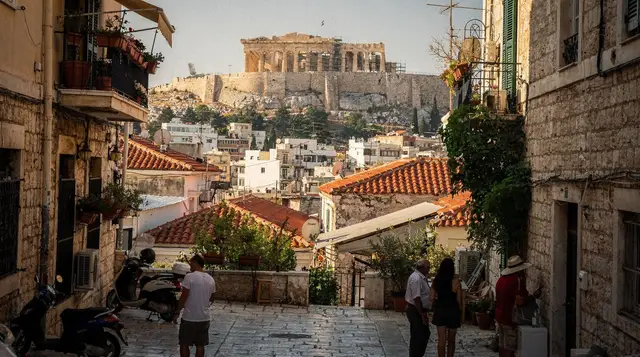
Plaka and Anafiotika sit side by side on the northern and northwestern slopes of the Acropolis, and together they form the most atmospheric walk in Athens. Plaka is the old town — Neoclassical mansions, 19th-century squares, tavernas whose outdoor tables colonise every available cobblestone. Anafiotika is something stranger: a tiny Cycladic village of 45 houses clinging to the rock face of the Acropolis at a height that should not be habitable, built by stonemasons from Anafi island in the 1840s and barely changed since.
The two neighbourhoods take roughly two hours to explore at a proper walking pace, or three hours if you stop for coffee and read every inscription. The loop described here is around 2.5 kilometres and gains about 80 metres of elevation, mostly concentrated in the final climb to Anafiotika.
| Where | North/northwest slope of the Acropolis |
| Cost | Free (Acropolis site ticket separate) |
| Time needed | 2–3 hrs at a leisurely pace |
| Best time | 8–10am on weekdays, before tour groups |
| Getting there | Metro to Monastiraki, walk east on Adrianou |
Starting point: Monastiraki Square
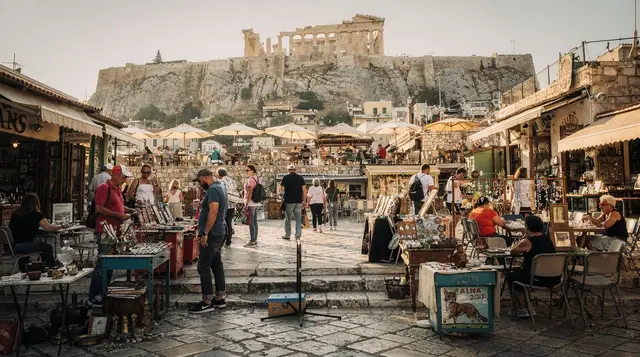
The natural entry point for this walk is Monastiraki Square, which sits at the western edge of Plaka where the metro line surfaces. From the square, face the Acropolis and walk east along Adrianou Street — this is Plaka’s main artery, lined with shops and cafés for most of its length, but still paved with the original stone that dates to well before the Greek War of Independence.
At the far end of Adrianou, roughly 600 metres from Monastiraki, you reach the Tower of the Winds (Horologion of Andronikos Kyrrhestes), an octagonal marble clocktower built around 50 BC and still standing to its full height. It served simultaneously as a sundial, water clock, and weather vane, and the carvings on each face depict the wind god corresponding to that compass direction. This is a freestanding monument visible from outside the Roman Agora fence, so no ticket is needed to photograph it.
Through the heart of Plaka
From the Tower of the Winds, turn south on Lysikratous Street to reach the Monument of Lysikrates — a cylindrical marble choragic monument erected in 335 BC to commemorate a victory in a theatrical competition. It is the only one of its type to survive complete, and Lord Byron stayed in the Capuchin monastery that surrounded it in 1810–1811 (a plaque marks the spot).
Continue south along Shelley Street to Kidathineon Street, which cuts east–west across Plaka and connects to the small square of Filomousou Etairias. This square, shaded by pepper trees, is where local families sit on Sunday mornings and where a small open-air market appears on weekends. The Museum of Greek Folk Art is on the north side.
Turn north on Angelikis Hadjimichali Street and then zigzag up the hillside on Thespidos Street, which narrows and steepens as it approaches the base of the Acropolis. You are now entering the transitional zone between tourist Plaka and the genuinely quiet upper lanes.
Anafiotika: the village inside the city
The entrance to Anafiotika is unmarked and easy to miss. At the top of Thespidos, a path branches right and begins to climb steeply through a gate in a garden wall. Once through, the architecture changes entirely: white cubic houses with blue shutters, bougainvillea cascading over terrace walls, cats on every step, and lanes so narrow that two people can barely pass.
Anafiotika exists because of a quirk of 19th-century Greek property law: any structure that could be roofed before dawn became the builder’s legal property. The stonemasons from Anafi who were hired to build Neoclassical Athens for the new Greek state worked on their own houses at night, raising walls in the dark and finishing them before sunrise. The result is a neighbourhood of roughly 45 houses that is simultaneously illegal (built on state-protected archaeological land), legally owned by descendants of the original builders, and protected from demolition by its own historic status.
From Anafiotika’s highest point — a small terrace just below the Acropolis walls — the view north over Athens is one of the best free viewpoints in the city. The Acropolis walls rise directly above you; the tiled rooftops of Plaka fall away below; and on a clear day you can see as far as the mountains of the Peloponnese.
Guided options for Plaka and Anafiotika
The streets in this neighbourhood are genuinely confusing even with a map, and the historical layers reward explanation. A guided walk adds the Ottoman-era geography, the story of the Anafi builders, and the 1821 independence sites that a solo walk will miss.
The Plaka and Monastiraki walking tour is the most popular dedicated option. It runs about 2.5 hours, covers both neighbourhoods in full, and typically includes the Hadrian’s Arch area and the edge of the Temple of Olympian Zeus, which frames the southern approach to Plaka.
For a tour that combines Plaka with the Acropolis highlights, the Athens highlights walking tour is the standard choice — this is a three-hour circuit that begins at the Acropolis and descends through Plaka, giving you the chronological narrative as well as the street-level texture.
If you want Plaka at night, when the lanes are lamp-lit and the tourists have mostly gone to restaurants, the night walking tour guide describes what to expect after dark.
The Acropolis from below
At no point on this walk are you more than 400 metres from the Acropolis, and the views of the Parthenon from different angles at different times of day are part of the attraction. The northeast-facing view from Anafiotika in late afternoon light is warm and close. The view from Adrianou Street looking south is more distanced but frames the full width of the hill.
Entering the Acropolis site itself requires a separate ticket (€30 full price, €15 reduced; each site is booked separately on the official Hellenic Heritage ticketing portal). The Acropolis tickets guide explains the options. For the mythology and history of what you see on the hill above, the gods of the Acropolis guide is the best primer.
Connecting to the wider walking circuit
Plaka connects naturally to the Archaeological Promenade along Dionysiou Areopagitou to the west, which runs car-free for 3.5 kilometres from the Acropolis to Kerameikos. This pedestrian boulevard, one of the longest in Europe, passes the Odeon of Herodes Atticus, the Stoa of Eumenes, and the entrance to the Acropolis Museum.
To the north, Plaka flows into Monastiraki and, beyond that, into Psyrri — the street art and nightlife district that forms the subject of the Athens street art tour guide.
For a full-day walk combining all these areas, see the self-guided Athens highlights walk.
A brief history: from Ottoman quarter to protected old town
Plaka is the only part of central Athens that survived largely intact through the 19th-century rebuilding of the new Greek capital, which is why its street pattern still follows Ottoman-era lanes rather than the neoclassical grid imposed elsewhere. In the 1970s the neighbourhood went through a rowdy nightclub era — bouzoukia bars and amplified music filled the same lanes that are quiet cafés today — before a 1980s municipal clean-up banned amplified music and vehicle traffic on most streets, restoring the pedestrian character visitors see now. Anafiotika’s protected status came later still: its houses were only formally recognised and safeguarded from demolition in the late 20th century, despite technically sitting on archaeologically protected land.
Eating on the walk
Plaka has more tavernas than any similarly sized area of Athens, and quality varies enormously by how close you are to Adrianou Street. For a sit-down meal, walk one block off the main tourist drag — Mnisikleous and the streets around Filomousou Etairias square have tavernas serving the same food to a majority-local clientele at noticeably lower prices. For something quick between sights, the small bakeries on Kidathineon sell spinach pies and koulouri (sesame bread rings) that make a perfectly good walking breakfast. The best tavernas in Athens guide and the Athens vegetarian and vegan guide both cover specific recommendations reachable from this route.
Plaka and Anafiotika after dark
Once the day-trippers thin out, Plaka’s character shifts again: lamp-lit lanes, tavernas with bouzouki or live Greek music on weekend evenings, and a noticeably calmer Anafiotika where a handful of residents’ lights are the only illumination on the upper paths. The Plaka and Anafiotika night walking tour is built specifically around this atmosphere, timed to start as the day-trip crowds disperse.
Practical notes
Best time to go: 8–10am on weekdays. Plaka’s main lanes are tourist-free before the tour groups arrive. Adrianou Street becomes very busy by 11am in summer.
Footwear: flat, closed-toe shoes with grip. The stone in Plaka is polished by centuries of foot traffic and is slippery when damp. The steps into Anafiotika are steep and irregular.
Cafés: Plaka has cafés everywhere, but prices on Adrianou and Kidathineon are inflated. Walk one block off the main drag for roughly half the price. The small square at Mnisikleous Street, just east of the Tower of the Winds, has good local-facing options.
Photography: Anafiotika is best photographed in early morning light from the east, or in late afternoon when the sun catches the white walls from the west. Avoid midday — the overhead light flattens everything.
Frequently asked questions about walking Plaka and Anafiotika
How long does it take to walk Plaka and Anafiotika?
Allow 2–3 hours for the full circuit at a comfortable pace with stops. If you add the Acropolis visit, plan for a full half-day.
Is Anafiotika easy to find without a guide?
It is findable but not obvious. The path up from Thespidos Street is unmarked. Using the Athens self-guided walk route or a downloaded map helps considerably. Several people walk past the entrance without realising it.
Can I visit Anafiotika for free?
Yes. Anafiotika is a residential neighbourhood on public footpaths — there is no entrance fee. You are walking through people’s streets, so keep noise down and respect garden walls and house fronts.
Are the lanes in Plaka wheelchair accessible?
No. Plaka and Anafiotika are almost entirely stepped, cobblestoned, or both. The flat section of Adrianou Street is accessible, as is Monastiraki Square, but the upper neighbourhood lanes are not suitable for wheelchairs or pushchairs.
What else can I see near Plaka on the same day?
The Acropolis Museum (just south of Plaka), the Ancient Agora (five minutes west), and the Kerameikos cemetery (15 minutes west) are all walkable from Plaka. The Athens history timeline gives context for each site.
Is there a free guided tour of Plaka?
Several free-with-tip tour operators run daily Plaka tours departing from Monastiraki or Syntagma Square. These are genuine guided experiences with professional guides funded by tips. Quality varies, so check reviews before joining.
Is Plaka too touristy to be worth visiting?
No — the density of souvenir shops on Adrianou Street is real, but it’s a small fraction of the neighbourhood. One block off the main drag, Plaka is quiet, residential, and genuinely beautiful, and Anafiotika in particular sees a fraction of Acropolis-level visitor numbers. Going early (before 9:30am) removes almost all the crowding anyway.
Is Plaka safe to walk at night?
Yes. Plaka is one of the best-lit, most populated parts of central Athens after dark, with tavernas and bars keeping the main lanes active until midnight or later. Standard city awareness applies on the quieter upper Anafiotika paths, which have far less foot traffic once the tavernas close.
Athens experiences on GetYourGuide
Verified deep-linked GetYourGuide tours. Book through these links and we earn a small commission at no cost to you.
GetYourGuide does not provide product photos: on its activity cards, the picture illustrates the type of experience and is not the operator's own photo.

More tours on Viator
Top-rated experiences with verified reviews, bookable on Viator (a Tripadvisor company).
 Viator
Sea Kayak Epidavros - Ancient Sunken City Tour
FromEUR 80Check availability → Viator
Best of Santorini Sightseeing Guided Tour 5h
FromEUR 108Check availability → Viator
Meteora: Morning Half Day Sightseeing and Monasteries Tour
FromEUR 35Check availability → Viator