
Gods and myths of the Acropolis: the essential guide
What gods and myths are on the Acropolis?
The Parthenon honours Athena Parthenos (Athena the Virgin). The Erechtheion is built over the site of Athena and Poseidon's contest for the city. The Temple of Athena Nike commemorates victory in war. The sculptural programme depicts the Gigantomachy, the Amazonomachy, and the Panathenaic procession.
The Acropolis as a theological statement
The Acropolis is not a random collection of buildings. Every structure on the plateau, every sculptural programme, every decorative choice was a deliberate theological and political statement made by the Athenian state in the 5th century BC. Understanding what those statements were — which myths each building invokes, which gods it honours, and what political message the combination was designed to project — transforms a visit from an architectural tour into something much richer.
| Where | Acropolis hill, central Athens |
| Cost | €30 Acropolis entry (€15 reduced), all year |
| Time needed | 2–3 hours on the hill; add 1.5–2 hours for the Acropolis Museum |
| Getting there | 15–20 min walk from Monastiraki, or Acropoli Metro station |
| Best time | Opening (8am) or from 4pm, to avoid heat and crowds |
This guide works through the Acropolis buildings in the order you encounter them ascending from Dionysiou Areopagitou, explaining the mythology at each stage.
The Propylaia: the gateway and its significance
The Propylaia is the monumental gatehouse through which you enter the Acropolis plateau. Built between 437 and 432 BC, designed by the architect Mnesikles, it is a building in a complicated structural situation: it had to create a dramatic threshold experience while navigating a steep, uneven site, accommodating both pedestrians and the cattle and sheep brought up for sacrifice, and respecting the sanctity of the adjacent temenos of Artemis Brauronia.
The mythology connected to the Propylaia is indirect but important. The right wing of the gatehouse contained the Pinakotheke, a picture gallery displaying paintings of mythological subjects — the earliest public art gallery in Western history. The works included depictions of scenes from the Trojan War, from the myths of Heracles, and from Athenian legend. None survive, but ancient descriptions (particularly in Pausanias’s Description of Greece from the 2nd century AD) give us the subject matter.
The Propylaia was never fully completed — the Peloponnesian War (431–404 BC) interrupted construction, and certain planned sections were never built. Even incomplete, it is considered one of the masterpieces of Classical Greek architecture.
The Temple of Athena Nike: victory, permanence, and the Wingless Victory
Before you enter the Propylaia, on the south bastion of the entrance to the right, stands the Temple of Athena Nike — the temple of Athena as goddess of victory. Built around 420 BC, it is the smallest temple on the Acropolis and the first you see on approach.
The mythological significance centres on the cult statue inside: Athena Nike depicted without wings, unlike the winged personification of Nike (Victory) familiar from other Greek art. According to the 2nd-century AD writer Pausanias, the wingless depiction was deliberate — the Athenians did not want Victory to be able to fly away. This is a piece of mythological engineering: by depicting Victory as wingless, you make her permanent.
The temple’s frieze depicts scenes from the Battle of Plataea (479 BC) on one side and the Battle of Marathon (490 BC) on another — the two decisive victories over Persia that the Athenians understood as divinely assisted. The Nike Adjusting Her Sandal, now in the Acropolis Museum, was part of the Nike Temple balustrade and is among the finest examples of Classical drapery carving: the thin wet fabric clinging to the goddess’s body as she bends to adjust her sandal is carved with impossible delicacy from marble.
The Erechtheion: the most mythologically charged building
The Erechtheion (421–406 BC) is the most mythologically complex building on the Acropolis and the least understood by visitors who have not read the background. It sits on the north side of the plateau, directly facing the Parthenon, and it is built over (and around) the most sacred spots on the hill.
What the Erechtheion contains (according to ancient sources and archaeology):
- The mark left by Poseidon’s trident when he struck the rock in the contest with Athena — a natural fissure in the bedrock, visible in the north porch
- The salt spring that appeared from Poseidon’s strike
- The olive tree planted by Athena (the current tree on the west side is a direct symbolic replacement)
- The ancient wooden cult statue of Athena Polias — the most sacred object in Athens, older than the city itself, the statue that the Panathenaic procession was dedicated to adorning with a new robe every four years
- The tomb of the legendary king Erechtheus (after whom the building is named), who was killed by Poseidon in a separate myth
- Shrines to Cecrops (the first king of Athens, who was present at the Athena–Poseidon contest), Hephaestus, and the hero Boutes
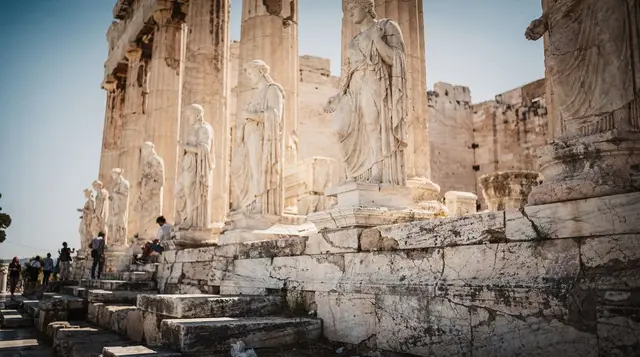
The Porch of the Caryatids on the south side of the Erechtheion is the most photographed detail of the building. The six draped female figures serving as columns — technically korai, not caryatids, though the name has stuck — are carved with a sophisticated understanding of the structural problem: the weight of the entablature is borne on their heads, and their weight-bearing leg is slightly more compressed, their supporting leg slightly relaxed, in a pose that distributes the load naturally. Five of the originals are in the Acropolis Museum; one was taken by Lord Elgin and is in the British Museum.
The Parthenon: Athena Parthenos and the complete sculptural programme
The Parthenon (447–432 BC) is the supreme monument of Classical Athens, dedicated to Athena Parthenos — Athena in her aspect as virgin warrior goddess and divine protector of the city. The architects were Iktinos and Kallikrates; the sculptural programme was overseen by Pheidias.
The inside of the Parthenon housed the Chryselephantine statue of Athena Parthenos — a cult statue approximately twelve metres tall, made of ivory (for the flesh) and gold (for the drapery, armour, and shield), standing on a base whose perimeter depicted the birth of Pandora. The statue carried a small figure of Nike on its right hand. The original was destroyed in antiquity; the best surviving copy is in the National Archaeological Museum of Athens.
The sculptural programme on the exterior of the Parthenon was comprehensive and explicitly mythological:
Metopes (the ninety-two square panels above the outer colonnade): Each side depicted a different mythological battle — the Gigantomachy (gods versus giants, south side) representing the victory of order over chaos; the Amazonomachy (Athenians versus Amazons, west side) representing the civilised world versus the barbaric; the Trojan War (east/north sides) representing Greek unity; the Lapiths versus Centaurs (south side) representing reason versus animal instinct. Each battle was simultaneously a metaphor for the Greek victories over the Persians.
Frieze (the continuous band running around the top of the inner wall): 160 metres of carved marble depicting the Panathenaic procession — the festival held every four years at which Athens presented a new robe (peplos) to the wooden statue of Athena in the Erechtheion. The frieze includes approximately 360 human figures and 220 animals, and depicts the entire civic community of Athens — cavalry, sacrificial animals, maidens carrying sacred vessels, musicians, athletes — assembled for the city’s most important religious event.
Pediments (the triangular gables at each end): The east pediment depicted the birth of Athena from the head of Zeus, in the presence of the assembled Olympian gods. The west pediment depicted the contest between Athena and Poseidon for the city of Athens — the founding myth of the city carved in marble at the most prominent location on the most prominent building. Only fragments survive; the best are in the British Museum and the Acropolis Museum.
How to engage with the mythology on site
The problem with understanding the Parthenon’s sculptural programme is that almost all of it has been removed. The metope carvings are in the Acropolis Museum (south metopes) and the British Museum (Elgin Marbles); the pediment figures are split between both museums; the frieze is similarly divided. What you see on the building itself are mostly casts.
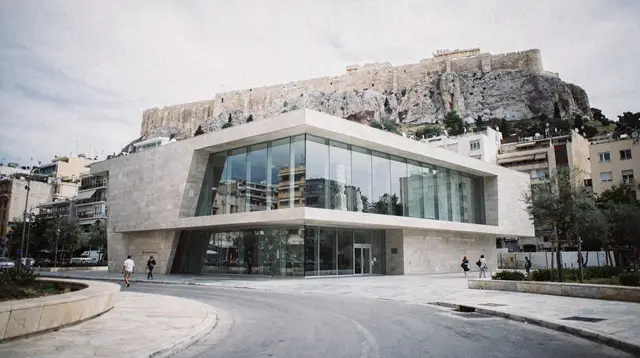
The Acropolis Museum (at the east end of Dionysiou Areopagitou, just below the hill) displays the originals that remain in Greece in an extraordinary purpose-built building. The frieze is displayed at the same height it occupied on the Parthenon, running around the third floor in a space flooded with natural light. Visiting the museum before or after climbing the hill is essential for understanding the mythology in full.
Guided mythology tours of the Acropolis
For visitors who want to engage with this mythological programme seriously, a guided tour is genuinely more efficient than self-guided reading.
The Athens mythology small-group tour uses the Acropolis as its central text and explains the sculptural programme, the contest of Athena and Poseidon, and the Panathenaic procession in the context of the city you can see around you. Groups are small and guides are classically trained.
The four-hour mythological walking tour extends beyond the Acropolis to the Theatre of Dionysus and the Areopagus, which allows the guide to connect the Acropolis mythology to the civic and theatrical mythology of the surrounding sites. This is the more comprehensive option for visitors who want to understand Athens as a totality.
For a private version of the same tour, the Athens private mythology tour allows the guide to focus specifically on the aspects of the Acropolis mythology that interest you most.
The Acropolis and the Greek mythology Athens guide
The Acropolis mythology sits within a larger web of Athenian myth. The Greek mythology Athens guide maps all the major myths to their corresponding sites across the city. Reading both guides together gives the complete picture.
For historical context on how the Acropolis buildings were constructed, who funded them, and what happened to them over 2,500 years, see the Athens history timeline.
The Acropolis mythology in context: the wider city
The Acropolis myths don’t stand alone — they connect directly to sites elsewhere in Athens. The contest between Athena and Poseidon echoed through Athenian civic identity for centuries, and the Ancient Agora below the hill was where that identity played out in daily political life. The Temple of Olympian Zeus, a short walk east, honours a different Olympian entirely and shows how the city’s religious landscape extended well beyond the Acropolis itself. For the origin myths behind Athens’s name and founding kings referenced above (Cecrops, Erechtheus), the Athens democracy birthplace guide traces how myth and early politics intertwined.
Visiting the Acropolis Museum for the fuller picture
Because so much of the sculptural programme described above survives only in the Acropolis Museum rather than on the hill itself, pairing the two visits matters more than most first-time visitors realise. The Acropolis Museum guide covers the layout, the glass floor over the excavation, and how to see the frieze and metopes in the order that makes the mythology clearest. Skip-the-line tickets are worth arranging in advance for both sites in peak season.
Guided Acropolis and Acropolis Museum tourFrequently asked questions about the gods and myths of the Acropolis
Who was Athena Parthenos and why is she important?
Athena Parthenos is Athena in her aspect as virgin warrior and patron of the city. She is distinct from Athena Polias (Athena of the city, worshipped in the Erechtheion) and Athena Nike (Athena of victory, in the southwest bastion temple). The Parthenon’s name derives from parthenos, meaning virgin. The cult statue inside depicted Athena fully armoured, holding Nike (Victory) in her right hand and a shield decorated with the Gigantomachy in her left.
What is the Gigantomachy and why does it appear so often on the Acropolis?
The Gigantomachy is the mythological battle between the Olympian gods and the Giants (offspring of Gaia). The gods won, establishing cosmic order. In Athenian political mythology, this battle was a metaphor for the Greek victories over the Persians — Athens defeating its own “giants.” The Gigantomachy appears on the Parthenon metopes (south side), on the interior of Athena’s shield, and was a theme of the peplos presented to Athena in the Panathenaic procession.
Can I see the original Parthenon sculptures?
The best surviving originals are split between the Acropolis Museum (about 50%) and the British Museum (the Elgin Marbles, about 40%), with fragments in other museums worldwide. The Acropolis Museum displays its collection in a purpose-built building at the base of the hill — visiting it alongside the Acropolis site gives the most complete picture.
Is there an entrance fee for the Acropolis?
Yes — €30 (€15 reduced), all year. Each site, including the Ancient Agora and Kerameikos, is booked separately on the official Hellenic Heritage ticketing portal; check there whether a multi-site ticket is offered. The Acropolis tickets guide explains all options including skip-the-line timing.
What time of day is best for visiting the Acropolis?
Early morning (opening, typically 8am) or late afternoon (from 4pm in summer). Both avoid the worst of the midday heat and the worst of the crowds. The light on the Parthenon is also better at low angles. The Acropolis at sunset from inside the site is extraordinary — walk in at 5pm in summer and you can stay until the 8pm closing.
Do I need a guide to understand the mythology, or can I do it self-guided?
This guide plus a good site map will get you through the major myths on your own — the contest of Athena and Poseidon, the Gigantomachy, the Panathenaic frieze. A guide adds real value if you want the mythology narrated on the spot with visual references, rather than pieced together from a printed guide, and helps you locate details (the trident mark, the wingless Nike statue) that are easy to walk past unnoticed.
Culture & mythology tours in Athens
Verified deep-linked GetYourGuide tours. Book through these links and we earn a small commission at no cost to you.
GetYourGuide does not provide product photos: on its activity cards, the picture illustrates the type of experience and is not the operator's own photo.
More tours on Viator
Top-rated experiences with verified reviews, bookable on Viator (a Tripadvisor company).


