
Greek mythology in Athens: the stories behind the sites
Where can you see Greek mythology in Athens?
The Acropolis is tied to Athena's contest with Poseidon. The Areopagus Hill to Orestes's trial and Paul's sermon. The Ancient Agora to Socrates and Theseus. The Theatre of Dionysus to Dionysus himself. Every major site in Athens has a mythological story attached to it.
Mythology as a lens for the physical city
Most visitors to Athens experience Greek mythology as something separate from the physical city: the myths they remember from school or films are abstract stories about gods and heroes in an unlocated divine realm. The extraordinary thing about Athens is that virtually every myth connected to the city is tied to a specific, visitable place. The rock where Poseidon struck his trident is on the Acropolis. The hill where Orestes was tried is 400 metres from the Acropolis entrance. The theatre where Dionysus was worshipped and his myths were staged is still standing.
| Where | Acropolis, Ancient Agora, Areopagus, Kerameikos — central Athens |
| Cost | Free to walk between sites; €30 Acropolis entry (€15 reduced); Agora €20 (€10 reduced) |
| Time needed | Half a day for the core mythology circuit, 3–4 hrs guided |
| Getting there | Walkable from Monastiraki or Acropoli Metro station |
| Best time | Morning, before midday heat and tour-group crowds |
This guide works through the major myths associated with Athens in the order in which you encounter the relevant sites walking through the city, from Monastiraki to the Acropolis and back through Plaka.
Theseus and the birth of Athens
Before Athens was a city, it was associated with Theseus — the legendary king who unified the villages of Attica into a single city-state, an event the Athenians called the synoikismos. Theseus’s biography follows the classic hero pattern: he was born to the king of Athens and raised in the Peloponnese, discovered his parentage (his father had left a sword under a stone for him to find when strong enough to lift it), killed the Minotaur in Crete, and returned to Athens to become king.
The specific Athenian site connected to Theseus is the Theseum — a name historically attached to the best-preserved ancient temple in Greece, now correctly called the Hephaisteion, the temple of Hephaestus. This sits in the northwest corner of the Ancient Agora, visible from Adrianou Street and from the hills above. The Hephaisteion’s metopes depict the labours of Theseus alongside those of Heracles. The bones believed to be Theseus’s were reportedly brought from the island of Skyros to Athens by Cimon in 475 BC and interred in what became a hero’s shrine in the Agora.
The Ancient Agora also contains the Stoa of Zeus Eleutherios (Zeus the Liberator), built to celebrate Athens’s liberation from Persian occupation in 479 BC, and the Altar of the Twelve Gods, which served as the geographic zero-point of the Athenian road network.
Athena and Poseidon: the contest for the city
The central myth of Athens concerns the contest between the goddess Athena and the god Poseidon for patronage of the city. According to tradition, both gods wanted the city and were invited to give a gift: whoever gave the more useful gift would win the honor of naming it.
Poseidon struck his trident into the rock of the Acropolis and a spring of salt water appeared — powerful, dramatic, marking his claim to the sea. Athena planted an olive tree — less dramatic, but more useful: a source of food, oil, timber, and trade. The gods judged Athena’s gift superior, and the city became Athens.
Both gifts are commemorated on the Acropolis today. The salt spring (or its memory) is referenced in ancient descriptions of the Erechtheion, the temple on the north side of the Acropolis hill. The ancient olive tree — the direct mythological descendant of the original — has been replanted in the spot described in ancient sources, to the west of the Erechtheion. When you see it from the Acropolis path, it is a direct living link to the city’s founding myth.
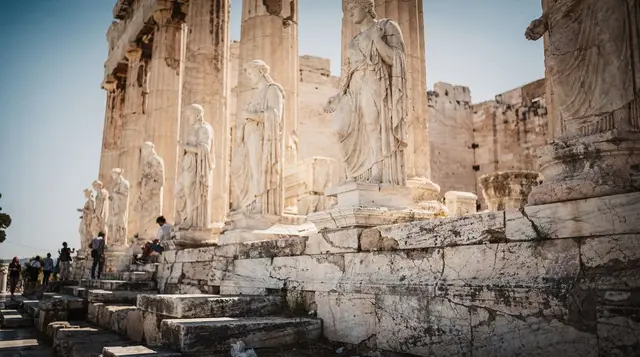
The Erechtheion itself is the most mythologically dense building on the Acropolis. It was built over the spot where the contest between Athena and Poseidon reportedly occurred, and it contained the ancient wooden cult statue of Athena Polias (Athena of the City) — the most sacred object in Athens, carried through the streets in the Panathenaic procession every four years. The famous Porch of the Caryatids, with its six draped female figures serving as columns, faces the Parthenon across the Acropolis plateau.
For a full treatment of Acropolis mythology, see the gods of the Acropolis guide.
Dionysus and the invention of theatre
Dionysus — god of wine, ecstasy, transformation, and theatre — has a specific physical address in Athens: the Theatre of Dionysus on the southern slope of the Acropolis, just east of the Odeon of Herodes Atticus on Dionysiou Areopagitou.
This is arguably the most important cultural site in Western history after the Parthenon. In the 6th century BC, a dancing space was established here in honour of Dionysus, and plays were performed as part of the Dionysia festivals. By the 5th century BC, this was the venue for the world premieres of the Oresteia (Aeschylus), Oedipus Rex and Antigone (Sophocles), and The Bacchae (Euripides) — foundational works of Western drama, all performed as religious acts in honour of Dionysus.
The stone theatre visible today was constructed in the 4th century BC and expanded in the Roman period. The front row of seats includes carved thrones for priests, one of which is dedicated to the priest of Dionysus and is the most elaborately decorated seat in any ancient theatre. Entry is booked on the official Hellenic Heritage ticketing portal.
Orestes and the Areopagus trial
The Areopagus (Mars Hill) is the rocky outcrop directly opposite the Acropolis entrance, accessible from Dionysiou Areopagitou. In mythology, it was the site of the world’s first murder trial: Orestes, who had killed his mother Clytemnestra to avenge his father Agamemnon, was tried here by a jury of twelve Athenian citizens assembled by the goddess Athena herself.
The trial is the subject of Aeschylus’s play The Eumenides, the third play of the Oresteia trilogy. When the jury votes and produces a tie, Athena casts the deciding vote in favour of acquittal — not because Orestes is innocent but because Athena believes that the principle of rational civic justice must supersede the older principle of blood vengeance. This is one of Greek mythology’s most sophisticated political arguments: the Areopagus trial represents the birth of the jury system, and by extension of democracy itself.
The hill is freely accessible, though the marble surface is polished smooth and requires careful footing. A plaque near the base marks the spot where Paul of Tarsus delivered his “Sermon to the Athenians” in 50 AD — an event described in Acts 17 and significant because Paul used the Athenians’ altar “To an Unknown God” as his entry point.
Hermes and the Agora
The Ancient Agora was under the particular protection of Hermes, god of commerce, communication, and boundaries — all three of which were central to the functions of a civic marketplace. Boundary markers called herms (stone pillars topped with a portrait of Hermes) marked the entrances to the Agora.
The most famous act of civic sacrilege in Athenian history involved these herms: the Mutilation of the Herms in 415 BC, the night before the Sicilian Expedition departed, when unknown parties smashed the faces off the herms throughout Athens. The event was interpreted as a terrible omen, contributed to the downfall of Alcibiades, and ultimately to the catastrophic failure of the expedition. The full story is in Thucydides’s History of the Peloponnesian War.
Mythology walking tours in Athens
The mythological layer of Athens rewards guided interpretation more than almost any other theme, because the stories are complex, the sites are dense, and the connections between them are non-obvious without expert explanation.
The Athens mythology small-group walking tour is the most popular introduction: a three-hour circuit that covers the Acropolis, the Areopagus, and the Ancient Agora with mythology as the primary interpretive frame rather than architecture or history. Guides trained in classics rather than standard tourism deliver the material.
The four-hour Athens mythological walking tour goes further, adding the Theatre of Dionysus and the Kerameikos cemetery (where the mythological hero Heracles supposedly passed on his way to his labours). The additional hour makes a significant difference — Kerameikos is undervisited by most tourists and its mythology connections (it was the gateway to the underworld for those who could not afford proper burial rites) are rarely explained anywhere else.
The Athens mythology storytelling tour takes a different approach — it is primarily oral, telling the stories of the major myths in full narrative form at the relevant sites, with more emphasis on the dramatic content of the myths than on the archaeological or historical context. This is the best option for visitors who want emotional engagement with the material rather than academic explanation.
The myths you can connect to sites not on the main circuit
Lycabettus Hill: Lycabettus is connected to the myth of Athena carrying a great rock to the Acropolis as a defensive fortification. A crow brought her bad news mid-journey and she dropped it in fright — Lycabettus is that rock. The hill appears in this story as a piece of Athenian divine clumsiness, which is why it is worth knowing.
The Kerameikos: The potters’ district and cemetery at the western edge of the old city is connected to the mythology of the underworld. This was the road the dead took out of Athens — the Sacred Way led from here to Eleusis, where the Mysteries of Demeter (the most important religious rites in Greece) were performed. The Delphi connection runs through these Mysteries.
Delphi itself: For the oracle mythology, the Oracle of Delphi story guide covers the full narrative. Delphi is a day trip from Athens (2.5 hours each way) and the mythological density of the site rivals anything in Athens itself.
Extending the mythology trail beyond Athens
Athens is the densest concentration of mythological sites in Greece, but it isn’t the only one within reach. Delphi carries the Apollo and oracle mythology, Mycenae and Epidaurus hold the myths of Agamemnon and the House of Atreus that directly connect to the Orestes story above, and Delos near Mykonos is the mythological birthplace of Apollo and Artemis. Travellers with a serious interest in mythology often build a route through several of these sites rather than treating Athens as a self-contained stop; the Athens history lovers 5-day itinerary sequences several of them together.
What to read or watch before you go
If you want more depth before visiting, the Oresteia trilogy (Aeschylus) covers the Orestes and Areopagus myth in full, and Sophocles’s Theban plays illuminate themes referenced throughout the Theatre of Dionysus’s history. For a lighter primer, several guided walking tours (below) narrate the same material without requiring any advance reading — a reasonable option if drama in translation isn’t your idea of holiday preparation.
Frequently asked questions about Greek mythology in Athens
Do I need to know the myths in advance to enjoy the walking tours?
No — the best mythology tours are designed for people with zero prior knowledge. They introduce the relevant myths at each site. But knowing the outlines of the main stories (Theseus, Athena, Dionysus, Orestes) will allow you to engage with more nuance and ask more interesting questions.
Is the mythology tour different from the history tour?
Yes, though they overlap. A history tour focuses on political events, material culture, and chronology — the Persian Wars, the Peloponnesian War, the construction timeline of the Acropolis. A mythology tour focuses on the religious stories attached to each place and the cultural meaning those stories had for the ancient Athenians. Both approaches are valid and complementary.
Can I learn about Greek mythology without visiting the Acropolis?
Yes. The Ancient Agora, the Areopagus, the Theatre of Dionysus, and the Kerameikos all have their own rich mythology that does not require an Acropolis visit. The National Archaeological Museum — not covered on most walking tours — contains the physical objects (statues, vases, armour) that are the most direct evidence of how the mythology was visualised.
Which myths are most relevant to the Acropolis specifically?
The contest of Athena and Poseidon, the Panathenaic procession (depicted on the Parthenon frieze), the Gigantomachy (battle of gods and giants, depicted on the metopes), and the life of Erichthonios — the mythological first king of Athens, born from the earth when Hephaestus’s seed fell there during an attempt on Athena. The gods of the Acropolis guide covers these in detail.
Is the Athens democracy birthplace story mythology or history?
Both. Athenian democracy has mythological foundations (Theseus’s synoikismos, Athena’s judgment at the Areopagus) and very real historical ones (Cleisthenes’s reforms of 508 BC). The Athens democracy birthplace guide separates the two strands.
Should I visit the Acropolis Museum for the mythology, or is the hill enough?
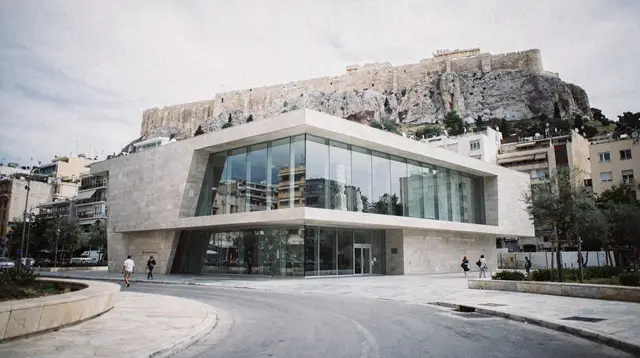
The hill gives you the physical settings — the trident mark, the Caryatids’ porch — but most of the sculptural evidence for these myths (the Parthenon frieze, the pediments) is in the Acropolis Museum rather than on the building itself. Pair the two for the fullest picture.
Culture & mythology tours in Athens
Verified deep-linked GetYourGuide tours. Book through these links and we earn a small commission at no cost to you.
GetYourGuide does not provide product photos: on its activity cards, the picture illustrates the type of experience and is not the operator's own photo.
More tours on Viator
Top-rated experiences with verified reviews, bookable on Viator (a Tripadvisor company).


