
The Oracle of Delphi: the complete story
What is the story of the Oracle of Delphi?
The Oracle of Delphi was a priestess (the Pythia) who sat above a chasm in the Temple of Apollo at Delphi and delivered prophecies on behalf of the god. She operated from at least the 8th century BC until 390 AD. Every major Greek city-state and many foreign kings consulted her before wars, colonisation expeditions, and political decisions.
The most powerful voice in the ancient world
For roughly a thousand years — from approximately 800 BC to 390 AD — the most important advisory institution in the ancient Mediterranean world was not an army, a navy, or a king. It was a woman sitting in a chamber underground at Delphi, on the slopes of Mount Parnassus in central Greece, inhaling vapours from a fissure in the earth and speaking words that were interpreted as the voice of the god Apollo.
This woman was the Pythia. Her responses — the Delphic oracles — shaped the founding of colonies across the Mediterranean, the outcomes of wars, the legitimacy of kings, and the philosophical traditions of ancient Greece. Herodotus, Thucydides, Plutarch, and dozens of other ancient writers treat the Oracle not as superstition but as a historical force. Understanding Delphi means understanding why the ancient Greeks gave an institution like this so much power, and how it actually worked.
| Where | Delphi, Mount Parnassus, ~2.5 hrs west of Athens |
| Active | c. 8th century BC – 390 AD |
| Site time needed | 1.5–2 hours for the main site |
| Best paired with | Arachova village or Meteora over 2 days |
| How to visit | Guided day tour, self-drive, or KTEL bus |
How the Oracle worked
The Pythia
The Pythia was not a single person but a succession of women chosen to fill the role, typically from a local Delphian family. In the Oracle’s peak period (roughly 600–300 BC), there were apparently three Pythiai serving simultaneously to meet demand. The requirements for the role varied across the centuries: in early accounts the Pythia had to be a young virgin; later sources describe middle-aged or older women serving.
The selection was based on character and local reputation rather than noble birth. The Pythia underwent purification before each consultation: bathing in the Castalia Spring (still visible at Delphi), fasting, and drinking from the sacred Kasotis spring. She then entered the inner sanctuary of the Temple of Apollo — the adyton, closed to all but her and certain priests — descended to a lower chamber, and sat on a tripod above a chasm in the earth.
Ancient sources describe the Pythia entering a state of divine possession — enthousiasmos, literally being filled with the god — before speaking. The words she spoke were interpreted and versified by priests called the Hosoi, who presented the oracle in response to the question posed.
The geological basis
For centuries, the ancient descriptions of vapour rising from a chasm at Delphi were treated as mythological embellishment. In 2001, a geological and chemical study by de Boer, Hale, and Chanton published in Geology confirmed the existence of two fault lines intersecting beneath the Temple of Apollo, and identified ethylene gas seeping from the fissure as a possible psychoactive agent consistent with ancient descriptions of the Pythia’s behaviour. This does not “explain away” the Oracle — it deepens the question of how the ancient Greeks understood the connection between physical phenomena and divine communication.
The questions and answers
Consultation was expensive and highly structured. Delegations from city-states and foreign kings paid substantial fees (pelanos) and performed sacrificial rituals before being admitted. Questions were typically posed in yes/no form or as choices: “Should we go to war with X or make peace?” “Is this site suitable for founding a colony?”
The Oracle’s responses were famously ambiguous. The most famous example: when Croesus of Lydia asked whether he should attack the Persian empire, the Oracle replied that if he did, “a great empire would be destroyed.” He attacked. A great empire was destroyed — his own. The Delphic ambiguity was not a failure of the system but a feature: it placed the interpretive burden on the questioner while protecting the Oracle’s credibility regardless of outcome.
The Oracle that most shaped Greek history came when the Athenians, facing the Persian invasion of 480 BC, were told to trust in “wooden walls.” The strategist Themistocles interpreted “wooden walls” as the Athenian fleet — and the naval victory at Salamis that followed, in which the Persian fleet was destroyed in the narrow straits near Athens, is arguably the most consequential battle in Western history.
Apollo at Delphi: the mythological foundation
Python and Apollo
The Oracle’s authority derived from Apollo’s ownership of Delphi — but the site had earlier associations with older earth deities, and Apollo had to establish his claim. The founding myth tells that the site was originally guarded by Python, a serpent (or dragon) child of Gaia (Earth), who served the original oracle at Delphi. Apollo killed Python with his arrows, claimed the site, and took the name Pythios (Killer of Python) — from which the Pythia derives her title.
The killing of Python is depicted on several red-figure vases in the National Archaeological Museum in Athens. The myth encodes a real historical transition: from a pre-Greek earth religion to the Olympian cult of Apollo. For the broader context of Greek myth and how it’s woven through the city’s sites, see the Greek mythology in Athens guide.
The omphalos
Apollo identified Delphi as the omphalos — the navel of the world. According to myth, Zeus released two eagles from opposite ends of the earth simultaneously, and they met directly above Delphi. A carved stone called the omphalos was placed in the Temple of Apollo to mark the spot. The original omphalos is in the Delphi Museum; a later copy stands in the archaeological site near its original position.
The Sacred Way
The path up through the Delphi site from the entrance to the Temple of Apollo is called the Sacred Way. In antiquity it was lined with dozens of treasuries — small temple-like buildings erected by individual city-states to house their votive offerings and to demonstrate their wealth and piety. The most complete surviving treasury is the Athenian Treasury (500 BC), built to commemorate the victory at Marathon. Its metopes depict the labours of Heracles and the exploits of Theseus — the two heroes most closely associated with Athens.
Walking the Sacred Way today, you pass the foundations of dozens of these treasuries, and the effect is of walking through a compressed history of the Greek world: Corinth, Siphnos, Thebes, Syracuse, Sparta, Athens — all competing for divine favor at the centre of the world.
The physical site today
The Delphi archaeological site sits at approximately 570 metres altitude on the southern slopes of Mount Parnassus, 2.5 hours west of Athens by car or bus. The site is compact — the main archaeological area can be walked in 1.5 to 2 hours — but the gradient is steep, with the Temple of Apollo partway up the slope and the stadium (where the Pythian Games were held every four years) at the top.
The principal monuments:
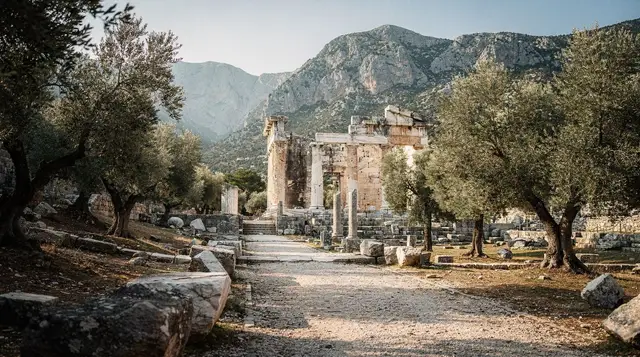
Temple of Apollo: The ruins visible today are from the 4th century BC (the third temple on the site; earlier structures were destroyed by earthquake and fire). Six columns of the original thirty-eight remain standing. The adyton where the Pythia sat is not accessible but is described in archaeological reports.
Theatre: Carved into the hillside immediately above the Temple of Apollo, seating 5,000, with a panoramic view south across the valley to the Gulf of Corinth. Still used occasionally for modern performances.
Stadium: 180 metres long, at the top of the site. The Pythian Games (athletics, music, poetry) were held here every four years; this is the second-largest festival in the ancient world after the Olympics.
Delphi Museum: At the entrance to the site, containing the finest archaeological finds from the sanctuary. The key objects include the Charioteer of Delphi (a near-intact bronze figure from 478 BC), the Naxian Sphinx (6th century BC), and the original omphalos.
Castalia Spring: Between the main site and the Marmaria (the Sanctuary of Athena Pronaia), a natural spring in a gorge where the Pythia and all pilgrims purified themselves before consulting the Oracle. The water is still flowing.
Sanctuary of Athena Pronaia: The area of the site below the road, which contains the famous Tholos of Delphi — a circular building of unknown function (possibly a hero shrine) from around 380 BC, three columns re-erected, and one of the most photographed ruins in Greece. Every visitor to Delphi photographs it; nobody is entirely sure what it was for.
Guided tours of Delphi from Athens
The distance from Athens (2.5 hours each way) makes a guided day trip the most efficient format for most visitors. A good guide makes the difference between seeing some old stones in a spectacular landscape and understanding why this particular site held the ancient world in its grip for a millennium.
The Delphi mythology and Arachova day tour combines the archaeological site with the mountain village of Arachova, the traditional stop for lunch and local cheese. The mythology focus means the guide covers the Oracle’s mechanism, the Apollo–Python myth, and the political history of the most significant oracles (the Croesus prophecy, the wooden walls of Athens, the Spartans at Thermopylae).
The Delphi Temple of Apollo and Oracle tour focuses specifically on the religious and philosophical dimensions of the Oracle — the Apollo cult, the meaning of the Delphic maxims (“Know thyself” and “Nothing in excess”), and the influence of Delphic religion on Socrates and Plato. This is the right choice for visitors with a specific interest in ancient philosophy or religion.
For the connection between Delphi and Athens in the context of democracy and philosophy, see the Athens democracy birthplace guide and the Athens history timeline.
For the practical logistics of the trip itself — travel time, tour options, and what else to combine with the site — see the dedicated Delphi day trip guide. The mountain village of Arachova, the traditional stop for lunch and local cheese on the way back to Athens, is worth an hour even if you’re not staying overnight.
The Delphic maxims
The Temple of Apollo at Delphi was inscribed with 147 maxims attributed to the Seven Sages of ancient Greece. The three most famous:
“Know thyself” (Gnothi seauton): Interpreted variously as a warning against hubris (know your place as a mortal before the gods) and as a Socratic invitation to philosophical self-examination. Socrates cited this maxim repeatedly as the foundation of his philosophical method.
“Nothing in excess” (Meden agan): The principle of moderation that underpins Aristotle’s concept of virtue as the mean between extremes.
“Surety brings ruin” (Eggua, para d’ata): The most practical: excessive confidence in others’ promises leads to disaster. This maxim was engraved above the entrance, the last thing you saw before consulting the Oracle.
Why the Oracle eventually fell silent
The Oracle’s decline was gradual rather than sudden. Roman-era writers, including Plutarch (himself a priest at Delphi in his later years), already wrote about the Oracle’s diminished authority compared to its Classical-era peak — fewer city-states consulted it as Roman power consolidated and local political independence declined. The famous story, recorded by Plutarch, of a ship’s captain hearing a voice cry “Great Pan is dead” during the reign of Tiberius has often been read as a symbolic marker of the old religion’s twilight, though it is almost certainly literary rather than literal.
The formal end came under the Christian Roman emperors. Theodosius I’s edicts against pagan worship in the late 4th century AD closed the sanctuary definitively around 390 AD, ending a continuous institution that had shaped Mediterranean politics for over a thousand years. Excavation of the site did not begin until the late 19th century, when the French School at Athens relocated the modern village of Kastri to uncover the ruins beneath it — the same French excavations that recovered the Charioteer of Delphi in 1896.
Delphi’s legacy in Western thought
The Oracle’s cultural afterlife extends well beyond archaeology. “Know thyself” became one of the most quoted phrases in Western philosophy, cited by thinkers from Socrates to Nietzsche. The idea of Delphi as the symbolic centre of the world persists in phrases like “delphic pronouncement,” used today for any statement that is deliberately, sometimes frustratingly, ambiguous — a direct linguistic legacy of the Pythia’s carefully hedged responses. Understanding this history adds a layer of meaning to a visit that a purely architectural reading of the ruins would miss entirely.
Frequently asked questions about the Oracle of Delphi
Was the Oracle real or was it theatre?
The institution was real, the political influence was real, and the geological basis for the Pythia’s altered state appears to have a physical foundation. Whether Apollo spoke through her depends on your theology. What is not in dispute is that the Delphic Oracle was consulted seriously by every major Greek state for a thousand years and that its answers demonstrably shaped political decisions that changed history.
How long does it take to visit Delphi from Athens?
Allow a full day. The drive is 2.5 hours each way; the site takes 2–3 hours. Organised tours handle the logistics and typically include a stop at Arachova. Self-driving is feasible; the intercity bus (KTEL) from Athens’s Liosion terminal takes 3 hours but runs only a few times daily.
Is Delphi worth visiting if I am only in Athens for three days?
For visitors with a specific interest in mythology, philosophy, or ancient religion — yes, absolutely. For a general first-time visitor to Greece, it is one of the best day trips available from Athens, but it competes with the Peloponnese (Mycenae, Epidaurus) and the islands. The best time to visit Athens guide and the destinations hub can help you prioritise.
What should I read before visiting Delphi?
Herodotus’s Histories (especially Books 1 and 7–8 for the Croesus and Thermopylae oracles), Plutarch’s essay “On the E at Delphi,” and Anne Carson’s translations of Pindar (who composed odes for Pythian Games victors) are the three best literary preparations. For practical archaeology, Michael Scott’s “Delphi: A History of the Centre of the Ancient World” (Princeton UP) is the standard contemporary reference.
What were the Pythian Games?
The second-most prestigious pan-Hellenic games after the Olympics, held at Delphi every four years in honour of Apollo. Unlike the Olympics, the Pythian Games included musical and poetic competitions as well as athletics. The prize was a laurel wreath (the origin of the tradition). The victors’ names were recorded and their cities celebrated them on return — Pindar’s victory odes (the Epinicians) are the surviving literature of this tradition.
Is a guided tour worth it for understanding the Oracle’s story?
Yes, more than at most archaeological sites. Delphi’s significance rests almost entirely on stories and religious practice rather than visually self-explanatory architecture — the ruins of the Temple of Apollo alone don’t convey why the Pythia’s pronouncements shaped Greek history for a millennium. A knowledgeable guide (or solid preparation beforehand, using this guide) makes a dramatic difference to how much the visit means.
Best day trips from Athens on GetYourGuide
Verified deep-linked GetYourGuide tours. Book through these links and we earn a small commission at no cost to you.
GetYourGuide does not provide product photos: on its activity cards, the picture illustrates the type of experience and is not the operator's own photo.
More tours on Viator
Top-rated experiences with verified reviews, bookable on Viator (a Tripadvisor company).


