
Combining Delphi and Meteora: the perfect 2-day circuit
Can you combine Delphi and Meteora in one trip from Athens?
Yes — and the combination is excellent. The standard circuit takes two days: Delphi on day one (west from Athens), overnight near Meteora, then Meteora monasteries on day two before returning to Athens. Or reverse it. Either way, you cover central Greece's two greatest sites in a single overnight loop.
Why Delphi and Meteora belong together
Delphi and Meteora are the two most compelling day trips from Athens — and they happen to sit on opposite sides of the same mountain range. Delphi clings to the slopes of Parnassus above the Gulf of Corinth; Meteora’s monastery-topped pillars rise from the Thessalian plain just beyond Parnassus’ northern flank. The straight-line distance between them is about 130 km; the drive via mountain passes takes roughly 2.5–3 hours.
This makes a two-day Athens–Delphi–Meteora–Athens circuit not just possible but genuinely elegant. You leave Athens, cross central Greece, see both UNESCO World Heritage Sites, and return having covered terrain most visitors never see.
This guide covers both route directions, organised tour options, where to sleep, and the honest time budget for each site.
| Where | Delphi (Mount Parnassus) and Meteora (Thessaly), central Greece |
| Cost | Around €140–€180/person for a 2-day organised tour with hotel |
| Time needed | 2 days minimum, 1 overnight near Meteora |
| Getting there | Self-drive, organised 2-day tour, or Athens–Kalambaka train + local logistics |
| Best time | Spring or early autumn, avoiding icy mountain roads in winter |
Route Option A: Athens → Delphi → Meteora → Athens
This is the more commonly used direction and the one most organised tours follow.
Day 1: Athens to Delphi (and overnight near Meteora)
Morning departure from Athens (07:30): Take the E962 motorway north-west toward Thiva (Thebes) and then through Livadia and up the mountain road to Delphi. Distance: 178 km, approximately 2.5 hours.
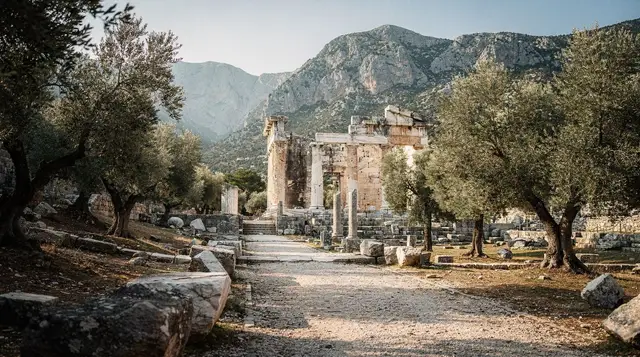
09:30–13:00 — Delphi: Arrive before the main tour coaches. Visit the archaeological site (the Sacred Way, Treasury of Athens, Temple of Apollo, theatre, stadium) and the Delphi Archaeological Museum. With the Athena Pronaia sanctuary below, the visit takes 3–3.5 hours at a good pace.
13:00–14:00 — Lunch in Delphi or Arachova: Arachova is 10 km above Delphi on the E65. The village has excellent mountain tavernas — good lamb, local wine, and honeys. A natural stopping point.
14:00–17:30 — Drive to Kalambaka: From Arachova/Delphi, take the E65 north through Amfissa and across the Thessalian foothills to Kalambaka. Distance: approximately 190 km, 2.5–3 hours via the mountain roads. This is the most scenic part of the circuit — passing through the agricultural flatlands of Thessaly with the Pindus mountains to the west.
Evening: Check in to accommodation in Kalambaka or the village of Kastraki. Dinner in Kastraki, with the rock formations above you catching the last light.
Day 2: Meteora monasteries and return to Athens
Morning: Visit 3–4 monasteries. Great Meteoron (the largest, closes Tuesdays) and Varlaam (closes Fridays) are the essential two. Roussanou convent and Agios Nikolaos Anapafsas are excellent additions. The morning light on the rocks before 10:00 is remarkable.
Midday: Leave Kalambaka southbound on the E75 motorway.
Option — direct return to Athens (3.5 hours): Via the E75 south, arriving Athens by 17:00–17:30.
Option — add Thermopylae stop: The famous pass and battlefield is directly on the E75 between Kalambaka and Athens, about 80 minutes south of Kalambaka. The monument, the hill of the last stand, and the small museum take about 1 hour.
Route Option B: Athens → Meteora → Delphi → Athens
This reverse direction works well if you want to arrive at Meteora in the afternoon/evening of day one (catching sunset over the rocks from Kastraki) and do a full morning at the monasteries before heading south to Delphi.
Day 1: Athens to Meteora
Depart Athens by 06:30 on the E75 north. Reach Kalambaka by 10:00–10:30. Check in, and visit 2–3 monasteries in the afternoon. Evening in Kastraki — the village ambience at dusk with the formations above is superb.
Day 2: Meteora morning and Delphi afternoon
Visit the remaining monasteries in the morning (those you didn’t see yesterday). Depart Kalambaka by 12:30–13:00 southbound, but instead of following the E75 back to Athens, turn west at Lamia and take the E65 west toward Amfissa and Delphi. This adds approximately 40 km versus the direct Athens return.
Arrive Delphi approximately 16:00–17:00. Visit the Athena Pronaia sanctuary (well-lit in late afternoon) and walk the Sacred Way with fewer crowds. The museum closes earlier — check hours. Evening drive back to Athens via the E962.
Honest assessment: Route B requires good time management on day two. Arriving at Delphi after 16:00 means the museum may be closed. Route A is slightly more comfortable.
Organised tours for the Delphi–Meteora combo
Several well-established Athens operators run this exact two-day circuit with hotel accommodation included.
2-day Meteora and Delphi tour with hotelThis covers both sites with a licensed guide, hotel accommodation in Kalambaka (usually half-board), and all transport. It represents genuinely good value — the guide context at both Delphi and the monasteries adds significant depth.
2-day Meteora with Thermopylae and DelphiThis version adds the Thermopylae stop on the return leg — recommended for those with a serious interest in Greek military history.
Athens–Delphi–Meteora 2-day loopAnother strong option with flexible routing.
How to get between Delphi and Meteora independently
By car: Delphi to Kalambaka is approximately 190 km via Amfissa–Lamia–Trikala. The roads are good — the first hour through the mountains is winding but scenic; the last hour across the Thessalian plain is fast. Google Maps shows this at 2.5–3 hours.
By public transport: There is no direct bus between Delphi and Kalambaka. You would need to bus back to Athens and then take the Meteora train — which converts the circuit into three travel days. Self-drive or organised tour is strongly recommended for this combination.
Where to stay between Delphi and Meteora
Kalambaka and the village of Kastraki (2 km north, right below the rocks) are the standard overnight bases.
Kastraki: Quieter, more atmospheric, several family guesthouses with terrace views of the formations. Best for those who want to wake up with the rocks in front of them.
Kalambaka: More hotel options, better restaurant variety, easier access to the train station. Fine for practical travellers.
Book at least 2–3 weeks ahead in July–August. In shoulder season (May–June, September–October), a week ahead is usually enough.
Costs: the 2-day Delphi–Meteora circuit
| Item | Approximate cost |
|---|---|
| Organised 2-day tour (with hotel) | €140–€180 per person |
| Car hire (2 days) | €80–€140 |
| Motorway tolls | €15–€20 |
| 1 night hotel in Kastraki | €70–€120 |
| Delphi entry (site + museum) | €20 |
| Meteora monasteries (3 x €3) | €9 |
| Meals (2 days) | €40–€60 per person |
Practical tips
Delphi timing: Arrive at Delphi before 09:30 to beat the coach groups. The site gets very busy between 10:30 and 14:00 in peak season. Morning light also gives the best photography conditions with the valley views.
Meteora timing: Similarly, the monasteries before 09:00 and after 15:00 are dramatically less crowded than midday. The two-day format lets you split your monastery visits to catch both time windows.
Monastery check: Each monastery closes one or two days per week. Great Meteoron closes Tuesday; Varlaam closes Friday. With two days at Meteora you have enough flexibility to work around closures.
Mountain driving: The roads between Delphi and Kalambaka involve mountain passes that can be icy in winter (November–March). Check road conditions if travelling out of season.
For individual site details, read the Delphi day trip guide and the Meteora 2-day trip guide. For the broader picture, see the best day trips from Athens overview.
Fitting the combo into a longer Greece itinerary
If you have four days or more in central Greece rather than a strict two-day window, the Athens Delphi Meteora 4-day itinerary spreads the driving out and adds a proper second night at each site, which matters if you want to see all six active Meteora monasteries rather than the usual three or four. Travellers building a longer national trip sometimes also weigh this circuit against the Peloponnese loop covering Mycenae, Epidaurus and Nafplio — that route stays closer to Athens and suits a single very long day, while Delphi–Meteora requires the overnight but delivers more dramatic scenery.
Should you rent a car or take the train partway?
Self-driving gives full control over timing, especially for catching the early-morning light at both sites before the tour coaches arrive. The alternative is the train from Athens to Kalambaka (around 4.5 hours), which handles the Meteora leg well but leaves you needing a taxi, local tour, or second train/bus connection to reach Delphi — a detour with its own connections that rarely saves time over a hire car. For most visitors without a strong preference, a hire car or the organised 2-day tour remains the simplest way to link the two sites without wasted transit hours.
Frequently asked questions about the Delphi–Meteora combo
Which should I visit first — Delphi or Meteora?
Most organised tours visit Delphi first (it’s closer to Athens and on the westward route), but both orders work. If arriving at Meteora in the evening matters to you (sunset over the rocks from Kastraki), do Meteora first and Delphi on the return. If you want a full morning at Delphi before crowds arrive, do Delphi first.
Can I do Delphi and Meteora in one day?
No. The two sites are 190 km apart and in different directions from Athens. Doing both in a single day is not feasible. The minimum sensible itinerary is two days with one overnight.
Is an organised tour worth it over self-driving?
If you want the licensed guide context at both Delphi (mythology of the oracle, Pythia, the Pythian Games) and Meteora (Byzantine monastic history, Orthodox iconography), a guide-led tour adds enormous value. If you’re confident drivers and prefer flexibility, self-drive is equally valid — the sites themselves are well-interpreted in English.
What if I only have time for one of the two?
Delphi is generally ranked above Meteora for overall archaeological importance and the combination of site + museum + landscape. But Meteora’s visual impact — the rock formations alone, before you even enter a monastery — is harder to convey in photos. Most visitors who see both say Meteora’s setting is unlike anything else; Delphi’s historical resonance is deeper.
Is Thermopylae worth adding?
For visitors with a specific interest in the Persian Wars, yes — the Thermopylae monument and hillside are moving in a way that’s different from Delphi and Meteora. For general travellers, it’s an efficient 60-minute add-on that does not significantly extend the journey. The “Hot Gates” site (now well inland from the sea due to millennia of sediment deposit) requires some imagination, but the memorial to the 300 Spartans is powerful.
What is the Osios Loukas monastery?
Osios Loukas is a Byzantine monastery 30 km south-east of Delphi, dating to the 10th century. It contains some of the finest Byzantine mosaics surviving in Greece. On the Delphi–Meteora circuit, it makes a possible morning detour before continuing north. See the dedicated tour option that includes both:
Delphi and Osios Loukas monastery tourIs this trip suitable for a first visit to Greece?
Yes, but it works best as an addition to Athens rather than a replacement for it — most first-time visitors should secure 2–3 days in Athens itself before heading out on this circuit. If your total trip is short, consider whether a single-site day trip (just Delphi, or just Meteora in its one-day version) fits your schedule better than committing an overnight to both.
Best day trips from Athens on GetYourGuide
Verified deep-linked GetYourGuide tours. Book through these links and we earn a small commission at no cost to you.
GetYourGuide does not provide product photos: on its activity cards, the picture illustrates the type of experience and is not the operator's own photo.
More tours on Viator
Top-rated experiences with verified reviews, bookable on Viator (a Tripadvisor company).
 Viator
Santorini Catamaran Cruise with Swim-Stops, Greek Meal and Sunset
FromEUR 150Check availability → Viator
Meteora Sunset with Monastery & Hermit Caves Tour in Small Group
FromEUR 35Check availability → Viator
Meteora Small Group Hiking tour with Transfer and Monastery Visit
FromEUR 35Check availability → Viator