Athens, Delphi, and Meteora: 4-day UNESCO itinerary
How this itinerary works
This four-day route visits three of Greece’s most extraordinary places: Athens (the ancient city), Delphi (the oracle sanctuary on the slopes of Parnassus), and Meteora (the rock-pillar monasteries of Thessaly). All three are Unesco World Heritage Sites. None requires a car — Delphi is a day trip from Athens, and Meteora is reachable by train from Athens in 4 hours and by day trip in a very long day. This itinerary splits the difference: Day 1 in Athens, Day 2 to Delphi, Day 3–4 in Meteora overnight (strongly recommended over a day trip — the monasteries at sunrise and sunset are utterly different from the midday tourist experience). Total walking: 15–18 km over the four days, including uphill paths at both Delphi and Meteora.
| Where | Athens → Delphi (178km NW) → Kalambaka/Meteora (via Athens, ~355km NW) |
| Cost | Around €500–750pp for 4 days incl. day trip, train, entries and meals |
| Getting there | Delphi by organised day trip; Meteora by InterCity train (~4hrs, €20–28) |
| Best time | April–June or September–October |
| Dress code | Knees and shoulders covered at every Meteora monastery — no exceptions |
| Day | Focus | Overnight |
|---|---|---|
| 1 | Acropolis, museum, Ancient Agora, Plaka | Athens |
| 2 | Delphi day trip (sanctuary, museum, Charioteer) | Athens |
| 3 | Train to Kalambaka, afternoon monasteries, sunset viewpoint | Kalambaka |
| 4 | Sunrise monasteries, train back to Athens | — |
Day 1: Athens — the Acropolis as a foundation
Morning — Acropolis early (07:30–12:00)
Begin the itinerary as every Athens visit should: at the Beulé Gate by 07:30, through the gate at 08:00, and on the hill for 90 minutes before the heat and crowds build. The Acropolis provides the visual and intellectual frame for everything that follows — Delphi and the Athenian Treasury there, Meteora and the ancient Greek relationship between sacred landscape and the divine. Knowing the Parthenon makes both later sites richer.
Pre-book entry:
Pre-booked Acropolis ticket — essential in summerA guided combination of the Acropolis, museum, and five surrounding sites is efficient on a tight schedule:
Acropolis + 5 sites combo guided tourSpend 75 minutes in the Acropolis Museum after the hill (entry ~€15). Focus on the Parthenon Gallery top floor and the Archaic Kore statues on the middle floor — both are relevant to what you will see at Delphi tomorrow. See our Acropolis Museum guide.
Afternoon — Ancient Agora and Plaka (13:00–18:00)
Lunch in Plaka (€14–18 per person), then 60 minutes in the Ancient Agora (combo ticket). The Temple of Hephaestus and the Stoa of Attalos museum are the priorities. Walk through Monastiraki for the flea market and a coffee, then early dinner in Psyrri (€35–45 for two). Early night — Delphi day starts early.
Day 2: Delphi — the oracle at the centre of the world
Getting there (07:30–10:00)
The guided day trip from Athens to Delphi is the most practical option: departure 08:00–08:30, arrival at the site 10:30–11:00, a full three hours at the sanctuary and museum, return to Athens by 19:00–20:00. Book this well ahead — the small-group tours fill up in spring and summer:
Delphi guided day tour from AthensAlternatively, the combined Athens–Delphi–Meteora 2-day tour is an option if you want everything in one booking:
Athens–Delphi–Meteora 2-day guided tourThe coach north from Athens crosses the Boeotian plain, then climbs into the mountain landscape of Parnassus. The approach to Delphi from the main road — the sanctuary visible as a terrace on the cliff face below the Phaedriades (the “shining rocks”) — is one of the great arrival moments in ancient Greek travel.
At Delphi (10:30–16:30)
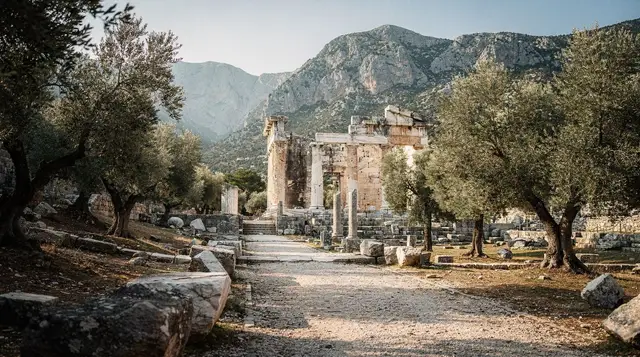
Delphi sits at 570 metres on the southern slope of Parnassus, where the Phaedriades cliffs drop to the olive-green valley of the Pleistos river below, and the Gulf of Corinth is visible as a silver line on the horizon. The ancient Greeks believed it was the centre of the world — they found the spot by releasing two eagles from opposite ends of the earth and marking where they met.
Sacred Way: The processional road climbing from the entrance past the treasury buildings. The reconstructed Athenian Treasury (built with the spoils of Marathon in 490 BC) shows what most of the treasuries would have looked like — small, jewel-like buildings packed with offerings from Greek cities across the Mediterranean.
Temple of Apollo: The 4th-century BC temple is largely reduced to its platform and six standing columns, but the setting — backed by the Phaedriades cliffs, facing the valley and sea — is incomparable. The Pythia (oracle) sat inside the inner sanctuary (adyton) in vapours from the earth, and the answers she gave here shaped Greek history for 800 years.
Theatre: 35 rows of limestone seating climbing the hill above the temple, with the sanctuary and the valley below as the backdrop. Built in the 4th century BC, expanded in the Roman period.
Stadium: A 15-minute climb above the theatre, and worth every step — the best-preserved ancient Greek stadium outside Olympia, seating 6,500 people for the Pythian Games (held every four years, four years after the Olympics).
Delphi Museum: Equally important as the sanctuary. The Charioteer of Delphi (478 BC) — a life-size bronze with inlaid glass-paste eyes, the finest surviving bronze of the Classical period. The Siphnian Treasury frieze. The Omphalos stone (the original navel of the world). The Antinoos portrait head. Allow 60–75 minutes.
Return to Athens for dinner, or if you are doing the 2-day tour, overnight in the small town of Delphi or Arachova (the atmospheric mountain village 10 km east — considerably more character than Delphi town).
Day 3: Train to Kalambaka — Meteora by afternoon and evening
Morning — Athens to Kalambaka by train (07:00–11:00)
The train from Athens Larissa station to Kalambaka (the town at the base of the Meteora rocks) takes 4–4.5 hours and costs ~€20–28 (InterCity express; book ahead on trainose.gr). The journey crosses the Thessalian plain and ends with the Meteora pillars rising from the flatland in front of you — one of the most dramatic railway arrivals in Europe.
Alternatively, if you have already booked the [athens-delphi-meteora-2day-t700] tour, the second day handles the Meteora visit on a structured programme.
Arrive in Kalambaka at 11:00–11:30. Drop your bag at a guesthouse or small hotel (book ahead — options are limited). Lunch in town (€12–16 per person; the local restaurants serve good grilled trout from the Pindus rivers).
Afternoon — Meteora monasteries (13:00–18:00)
Meteora — literally “suspended in the air” — is a geological formation of 60-million-year-old sandstone pillars rising 400 metres from the plain. Between the 14th and 16th centuries AD, Byzantine monks built monasteries on top of the most inaccessible ones, hauling construction materials up in rope nets. Of the original 24 monasteries, six remain active today.
The afternoon circuit covers the most accessible monasteries by the road that winds between the rocks:
- Great Meteoron (the largest and oldest, 14th century; dress modestly — free shawls provided at entrance; entry ~€5)
- Varlaam (16th century; best-preserved interior frescoes, the original rope-net mechanism displayed)
- Rousanou (built on the narrowest pinnacle; nuns’ monastery; the exterior view from the road is as remarkable as the interior)
Each monastery requires a short climb from the parking area or road — 50–200 steps depending on which. Wear closed shoes. The combined walk between the three in the afternoon is 3–4 km.
The late-afternoon light — when the direct sun hits the rock faces and the shadows of the pillars stretch across the plain below — is the best visual window of the day.
Evening — Sunset viewpoint (18:00–20:00)
The viewpoint above Kastraki village (15 minutes on foot from Kalambaka) offers the classic Meteora photograph: all six monasteries and their columns framed against the setting sun. This is the most visited viewpoint in Meteora at sunset — arrive 30–45 minutes early for a good position.
Dinner in Kalambaka town (€25–35 for two). Sleep well — Day 4 starts at dawn.
Day 4: Meteora at sunrise, then return to Athens
Dawn — Sunrise at the rocks (06:00–08:30)
Sunrise at Meteora is the experience that justifies the overnight stay over the day trip. By 06:00 the light is changing from grey to gold, the plain below is still misty, and the monastery windows catch the first horizontal light. The monastery steps and viewpoints are entirely empty. The rocks that look monumental in daylight look surreal at dawn — more like a painting than a landscape.
The Agios Nikolaos Anapafsas monastery on the east side of the complex opens earliest (07:00; entry ~€4). Its tiny interior holds some of the finest 16th-century frescoes in Greece, the work of the Cretan painter Theophanis.
Morning — Remaining monasteries (08:30–12:00)
Holy Trinity Monastery (Agia Triada) — the most dramatically positioned of all, reached by 140 steps cut into the rock face. This is the monastery used in the James Bond film “For Your Eyes Only” — recognisable from the exterior views. The interior church is small but has well-preserved 17th-century frescoes. View from the terrace south toward Kalambaka is extraordinary.
Agios Stefanos — a nuns’ monastery on the eastern edge of the complex, with a road-level entrance (the only one not requiring a climb). The 15th-century church interior and the museum of Byzantine ecclesiastical objects are both excellent.
Return to Athens (13:00–17:30)
Lunch in Kalambaka, then the train back to Athens Larissa station (departs ~13:30–14:00, arrives ~17:30–18:00). You will be back in Athens for an early dinner and a final evening in the city.
Dinner recommendation: a quieter neighbourhood meal in Koukaki or Thissio — both are low-key and pleasant for a last evening after four days of serious travel.
Delphi vs Meteora if you can only choose one
Both are extraordinary, but they reward different interests. Delphi suits travellers drawn to mythology, oracle history, and classical sculpture — it is more intellectually dense and works well as a single day trip. Meteora suits travellers who want dramatic landscape and living monastic culture, and genuinely needs the overnight stay to deliver its best light. If your schedule only allows one, read our Delphi vs Meteora comparison for a fuller breakdown before deciding, or consider the combined Meteora day trip from Athens and Combining Delphi and Meteora: the perfect 2-day circuit guides for compressed alternatives.
Frequently asked questions about Athens, Delphi, and Meteora
Can Meteora be done as a day trip instead of overnight? Yes, organised day-trip coaches from Athens run to Meteora, but they typically allow only 4–5 hours at the rocks and involve a very long day (departure before 07:00, return after 22:00). The overnight version in this itinerary gives you both sunset and sunrise light, which is the real reason to visit Meteora rather than simply tick it off. See Meteora 2-day trip from Athens for the structured 2-day tour alternative to the independent train version used here.
What should I wear to visit the Meteora monasteries? Knees and shoulders must be covered at every monastery; most lend wrap skirts and shawls at the entrance for anyone in shorts or sleeveless tops, but do not rely on availability at busy times. Closed shoes are essential for the stone steps, some of which run to 140 steps at the more dramatically sited monasteries.
Practical tips
Monasteries dress code: Both men and women must cover knees and shoulders. Women must wear skirts (most monasteries lend them at the entrance). Shorts and sleeveless tops are not permitted. This applies strictly.
Meteora opening hours: Most monasteries open 09:00–17:00, with varying closure days (different monasteries close on different days of the week to give monks/nuns time for religious observance — check individual monastery schedules before your visit).
Kalambaka accommodation: Book 3–4 months ahead for summer visits. Options range from small family guesthouses (€60–80 per night) to comfortable hotels with Meteora-view terraces (€120–180). The best Meteora views are from Kastraki village, 2 km from Kalambaka.
Train booking: Book Kalambaka trains on trainose.gr at least a week ahead. The InterCity service is comfortable and punctual.
Day trip vs overnight: A day trip to Meteora from Athens (offered as an excursion) gives you roughly 4–5 hours at the rocks. Overnight gives you two full windows of light. The difference is significant — overnight is strongly recommended.
Delphi independently: KTEL buses from Terminal B in Athens (Line to Delphi/Amfissa, €17 one way, 3 hours) if you prefer self-guided. The site and museum require a combined ticket (~€24). See our Delphi day trip from Athens guide.
Best day trips from Athens on GetYourGuide
Verified deep-linked GetYourGuide tours. Book through these links and we earn a small commission at no cost to you.
GetYourGuide does not provide product photos: on its activity cards, the picture illustrates the type of experience and is not the operator's own photo.