
Acropolis Museum guide: what to see and is it worth it
Is the Acropolis Museum worth visiting?
Absolutely. The Acropolis Museum holds the finest surviving sculptures from the Athenian Acropolis, including original Caryatids and 160 metres of Parthenon frieze. Plan two hours minimum. It is one of the most rewarding museum visits in Europe.
Why the Acropolis Museum deserves two hours of your Athens trip
The Acropolis Museum opened in 2009 on the southern slope of the Acropolis hill, purpose-built to house the sculptures and artefacts recovered from the sacred rock above. Before it existed, original pieces were scattered between basement storage, the old on-site museum, and the British Museum in London. Today, walking through this building is the clearest way to understand what the Acropolis actually looked like at its fifth-century BC peak.
| Where | Dionysiou Areopagitou 15, 5 min walk from Acropolis metro |
| Cost | €20 full price, €10 reduced |
| Time needed | 2–2.5 hours self-guided, around 90 minutes with a guided group |
| Getting there | 7-minute walk from Plaka, 20 minutes on foot or one metro stop from Syntagma |
| Best time | Weekday mornings right at opening, or the late Friday opening (until 22:00) |
The building itself is a statement. Swiss architect Bernard Tschumi designed it so the top floor is rotated to align with the Parthenon, which you can see through full-height glass walls while standing beside the frieze. Below the entrance, a glass floor reveals an ongoing excavation of an ancient Athenian neighbourhood. You step over 2,500-year-old streets before you even buy your ticket.
It is not the largest museum in Athens — the National Archaeological Museum holds that title — but the Acropolis Museum is more focused, more theatrical, and arguably more moving.
Practical information for 2026
Address: Dionysiou Areopagitou 15, Athens. A five-minute walk from the Acropolis metro station (red line).
Opening hours: From April to October, Monday 09:00–17:00 and Tuesday to Sunday 09:00–20:00; from November to March, Monday to Thursday 09:00–17:00 and Saturday–Sunday 09:00–20:00. Year-round, the museum stays open until 22:00 on Fridays. It is closed on 1 January, Orthodox Easter Sunday, 1 May, and 25–26 December. Check the official website before you go, as hours change on holidays.
Admission in 2026:
- Full price: €20
- Reduced: €10 (eligibility conditions on the museum’s official website)
- Free admission days: 6 March, 25 March, 18 May, and 28 October
Combination tickets: For the Acropolis site and other archaeological sites, check the current combined tickets on the official ticketing site, hhticket.gr. Museum tickets themselves are sold on the museum’s own website.
Book an Acropolis Museum combo ticketAllow two to two-and-a-half hours for a thorough self-guided visit. A guided group tour typically runs 90 minutes to two hours and covers the highlights efficiently.
Join a small-group guided tour of the Acropolis MuseumFloor by floor: what you will actually see
Ground floor — the Acropolis slopes
The visit begins before you are even inside. From the entrance walkway, look down through glass panels at the archaeological excavation. Visible ruins include ancient roads, workshops, and household wells. This neighbourhood was occupied continuously from the fifth century BC to the twelfth century AD.
Inside, the ground floor displays artefacts found on the slopes of the Acropolis itself: pottery, small bronzes, and architectural fragments from sanctuaries that predate the Parthenon. The sculptural programme here already gives you a sense of scale — fragments of pediments, relief panels from the Sanctuary of Asclepius, and a series of archaic korai (votive female figures) with their painted surfaces still partially intact.
First floor — the Archaic Acropolis gallery
This long, ramp-accessed gallery contains some of the museum’s most arresting pieces: the archaic pediment sculptures from before the Persian destruction of 480 BC. The Moschophoros (the Calf-Bearer), dated to around 570 BC, is a strikingly human image of a man carrying a sacrificial calf across his shoulders. Nearby, the Peplos Kore — a painted female figure from around 530 BC — retains traces of red and blue pigment that remind you these were not the white marble objects we imagine.
The Kritios Boy (c. 480 BC) marks a turning point: this is one of the earliest sculptures to show the body in contrapposto, with weight shifted to one leg. Art historians read it as the threshold between archaic rigidity and the naturalism of the Classical period. That transition, visible in a single room, is reason enough to visit.
Top floor — the Parthenon Gallery
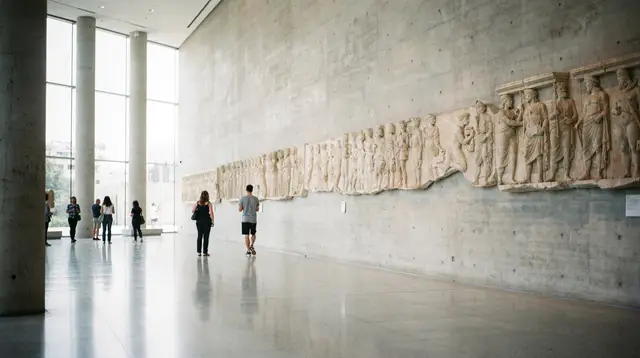
The centrepiece of the museum and one of the great rooms in any museum anywhere. The top floor is a glass-walled rectangle oriented on the same axis as the Parthenon itself, visible through the windows as you walk. Around the perimeter, 160 metres of the original Parthenon frieze are displayed at eye level — the height at which they were never meant to be seen in antiquity, where they sat 12 metres above the colonnade.
The frieze depicts the Panathenaic Procession, the city’s great religious festival. About half the surviving pieces are originals; the rest are plaster casts of sections now in London, Paris, and other European museums. The originals are distinguished by a warm honey tone against the whiter casts, making the missing sections immediately apparent. This is a deliberate choice by the museum.
The pediment sculptures — the birth of Athena from Zeus’s head, and the contest between Athena and Poseidon for the patronage of Athens — are displayed in the centre of the room. Several figures are heavily damaged, but the compositional logic still reads clearly.
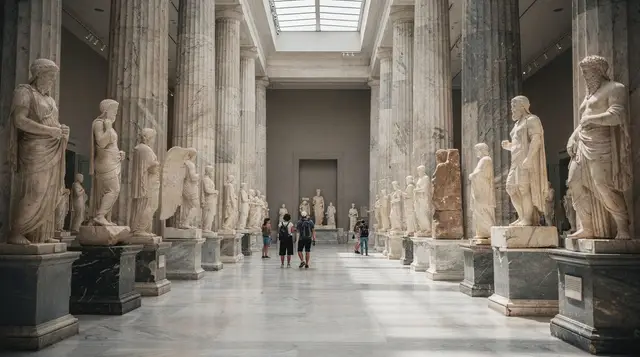
The four original Caryatids (the porch columns in female form) from the Erechtheion stand in a separate enclosed section at one end of the gallery. They are smaller than most visitors expect: about 2.3 metres tall. The sixth Caryatid is in the British Museum; her absence is marked by an empty plinth.
Book a guided tour of the Acropolis MuseumAudio guides and self-guided options
The museum offers a well-produced audio guide (€5) available at the entrance in English, Greek, French, German, Spanish, and other languages. It covers around 30 objects and takes approximately 90 minutes to complete. The narration is academic but accessible.
Several tour operators also offer skip-the-line entry combined with a licensed guide, which can be worth the premium during peak summer months when ticket queues run 20–30 minutes.
Get entry plus an audio guide for the Acropolis MuseumThe museum café and bookshop
The rooftop café has an unobstructed view of the Acropolis and serves decent coffee and light meals. Prices are tourist-level (€5–8 for a drink and snack) but the terrace is one of the better spots in central Athens for that view. The bookshop on the ground floor stocks serious academic titles on Greek art alongside standard souvenirs.
Combining the Acropolis Museum with the Acropolis site
The logical sequence is to visit the Acropolis site first, then walk downhill to the museum. Seeing the Parthenon in person — even without its sculptures — gives you a physical sense of scale before you encounter the fragments close-up. The museum has its own ticket. Plan a full morning for the site, then two hours for the museum in the early afternoon, with a break in Plaka in between.
From Plaka, the museum is a seven-minute walk south. From Syntagma, allow 20 minutes on foot or take the metro one stop to Acropolis.
If rain is in the forecast, the museum is one of the best things to do in Athens on a rainy day: entirely indoors, easily filling three hours, and far less crowded than on a clear day.
How the Acropolis Museum fits into a broader museum itinerary
Athens has more world-class museums per square kilometre than most European capitals. If you are interested in ancient Greece beyond the Acropolis specifically, the National Archaeological Museum is the essential next stop — it covers all of Greek prehistory and antiquity. For a broader picture of Greek culture across different periods, see the museums of Athens overview.
The Museum of Cycladic Art in Kolonaki makes a compelling half-day companion visit for its prehistoric marble figurines. The Benaki Museum covers Greek culture from prehistory to the twentieth century in a single building.
Self-guided, audio guide, or licensed tour: which fits your visit
| Option | Best for | Roughly | Time |
|---|---|---|---|
| Self-guided with panels | Independent pace, reading everything | Ticket only, €20 | 2–2.5 hours |
| Ticket + audio guide | Depth without a group | Ticket + around €5 | Around 90 minutes |
| Small-group guided tour | Context from a licensed guide, no reading | Tour price, entry usually included | 90 min–2 hours |
| Skip-the-line combo (site + museum) | First visit, limited time, peak summer | Varies by operator | Half day for both |
None of these is objectively “best” — a first-time visitor short on time gets the most out of a guided combo, while a returning visitor who already knows the site benefits more from the unhurried self-guided pace with the audio guide filling in detail.
Best time to visit and avoiding crowds
The museum is busiest between 10:00 and 13:00, when tour groups arrive after finishing the Acropolis site above. Arriving right at the 09:00 opening, or after 15:00, generally means shorter queues at the ticket desk and a quieter Parthenon Gallery. The late Friday opening (until 22:00) are consistently the calmest slot of the week — a good option if your schedule allows an evening visit and you want the top-floor frieze without a crowd blocking the glass wall to the Parthenon itself.
Cruise-ship days at Piraeus tend to push extra visitors toward both the Acropolis and its museum in a single mid-morning wave; if you are not on a fixed shore-excursion schedule, shifting your visit to the afternoon avoids the worst of it.
Frequently asked questions about the Acropolis Museum
Do I need to book tickets in advance?
In July and August, queues at the door can reach 30–40 minutes. Online booking (etickets.theacropolismuseum.gr) lets you choose an entry time slot. From October through April, walk-up entry is usually immediate.
Is photography allowed inside?
Yes, personal photography without flash or tripods is permitted throughout the museum, including the Parthenon Gallery. Commercial photography requires a separate permit.
How does the Acropolis Museum compare to the British Museum’s Elgin Marbles?
The Acropolis Museum was explicitly designed to make the case for reunification. The plaster casts alongside originals in the Parthenon Gallery visually demonstrate what is missing. The British Museum displays its pieces in the Duveen Gallery — fine context, but no view of the Parthenon. The Acropolis Museum experience is more emotionally coherent; the British Museum sections are more detailed in their didactic labelling.
Are there lockers for bags?
Yes, free bag storage lockers are available at the entrance. Large backpacks must be stored before entry.
Is the museum accessible for visitors with mobility issues?
The building is fully accessible. Ramps connect all floors, and the audio guide is available in formats for visitors with hearing impairments. Wheelchairs are available on request at the entrance desk.
Can children visit, and is it engaging for them?
Children under 18 enter free. The museum provides a dedicated children’s activity booklet (available in Greek and English) that encourages close observation of specific objects. The ground-floor excavation visible through glass tends to fascinate younger visitors. Allow around 90 minutes for a family visit rather than the full two-plus hours.
Is the Acropolis Museum better than the Acropolis site itself?
They answer different questions rather than compete. The site gives you the physical scale and the view; the museum gives you the detail — faces, folds of drapery, and the original colour traces you simply cannot see on the weathered marble up on the rock. Our Acropolis vs Acropolis Museum guide breaks down which to prioritise if you truly only have time for one.
How much time should I leave between the Acropolis site and the museum?
A short break works well rather than rushing straight downhill. Grab a coffee in Plaka or on the museum’s own rooftop terrace before starting the galleries — the site visit is physically tiring in summer heat, and the museum rewards a fresher pair of eyes.
Athens museums & heritage on GetYourGuide
Verified deep-linked GetYourGuide tours. Book through these links and we earn a small commission at no cost to you.
GetYourGuide does not provide product photos: on its activity cards, the picture illustrates the type of experience and is not the operator's own photo.

More tours on Viator
Top-rated experiences with verified reviews, bookable on Viator (a Tripadvisor company).
 Viator
Knossos Palace, Museum & Rethymno city Private Tour from Chania
FromEUR 540Check availability → Viator
Santorini Small Group Guided E-bike Tour & Local Tomato Museum
FromEUR 130Check availability → Viator
Acropolis & Acropolis Museum Group tour in German
FromEUR 129Check availability → Viator