Acropolis vs the Acropolis Museum: which should you visit first?
Should I visit the Acropolis or the Acropolis Museum first?
Visit the Acropolis first (go at opening, 8 am), then the Acropolis Museum immediately after. The site gives you the physical experience and scale; the museum explains what everything meant and displays the original sculptures. In that order, the museum deepens what you just saw. Reversed, the context is excellent but the site can feel anticlimactic.
Two extraordinary experiences — and they are not interchangeable
A common question from visitors planning Athens: do I need to visit both the Acropolis hill and the Acropolis Museum, or is one enough? The answer is that they are genuinely complementary rather than duplicating each other, and both are worth your time. But they offer radically different experiences, and the order in which you visit matters significantly.
| Where | Both on Dionysiou Areopagitou; the museum sits at the foot of the hill |
| Cost | €30 for the site, €20 for the museum |
| Time needed | Budget roughly 1.5–2.5 hours for each |
| Getting there | Akropoli metro station (Line 2, red), short walk to either |
| Best time | Site at 8 am opening; museum any time, quieter than the site |
The Acropolis is an outdoor archaeological site on a 156-metre limestone hill. It contains the standing ruins of the Parthenon, the Erechtheion with its Caryatid porch, the Propylaea gateway, and the Temple of Athena Nike — all set against a panorama of Athens and the Aegean. The physical scale, the position, and the view are irreplaceable.
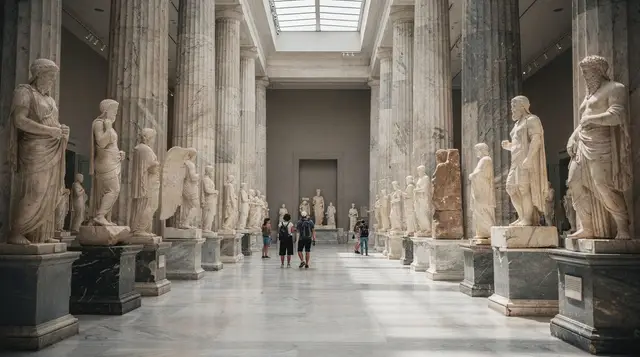
The Acropolis Museum is a purpose-built contemporary museum completed in 2009, positioned at the foot of the hill. It houses the original sculptures and architectural fragments from the Acropolis that have survived — many of them never publicly displayed before the museum opened — alongside the world’s most direct and sustained argument for the return of the Elgin Marbles.
What the site gives you that the museum cannot: physical presence at the summit of Western civilisation’s symbolic origin. The wind, the scale, the views, the experience of walking on 2,500-year-old marble. What the museum gives you that the site cannot: the original sculptures, detailed explanations, context for what every building meant, and the complete Parthenon frieze displayed at eye level in chronological order.
The Acropolis site: what you actually see
The Acropolis has been continuously occupied since at least 3000 BCE. What visitors see today is primarily the Classical period construction programme initiated by Pericles in 447 BCE — a deliberate act of post-war city-branding that remains the most influential building programme in Western history.
The Parthenon dominates the summit: a Doric temple to Athena Parthenos (Athena the Virgin), 69.5 metres long, with 46 exterior columns. The frieze that once ran around all four sides of the interior depicted the Panathenaic Procession — 160 metres of carved marble showing gods, horses, and 360 Athenian citizens. About 50% of the surviving frieze is in the British Museum (the Elgin Marbles); the rest is in the Acropolis Museum. What remains on the temple itself is mostly cast replicas.
The Erechtheion is architecturally stranger and historically more complex: a temple to both Athena and Poseidon, built over the sacred olive tree that Athena supposedly gave Athens in her contest with Poseidon. The south porch uses six female figures (Caryatids) instead of columns — five originals are in the Acropolis Museum; the sixth is in the British Museum.
The Propylaea gateway is the monumental entrance to the Acropolis. The ramp approach and the five-door gateway would have been experienced by every Athenian, every foreign visitor, and every religious procession for 900 years of antiquity.
The Odeon of Herodes Atticus on the south slope is not Classical but Roman (161 AD), and still hosts performances during the Athens and Epidaurus Festival.
What the site does not give you: Explanation. The ruins are largely unlabelled. Standing at the Parthenon without prior knowledge or a guide, it is difficult to understand what the frieze depicted, what the building’s interior contained, or what the sequence of structures on the hill meant as a designed whole. This is where the museum becomes indispensable.
The Acropolis Museum: what you actually see
The Acropolis Museum was designed by architect Bernard Tschumi and opened in 2009 after decades of political and logistical struggle. It is built directly over an archaeological excavation — visible through glass floors on the ground level — and orientated so that the top-floor Parthenon Gallery aligns precisely with the Parthenon on the hill above.
Ground floor (Slope of the Acropolis Gallery): Objects found on the Acropolis slopes from the 7th century BCE through the Byzantine period. The glass floor reveals the excavated ancient neighbourhood underneath the museum.
First floor (Archaic Gallery): The Korai — a series of early Greek maidens dedicated to Athena, carved between 570–480 BCE. These are among the greatest pieces of early Greek sculpture anywhere: painted, detailed, smiling in the “Archaic smile” that precedes the Classical period’s more naturalistic expression. The painted colours of these figures, mostly invisible on the marble now but reconstructed in models nearby, are a revelation about how colourful ancient Athens actually was.
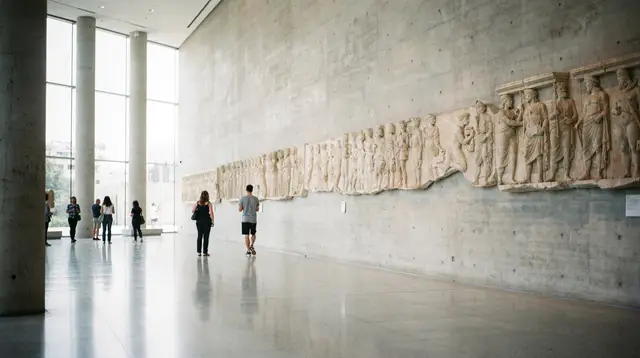
Top floor (Parthenon Gallery): The most significant room in the museum and arguably one of the most significant rooms in any museum in the world. The gallery is oriented to align with the temple on the hill, with glass walls giving direct sightlines to the Parthenon itself. The original sections of the Parthenon frieze are displayed alongside plaster casts of the Elgin Marbles (shown in grey as a deliberate contrast to the original marble) — the single most direct argument for the return of the British Museum’s portion.
Acropolis + Museum combo ticket — covers both sites at a combined priceHead-to-head comparison
| Factor | Acropolis Site | Acropolis Museum |
|---|---|---|
| Time required | 1.5–2.5 hours | 1.5–2.5 hours |
| Physical effort | Moderate (steep climb) | Minimal (elevator, flat floors) |
| Weather dependent | Yes — avoid midday in summer | No — fully air-conditioned |
| Best time to visit | 8 am sharp (opening) | Any time; 10 am–5 pm fine |
| Children’s suitability | 5+ (climb + heat considerations) | All ages (glass floor is a hit) |
| Skip-the-line essential? | Yes, in peak season | Less critical, but still useful |
| Ticket price | €30 | €20 adults; free under-18 |
| Accessibility | Limited (stone paths, stairs) | Full (elevator, smooth floors) |
| Original sculptures | Mostly casts/replicas | Yes, originals |
| Views and atmosphere | Extraordinary | No exterior views except through glass |
Which to do first: the site or the museum?
The correct order for most visitors: Acropolis site first, museum immediately after.
Starting at the hill gives you the physical, spatial experience first — the position of each building relative to the others, the scale of the Parthenon in its landscape, the experience of the Propylaea as a processional gateway. When you then descend to the museum, every object you see connects to a physical location you have just experienced. The Caryatids become the porch figures you just stood beneath. The frieze sections become the relief you circled around the Parthenon looking for.
The case for museum first: If you are visiting in peak summer heat (July–August) and want to avoid the worst temperatures on the hill, visiting the museum in the cool morning and the site in the early evening (5–7 pm, when temperature drops and light improves) is a perfectly valid approach. The museum provides context that makes the site more meaningful, not less. Some archaeology-focused visitors prefer this order.
Never visit just one: The question “can I skip the museum?” comes up constantly. The answer is: technically yes, but you would be missing half the story. The original Caryatids, the Archaic Korai collection, and the Parthenon frieze display alone justify the €20 museum admission. The museum is also air-conditioned, which in July–August has practical value beyond the cultural.
Booking and logistics
Acropolis site entry: The standard entry ticket is €30 for adults all year (€15 reduced). EU citizens under 18 enter free. Each site sells its own ticket on the official Hellenic Heritage ticketing portal; book online there, which is essential in peak season.
Acropolis Museum entry: €20 adults, free for EU under-18s, €10 reduced. No timed entry — arrive when you like. The museum is much less crowded than the site and queue times are minimal except at holiday peaks.
Combo options: A commercial Athens city pass may cover both; the Acropolis tickets guide explains the options. For most visitors spending 2–3 days in Athens, separate tickets for each archaeological site plus the museum ticket is the most efficient approach.
Early morning Acropolis + Museum guided tour — the best of both sites in sequenceThe Elgin Marbles question
The Acropolis Museum is, in part, an argument: the case for reuniting the Parthenon sculptures currently in the British Museum with the originals in Athens. The top-floor gallery makes this argument silently but powerfully — the original marble sections displayed alongside grey plaster casts of the British Museum pieces, with the Parthenon visible through the glass above.
Visitors from the UK often find this unexpectedly affecting. The museum is not polemical about it; the installation is designed to let the absence speak. Standing in the Parthenon Gallery looking at the frieze sequence, the grey sections (representing London) and the cream-coloured originals (in Athens) make a visual argument that no speech could equal.
For more on both experiences, see the Acropolis tickets guide and the Acropolis Museum guide.
If you’re short on time: which one wins
Occasionally a schedule genuinely only allows for one — a cruise stop, a tight layover, or a single free morning. In that scenario, most first-time visitors should choose the site: the physical experience of standing on the Acropolis, with the Parthenon and the view of Athens below, is the one thing you cannot get anywhere else, including from photographs of the museum’s collection. Repeat visitors, or anyone who has already seen the hill on a previous trip, get more marginal value from the museum instead, since its collection changes far less between visits than the experience of the light and crowds on the rock. For a one-day Athens visit built around this trade-off, see Athens in one day for how cruise and layover visitors typically sequence it.
Combining both with the wider Acropolis area
Both sights sit within walking distance of several other worthwhile stops that make sense to fold into the same day: the Ancient Agora and the Roman Agora are both a short walk north, and Plaka below the hill is the natural spot for the lunch break between the site and the museum. Treating the whole area as a single half-day loop, rather than two separate outings, is generally the most efficient use of time.
Frequently asked questions about Acropolis vs Acropolis Museum
Can I visit the Acropolis and the museum in the same day?
Yes, and this is recommended. Most visitors do both in a single morning: Acropolis at 8 am (1.5–2 hours), brief break for coffee and water, Acropolis Museum from 10:30 am (1.5–2 hours). You will be done before noon, before the worst heat and the tour group peak.
Is the Acropolis Museum worth the separate entry fee?
Yes, without qualification. At €20 for adults (free for EU under-18s), it is one of Europe’s best-value major museums. The collection includes irreplaceable objects — the original Caryatids, the Parthenon frieze sections, the Archaic Korai — and the building itself is architecturally significant.
Which is harder for elderly visitors or those with mobility limitations?
The Acropolis hill is significantly harder. The path involves a steep approach, uneven marble surfaces, and no air conditioning. Comfortable walking shoes and heat preparation are essential. The Acropolis Museum is fully accessible: smooth floors, elevator to all levels, air conditioning, wheelchair access throughout. Elderly visitors who find the hill too challenging will still have a rich experience at the museum.
Are there guided tours that cover both the site and the museum?
Yes — several Athens operators run combined Acropolis + Museum tours of 3.5–4 hours that start at the hill at 8 am and finish with the museum. These are excellent value: a single guide who contextualises both experiences in sequence. See the family Acropolis tour for family-specific versions.
Is photography allowed in both the Acropolis and the museum?
Photography for personal use is permitted at the Acropolis site. In the Acropolis Museum, photography without flash is permitted throughout, including in the Parthenon Gallery. Tripods are not permitted. Video is generally permitted for personal use.
Which one is better for someone with only a couple of hours?
The site, for most first-time visitors — the physical experience of the hill, the Parthenon and the view cannot be replicated anywhere else. If you’ve already visited the Acropolis on a previous trip, the museum is the better use of a short window since its collection rewards repeat viewing more than the site does.
Does visiting one make the other feel repetitive?
No — visitors consistently report the opposite. Seeing the actual Caryatid porch on the hill, then the four original Caryatids up close in the museum, deepens the experience of both rather than duplicating it. The same applies to the frieze: circling the Parthenon looking for surviving sections, then seeing them displayed at eye level in the museum, makes each visit more meaningful.
Athens museums & heritage on GetYourGuide
Verified deep-linked GetYourGuide tours. Book through these links and we earn a small commission at no cost to you.
GetYourGuide does not provide product photos: on its activity cards, the picture illustrates the type of experience and is not the operator's own photo.