
Athens with kids: a practical family travel guide
Is Athens good to visit with kids?
Yes — Athens is excellent with kids. Ancient ruins, interactive museums, street food, and a walkable historic core make it engaging for all ages. The Acropolis suits children 5 and up; the Acropolis Museum has dedicated kids' activities; and the National Garden offers shaded space for tired toddlers.
Why Athens works brilliantly for families
Athens is one of those rare destinations where the main attractions genuinely captivate children rather than testing their patience. The Acropolis is a real hilltop fortress. The ancient ruins tell stories involving gods, warriors, and monsters. The street food — souvlaki, loukoumades, creamy yoghurt — is universally crowd-pleasing. And the city is compact enough that you can walk between most highlights without relying on taxis or the metro.
That said, Athens is not a theme park. It requires some planning to keep young visitors energised and happy. Heat in July and August can knock out even the most enthusiastic child by noon, uneven cobblestones challenge buggies, and some museums lean heavily on static displays without child-specific programming. This guide covers exactly how to make it work, whatever your children’s ages.
| Best age range | 4 and up gets the most out of the Acropolis and museums |
| Minimum time | 3 full days for the essentials |
| Cost | EU under-18s free at national sites; Acropolis ticket €30 for adults |
| Best season | April–May and September–October |
| Stroller-friendly? | Partially — Acropolis Museum yes, Plaka/Monastiraki cobblestones no |
Best age to visit Athens with children
Toddlers (1–3 years): Manageable but tiring. The National Garden in Syntagma is the best friend of parents with toddlers — shaded paths, a small zoo, and a duck pond. Skip the Acropolis climb; it is hot, steep, and pram-unfriendly in sections. The Acropolis Museum at ground level works better: smooth floors, wide spaces, and scale models children can grasp.
Young children (4–7 years): This is when Athens starts to click. Ancient Greek stories — heroes, gods, the Minotaur — fire imaginations at exactly this age. The Acropolis becomes a real adventure. Budget around 90 minutes at the summit, start early (8 am gate opening), and bring a story to read at the top.
Older children (8–12 years): The sweet spot. Old enough to absorb context, young enough to find gladiator helmets and chariot races thrilling. The National Archaeological Museum becomes genuinely exciting with the right preparation. This age group also handles longer day trips from Athens well.
Teenagers: Athens’ café culture, street art in Psyrri, sunset hike up Lycabettus Hill, and ferry day trips to islands all appeal strongly. Budget a half-day of independent time in Plaka or Monastiraki and teenagers will leave happy.
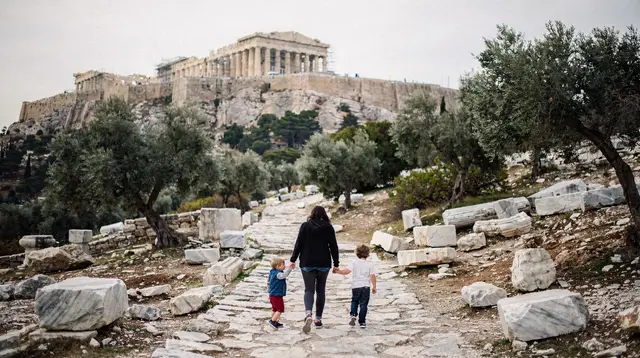
The Acropolis with children
The Acropolis is the centrepiece of any Athens family trip, but logistics matter enormously. Heat and crowds by mid-morning combine to make it genuinely unpleasant without advance planning.
Arrive at opening (8 am April–October, 9 am November–March). Temperatures are tolerable, tour groups haven’t arrived, and the golden light makes the marble glow. A family of four can cover the summit comfortably in 90 minutes at this hour.
Book skip-the-line tickets in advance. Queue times of 45–90 minutes are common from May to September, and standing in direct sun with small children is miserable. The Athens Acropolis family tour with a guide adds genuine value here — a skilled narrator turns the Parthenon from “old building” into a story about democracy, war, and the goddess Athena.
Stroller warning: The main path up the Acropolis involves steep ramps and uneven stone. A lightweight, collapsible buggy is manageable; a large travel system is not. Carriers work better for children under 3. The Acropolis Museum, immediately below, is fully pram-accessible.
Book the family Acropolis tour — child-friendly storytelling, skip-the-line entryTickets by site: An Acropolis ticket costs €30 for adults (free for under-18s from EU countries; non-EU children under 18 also enter free). Each site, such as the Ancient Agora, sells its own ticket on the official Hellenic Heritage ticketing portal. This keeps the Acropolis affordable for families.
Acropolis Museum with children
The Acropolis Museum is one of Europe’s best child-friendly archaeology museums. The building is modern, air-conditioned, and flooded with natural light. The ground floor has a glass floor over an excavated ancient neighbourhood — children invariably crouch down trying to spot the ruins below.
The museum runs dedicated family programmes on weekend mornings, including hands-on myth workshops for children aged 5–12. Book these at the museum website in advance; they fill quickly in high season. Even without the programme, the top-floor Parthenon Gallery, with the original frieze at eye level, holds attention for 20–30 minutes.
Acropolis + Museum combo — one ticket, two unmissable sitesFamily-friendly neighbourhoods
Plaka: The old Ottoman neighbourhood immediately below the Acropolis. Narrow streets, souvenir shops, outdoor tavernas — children love it. Traffic-free lanes make it safe for kids to explore. The slight tourist-trap quality is actually useful here: menus are translated, staff are patient, and no one minds if a toddler drops their tzatziki.
Thissio: Thissio sits just west of the Acropolis and has a long pedestrianised promenade with extraordinary views of the Parthenon. Ice cream shops, low traffic, and benches for tired parents make it a natural rest stop between the Ancient Agora and Plaka.
Monastiraki: The flea market is endlessly entertaining for older children — vintage goods, street food, and the kind of chaotic energy that makes travel feel like an adventure. Avoid it on Sunday mornings with pushchairs; it becomes extremely crowded.
Beat the heat: summer family strategy
From late June through August, Athens regularly hits 35–38°C. This is the city’s busiest tourist season, but it requires a strict schedule with children.
- 6 am–11 am: All outdoor sightseeing. Acropolis, Ancient Agora, Cape Sounion day trip.
- 11 am–5 pm: Air-conditioned retreats. Acropolis Museum, National Archaeological Museum, hotel pool, or an air-conditioned café for a two-hour Greek lunch.
- 5 pm–8 pm: Return outdoors. Lycabettus funicular, Plaka dinner, rooftop ice cream.
For families travelling in summer, the Athens Riviera is a lifesaver. Glyfada and Vouliagmeni are 30–40 minutes from the city centre by tram or car, with organised beaches that have shallow water, sunloungers, changing facilities, and beach bars. Children under 5 enter most beaches free.
Ancient Greek games — a hidden family gem
One of Athens’ most underrated family experiences is a session of ancient Greek athletic games in a historic setting. Children compete in javelin, discus, chariot racing (the toy variety), and hoplite drills while a costumed guide explains the Olympic origins. It is loud, physical, and completely unlike a museum.
Ancient Greek games for families — hands-on history, huge funAges 5 and up are suitable; the experience runs 2–3 hours and typically includes a guide through the Panathenaic Stadium. Book early in peak season.
Age-by-age quick reference
| Age group | Best sights | Watch out for | Ideal pace |
|---|---|---|---|
| Toddlers (1–3) | National Garden, Acropolis Museum ground floor | Steep Acropolis climb, heat | Short outings, long rests |
| Young children (4–7) | Acropolis summit, mythology stories, Greek games | Midday heat, long queues without pre-booking | 90 minutes at a site, then a break |
| Older children (8–12) | National Archaeological Museum, day trips, Ancient Agora | Museum fatigue without a hands-on element | Full mornings, air-conditioned afternoons |
| Teenagers | Psyrri street art, Lycabettus sunset, island day trips | Wanting independent time | Half-day structured, half-day free |
Practical logistics for families in Athens
Getting around: The Athens metro is clean, air-conditioned, and reliable. Stations around the city centre — Akropoli, Monastiraki, Syntagma — put you within easy walking distance of main sights. Pushchairs fit easily in carriages outside peak hours. Taxis (use the Beat app) are affordable and easy.
Eating with children: Greeks love children visibly and loudly. Tavernas will happily split portions, bring extra bread, and accommodate fussy eaters. Greek staples — grilled chicken, chips, cheese pies (tiropita), watermelon — suit most children. Avoid restaurants in the immediate tourist drag around Syntagma Square; quality drops and prices rise.
Food hygiene: Athens tap water is safe to drink in most areas, though many locals prefer bottled. Fresh produce and cooked food are generally very safe — this is not a destination where travellers routinely get ill.
Medical: Pharmacies (the green cross) are everywhere and pharmacists speak enough English to advise on common children’s ailments. The KAT General Hospital in northern Athens has a paediatric emergency unit.
Pram practicality: Cobblestones are the main enemy. In Plaka and Monastiraki, expect rough surfaces. A lightweight buggy with inflatable tyres or a good carrier is far more practical than a large travel system.
Packing for the heat: Broad-brimmed hats, reef-safe sunscreen, a refillable water bottle per child, and light, breathable clothing matter more in Athens than almost any other packing consideration. Public drinking fountains near the Acropolis and at Monastiraki Square make refills easy — use them rather than buying bottled water constantly.
Recommended family itinerary: 3 days in Athens
Day 1 — Acropolis and Plaka Rise early, Acropolis by 8 am, follow with the Acropolis Museum. Afternoon rest. Plaka for dinner.
Day 2 — Ancient Agora, Greek games, Thissio Ancient Agora opens at 8 am and is quieter than the Acropolis. Greek games session mid-morning. Thissio promenade for lunch with Parthenon views. Lycabettus funicular in late afternoon.
Day 3 — Museum or beach National Archaeological Museum for older children and teenagers. Or swap to the Athens Riviera for a beach day if travelling in summer — a perfect final day.
For more ideas on what to do, see the full family-friendly Athens activities guide and things to do with kids hub. For day-trip options once the city itself is covered, the kid-friendly day trips from Athens guide and the Athens beaches for families guide are useful next steps.
Frequently asked questions about Athens with kids
Is the Acropolis suitable for young children?
Yes, from around age 4–5 upwards. The climb is a 10–15 minute walk on a paved path with handrails in key places. It is steep in sections but manageable. The main challenge is heat — always go early in the morning and bring water, sun cream, and hats. Children under 18 (EU nationals) enter free.
Are strollers practical in Athens?
In parts. The Acropolis Museum, National Archaeological Museum, and most shopping areas are fully pram-accessible. Historic neighbourhoods like Plaka and Monastiraki have cobblestones that make strollers awkward. A lightweight, collapsible buggy works best; a carrier is invaluable as a backup.
What is the best neighbourhood to stay in with kids?
Plaka or Koukaki (just south of the Acropolis) are ideal for families. Both are walkable to main sights, quieter than Monastiraki at night, and have many family-run restaurants. Koukaki has slightly more local character and better-value accommodation.
Is Athens safe for families with children?
Athens is safe for tourists, including families. Petty crime (pickpocketing) exists in crowded areas like Monastiraki flea market — the same awareness required in any major European city. Traffic can be chaotic on main roads; teach children to use pedestrian crossings.
When is the best time to visit Athens with children?
April–May and September–October are ideal: warm enough for beaches and outdoor sightseeing, not punishingly hot, and significantly less crowded than summer. School-holiday summer visits are possible with strict morning-sightseeing schedules and beach afternoons.
How many days do you need in Athens with kids?
Three full days is the minimum to cover the Acropolis, Acropolis Museum, and one other major sight without rushing. Four to five days allows a day trip — Cape Sounion, the Saronic Islands, or a first taste of Santorini or Mykonos.
Are there baby-changing facilities in Athens?
Yes, in the major museums (Acropolis Museum, National Archaeological Museum), shopping centres, and larger cafés, though standalone public toilets rarely have them. Plan changes around museum or café stops rather than relying on finding a public facility on the street.
Do children need to wear sun hats and sunscreen even in spring?
Yes, especially at exposed sites like the Acropolis. Even in April and May, the reflected light off white marble is strong, and children burn faster than adults realise. Broad-brimmed hats, reapplied sunscreen, and a water bottle each are worth packing regardless of season.
Family-friendly tours in Athens
Verified deep-linked GetYourGuide tours. Book through these links and we earn a small commission at no cost to you.
GetYourGuide does not provide product photos: on its activity cards, the picture illustrates the type of experience and is not the operator's own photo.


More tours on Viator
Top-rated experiences with verified reviews, bookable on Viator (a Tripadvisor company).

