The highest point in the city
Athens is ringed by hills — Filopappou, Tourkovounia, Hymettus in the east — but Lycabettus is the only one that rises from the middle of the built city like an exclamation mark. At 277 metres, it is about twice the height of the Acropolis rock and sits far enough from the ancient plateau that from the summit you can see the entire ancient and modern city spread in every direction.
The hill is limestone, pine-covered on the lower slopes, bare rock at the top. The small white chapel of Agios Georgios (St George) at the summit has been there in some form since the Middle Ages; the current structure dates from the 19th century. A terrace cafe and a more formal restaurant operate near the summit. The funicular station at the top is tiny — a tunnel bored through the hillside with a single cable car that takes about three minutes to ascend from the Kolonaki base.
The view justifies all of it.
| Where | Above Kolonaki, central Athens |
| Getting there | Funicular (€7 return) or 25–30 min walk from Kolonaki square |
| Time needed | Around 2 hours including ascent, summit and descent |
| Best time | 90 minutes before sunset |
| Cost at top | Free summit access; terrace cafe drinks from around €5–8 |
Getting to the top: funicular vs walking
Funicular: the most popular option. The station is at the top of Plutarchou street in Kolonaki — the street that runs directly uphill from Kolonaki square. The cable car runs roughly every 30 minutes (check current schedule; hours vary seasonally). Return ticket is €7. There is occasionally a queue; in summer this can run 20–30 minutes at peak sunset time. Buying a return ticket avoids the risk of the last car filling before you can descend.
Walking: several paths lead up from the Kolonaki side. The main stepped path begins near the funicular station and zigzags through pine trees to the summit in 25–30 minutes. It is a genuine uphill walk — not technical, but steeper than it looks on a map. Wear shoes with grip. The path is pleasant in cool weather and miserable in midsummer heat.
A middle option: take the funicular up, walk down. The descent on the pine-shaded path in the cool of the early evening is genuinely pleasant and gives you perspective on the hill’s scale.
The view: what you can see and from where
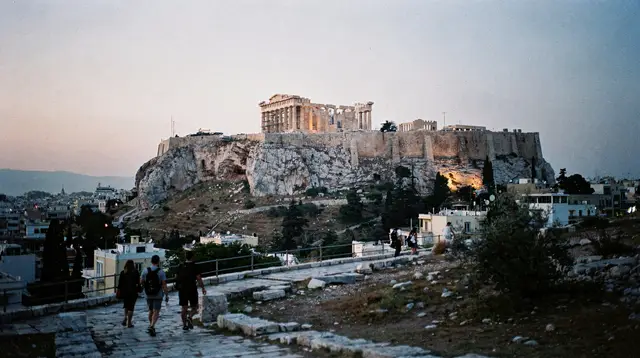
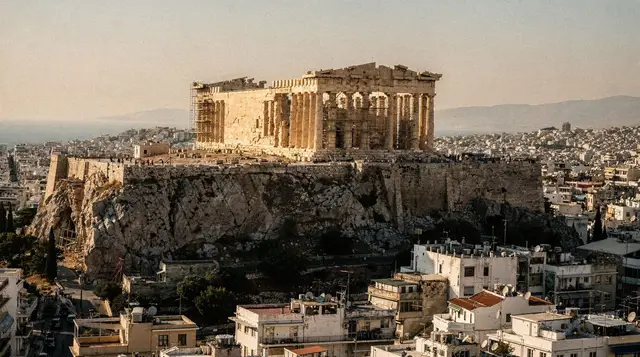
From the summit terrace, looking southwest, the Acropolis is directly below and about 1 km distant. The sightline includes the entire Parthenon, the Propylaea and the Erechtheion in a single frame — unusually for Athens, you are looking down at the monuments rather than up at them. The flat expanse of the city extends in every direction; on a clear day the Saronic Gulf and the islands of Aegina and Salamina are visible to the southwest, and the mountains of the Peloponnese on the far horizon.
Looking north, the Olympic Stadium (1896 original) and the newer 2004 Olympic complex are visible; further north, the mountains of Attica. East, the ridge of Hymettus fills the horizon; west, the hills of the Peloponnese on clear winter days.
The best single view is from the northwest corner of the summit terrace, which frames the Acropolis against the setting sun. This corner fills up in the last 30 minutes before sunset; arrive earlier and secure a position.
The sunset experience
Lycabettus at sunset is not a secret. The terrace fills with visitors from about 30–40 minutes before sunset, and the funicular will be running at capacity. None of this diminishes the view — the crowd’s collective silence when the sun drops behind Parnitha on a clear day is its own kind of atmosphere.
The Lycabettus sunset tour takes a small group up the hill with a guide who explains what you are looking at across the cityscape — useful for orienting yourself to the geography of a city that can feel large and undifferentiated from street level.
For the sunrise version — more ambitious but rewarding on a clear morning — the Athens sunrise hike brings you to the summit before the city wakes. The morning light from this angle, falling on the Acropolis from the east, is different from the sunset and in some ways more dramatic.
Reading the city from above
The summit is the best place in Athens to understand how the city fits together, and it pays to spend a few minutes just orienting yourself before reaching for the camera. Start with the Acropolis, the obvious anchor, then let your eye drift to the pale, crowded lanes at its foot. The tight grid of Plaka and the rooftops of Monastiraki sit right beneath the rock, while the open square near the parliament marks Syntagma. Once you can place those three, the rest of the centre falls into order.
Turn a little further and the quieter districts appear: the leafy, residential slopes of Koukaki behind the Acropolis, the bars and small theatres of Psyrri, and the lower, livelier streets of Exarchia closer to the hill itself. Seen from here, Athens is less a monument with a city around it than a dense, low-rise carpet that runs right up to the foot of every hill. That perspective alone makes the climb worthwhile, and it helps when you are planning the rest of your stay with the Athens itinerary planning guide.
If you like to match a view to a map, the summit is also a good place to decide which day trip appeals most. The coast to the south points toward the Athens Riviera and the sea routes that begin at Piraeus, while the open horizon beyond hints at why so many visitors continue on to the islands.
Choosing your moment: light, season and weather
Lycabettus changes character depending on when you go, and none of the versions is wrong. Late afternoon gives warm, directional light on the city; sunset adds colour and company; dawn gives stillness and a soft first glow on the Acropolis. Midday offers the clearest visibility for distant landmarks but the harshest conditions on an exposed summit, so it suits cooler months better than high summer.
In the hottest weeks, plan the climb around the heat rather than against it, and read the advice in Athens in summer heat and the August heat survival story before committing to a midday walk. In the cooler seasons the hill is a different place: crisper air, longer sightlines and far less queuing, which the Athens in winter guide explains more fully. If you are still deciding when to travel at all, the best time to visit Athens guide puts the hill in a seasonal context.
Rain deserves a mention too. A clearing after a storm can produce some of the sharpest views of the year, but the stepped path is slippery when wet, so treat the funicular as the safer option and see Athens on a rainy day for what to do when the weather turns. Haze is the other variable: on a hazy day the far islands and mountains may vanish, yet the Acropolis below remains perfectly clear, so the visit is rarely wasted.
Who the hill suits best
First-timers get the most from Lycabettus, because it gives a visual map of everything they are about to see. Couples tend to favour the sunset terrace, and photographers should read the best photo spots in Athens guide to see where the hill fits among the other frames worth chasing. Families can manage the hill comfortably if they take the funicular and keep the visit short; the Athens with kids guide has more ideas for pacing a day with children.
Keen walkers can turn the hill into a small outing of its own, climbing on foot and wandering down through the pines to the cafes below. Anyone arriving on a cruise should think carefully about time: if you have only a day in port, the Athens in one day from the port guide will help you decide whether the summit earns a place in your schedule or whether a nearer viewpoint is the wiser choice.
After the summit
The descent into Kolonaki provides a natural transition to the evening. The cafes and wine bars on Tsakalof and Milioni streets are 10 minutes’ walk from the funicular base. For a full evening, the sequence is: funicular up for sunset, terrace drink at the summit, descent on foot through the pines, dinner in Kolonaki.
The Lycabettus and Athens timeless hills tour extends the experience with stops at other viewpoints and historical context about the city’s relationship with its surrounding topography — a good choice for visitors who want more than a viewpoint selfie.
Lycabettus Theatre
On the hill’s northeast slope, the Lycabettus Theatre — an open-air amphitheatre cut into the rock — hosts concerts and events from June to September as part of the summer festival programme. The setting is exceptional; acts from Greek and international music appear regularly. Check the current programme online (the Athens Festival website lists dates). Tickets sell quickly for the most popular acts; booking ahead is essential for anything mainstream.
The combination of a performance at Lycabettus Theatre and a late dinner in Kolonaki below is one of the better Athens evenings on offer. The 3-day Athens itinerary includes an evening at Lycabettus as the recommended second-day conclusion.
How it compares to other Athens viewpoints
Lycabettus is the highest and widest view, but not the only one, and not always the right choice if you are short on time or averse to crowds.
| Viewpoint | Height / distance | Best for |
|---|---|---|
| Lycabettus Hill | 277m, funicular or 25–30 min walk | The single widest 360° panorama; sunset crowds |
| Philopappos Hill | 147m, 15 min walk from Acropolis | Best straight-on Acropolis photo, fewer crowds |
| Areopagus Rock | Low, free scramble by the Acropolis entrance | Quick, free, no ticket — but very crowded at sunset |
| Acropolis Museum rooftop cafe | Ground level, paid entry | Acropolis view with air conditioning and a meal |
For a broader guide to framing the Acropolis and the cityscape from these and other angles, see the best photo spots in Athens guide, and for sunset-specific advice from the rock itself, the Acropolis sunset photography guide.
Building Lycabettus into a wider plan
The hill works best as an anchor for the end of a day rather than a stand-alone stop. A morning among the ruins, a slow lunch, and the summit as the closing act is a rhythm that suits almost every itinerary. For a compact first visit, the Athens in one day and Athens in two days plans show how an evening viewpoint slots in without crowding the daytime sights, and the first-timers weekend is a gentle option if you want the hill to be one highlight among several.
Getting to the base is simple: Kolonaki is well served by the city’s transport, and the Athens metro guide explains how to reach the neighbourhood without a taxi. For other ways to move around once you are down from the hill, the getting around Athens guide covers the options. If you are still choosing where to base yourself, the where to stay in Athens guide shows why the streets near the hill are such a pleasant place to sleep.
Food is the natural finish. After a long descent, a table in Kolonaki is hard to beat, and the best tavernas in Athens and Athens rooftop bars guides offer alternatives if you want to keep the views going. For a story-led take on the whole sunset-and-dinner evening, the blog account of the best rooftops with an Acropolis view is a useful companion.
Practical notes for the climb
Bring water even for the funicular route — the summit terrace is exposed and queues in summer can add a warm 20–30 minute wait. If walking, proper shoes matter more than the modest distance suggests: the stepped path is uneven limestone and slippery when wet. Families with small children or anyone with mobility limits should default to the funicular; the walking path has no real handholds on its steeper sections. Dawn is a genuine, much quieter alternative to sunset — read the climbing Lycabettus at dawn story before attempting it, since the funicular does not run that early and the walk up in the dark needs a headlamp.
Frequently asked questions about Lycabettus Hill
Is the Lycabettus funicular worth it, or should I just walk? The funicular (€7 return) is worth it if you’re short on time, visiting at sunset when the path can feel crowded and warm, or travelling with kids or anyone unsteady on uneven ground. The walk is free, takes 25–30 minutes, and is genuinely pleasant in cool weather — a fair trade if you’re not in a hurry and want the exercise.
Can I see the Acropolis and Lycabettus in the same day? Yes, and it’s one of the best Athens combinations: visit the Acropolis in the morning before the heat and crowds peak, then head up Lycabettus in the late afternoon for sunset, since the two sights face each other and the second view puts the first in context. The 3-day Athens itinerary sequences this exact pairing.
Is Lycabettus better than the Acropolis for photos? They do different jobs. The Acropolis is the subject, and Lycabettus is the place to photograph it from, together with the sprawl of the city around it. If you want the monument itself in detail, see Acropolis sunset photography; if you want the whole picture, the hill wins.
What should I do if the summit is too crowded? Move away from the northwest corner and explore the other sides of the terrace, which are quieter and still offer wide views. You can also come back at a different hour, or choose Philopappos Hill for a calmer alternative with a similar view of the Acropolis.