Acropolis sunset photography: the complete location guide
Where is the best place to photograph the Acropolis at sunset?
The best positions for Acropolis sunset photography are Filopappou Hill (west, direct frontal view), the Thissio pedestrian walkway (north, with city foreground), and Monastiraki Square (for the post-sunset illuminated Parthenon against the blue-hour sky). Arrive 30–40 minutes before sunset to claim your position.
Understanding the light: why sunset at the Acropolis works
| Where | Filopappou Hill, Thissio walkway, Monastiraki Square, Lycabettus Hill |
| Cost | Free at every viewpoint; guided sessions from around €50–90 |
| Time needed | Arrive 30–40 min before sunset, shoot through blue hour (20–35 min after) |
| Getting there | Filopappou and Thissio are a short walk from Plaka; Lycabettus has a funicular |
| Best time | May, September and October for manageable heat and earlier, more sociable sunsets |
The Parthenon faces east. Its narrow west end faces toward Filopappou Hill and receives the full force of the setting sun in late afternoon and evening. This creates a specific photographic opportunity that the summit of the Acropolis itself cannot offer: the possibility of shooting toward the Parthenon with the sun to your back, lighting the marble from front on.
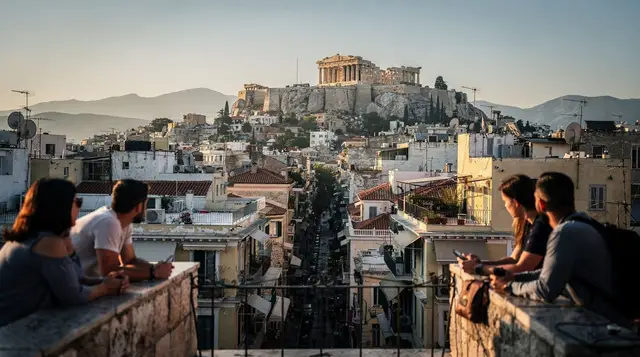
From the hill, Filopappou is the natural tripod position. From street level around the hill, the long pedestrian promenade of Thissio and Dionyssiou Areopagitou offers shooting angles with the sun dropping behind you to the southwest, illuminating the Acropolis’s west and north faces.
From the Lycabettus Hill summit to the northeast, you shoot west — the Acropolis appears in the foreground of the city, with the sun dropping behind it and creating backlit silhouette possibilities in the final minutes before sunset.
Each position gives a fundamentally different photograph. This guide covers all four primary sunset positions with exact timing, compositional approach, and practical logistics.
Weather and haze also shape the result more than most visitors expect. Athens summers occasionally carry a fine dust haze from the wider Attica basin that softens contrast and mutes the warm tones photographers chase; a clear day after rain, by contrast, gives the cleanest air and the most saturated colour. If you’re planning a trip specifically around photography, our best time to visit Athens guide covers which months combine reliable clear skies with manageable crowds and heat.
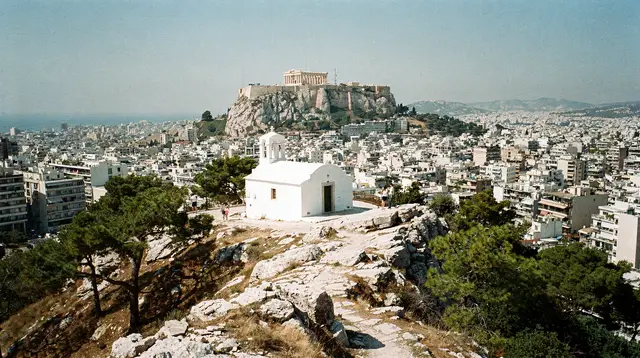
Position 1: Filopappou Hill — the frontal view
Character of the shot: The Parthenon’s west facade, illuminated from the side and front by low westerly light. Pine trees and the rocky hillside in the foreground. City rooftops of Plaka visible below.
Best time to arrive: 40 minutes before sunset. The viewpoint near the Filopappos Monument on the hill’s summit has limited space and is increasingly used by photographers — arrive early to claim a position with unobstructed sightlines.
Light sequence:
- Minus 40 minutes to minus 20 minutes: Harsh, high-angle afternoon light. Use this time for scouting and framing.
- Minus 20 minutes to minus 5 minutes: Golden hour begins. The light drops angle and warms significantly. The Parthenon columns begin to show texture and the stone reads as warm amber rather than bleached white. This is the core shooting window.
- Sunset: The sun clears the hill behind you, briefly backlighting the Parthenon from below the horizon — the sky goes warm orange above the temple.
- Plus 5 to plus 25 minutes: Post-sunset. The ambient light is even, shadows soften, and the scene takes on a painterly quality without harsh shadow. The Acropolis illumination activates during this window in summer.
- Plus 25 to plus 40 minutes: Blue hour. If architectural illumination is on, you have the Parthenon glowing golden against deep blue sky — the most coveted shot.
Composition options:
- Wide angle (24mm): Include the full width of the Acropolis hill with Filopappos Monument in the foreground.
- Standard (50mm): Frame the Parthenon and Erechtheion together with a narrow strip of city below.
- Telephoto (85–135mm): Compress the scene, filling the frame with the Parthenon’s west facade and reducing background clutter.
Practical notes: The path to the Filopappos viewpoint is unpaved and unlit. Wear comfortable shoes. For a predawn sunrise session, bring a headlamp. The park is technically open 24 hours; there is no gate to lock you in or out.
Position 2: Thissio pedestrian walkway — the street-level urban frame
Character of the shot: The Acropolis rising above the rooftops of the Plaka and Monastiraki neighbourhoods. Café tables, pedestrians, and urban life in the foreground. The juxtaposition of ancient and contemporary in a single frame.
Best section of the walkway: The southern half (closest to the Acropolis Metro station, between Apostolou Pavlou Street and Dionyssiou Areopagitou Street). Here the hill is closest and most elevated relative to the street, creating the best foreground-to-background relationship.
Best time to arrive: 30 minutes before sunset. The walkway is always populated — you are photographing within the scene rather than isolated above it.
Light sequence:
- Minus 30 to minus 10 minutes: Side lighting from the west illuminates the north face of the Acropolis. The Parthenon columns are side-lit, showing texture. The sky begins to warm.
- Sunset to plus 20 minutes: The western sky behind you glows orange-pink. The Acropolis catches ambient warm light while still in the last of the direct sun. Ideal for exposures that balance the lit sky with the illuminated temple.
- Blue hour: The illumination activates and the walkway’s café lights create a warm street-level base. The Acropolis glows above the city — composed with a 50mm this frames tightly on the contrast between the ancient lit hill and the modern inhabited foreground.
Composition notes: This position works best at 35–85mm. Wider angles include too much urban infrastructure; telephoto loses the urban context that defines the shot. A low shooting angle (crouching or sitting on the walkway edge) emphasises the rooftop foreground and pushes the Acropolis higher into the frame.
Athens Instagram scenic tour — Thissio and beyond at golden hourPosition 3: Monastiraki Square — three civilisations, one frame
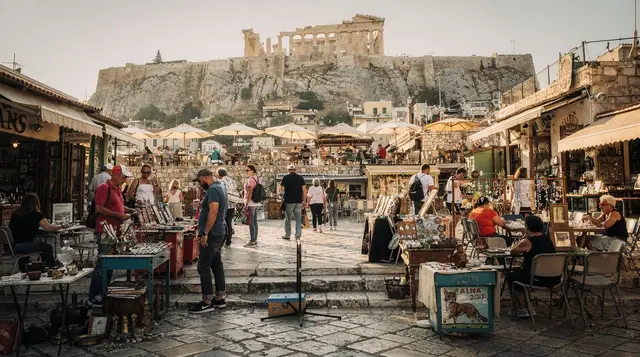
Character of the shot: The Byzantine church of Pantanassa (10th century), the Ottoman Tzistarakis Mosque (1759), and the Acropolis with the Parthenon (5th century BCE) in a single frame. A uniquely Athenian layering of history.
Best time: Sunset to blue hour. This position is primarily valuable for the illumination window — the blue-hour shot here is one of the most reproducible iconic Athens images.
Light sequence:
- Sunset: The square is a mixed lighting situation — direct sun from the west, shade from buildings. Less useful for warm-light architectural shots.
- Post-sunset: Sky softens, light evens. The Byzantine church’s white and yellow stone is visible without harsh shadows.
- Blue hour (the key window, 20–35 minutes post-sunset): The Acropolis illumination activates. The square’s own ambient lighting (street lamps, shop fronts, café lights) fills the foreground. A tripod and 2–6 second exposures in RAW format give the cleanest captures. This is the shot.
Settings for blue hour: ISO 200–400, aperture f/8 (for maximum depth of field from square to Acropolis), shutter speed 2–8 seconds on tripod. The consistency of the illumination and the long twilight in Athens (unlike northern Europe, the blue sky here stays saturated for 20–25 minutes post-sunset rather than 10) gives an extended shooting window.
Crowds: Monastiraki Square is always busy. This is simultaneously a disadvantage (crowds interfere with clean architectural shots) and an advantage (motion blur of moving pedestrians in long exposures creates energy in the foreground). Decide which approach you want before you shoot.
Position 4: Lycabettus Hill summit — the city context shot
Character of the shot: The Acropolis in the context of the city — a small illuminated outcrop amid the urban sprawl, with the Saronic Gulf silver in the distance.
This is the only position from which the Acropolis appears small. It is the opposite of the Filopappou close-up, and it tells a different story: not the Parthenon as a monumental building, but Athens as a living city that grew around its ancient centre.
Best time: 1 hour before sunset through blue hour. The funicular runs until midnight in summer; there is no access issue for late-shooting.
Light sequence:
- Golden hour from summit: The city below catches warm light; the Acropolis is a warm honey-gold among the blue-grey urban rooftops.
- Sunset: Looking west, the sun drops toward Piraeus and the sea. The city transitions to warm ambient; the Acropolis illumination activates.
- Blue hour from summit: The most wide-angle shot: Acropolis illuminated, city lights activated below, blue sky. A 24mm or 35mm lens captures the panoramic scope. A telephoto (135–200mm) compresses and isolates the Acropolis against the city in a more graphic composition.
Position 5: Rooftop bars — the intimate view
Several Plaka and Monastiraki rooftop bars offer Acropolis views from an elevation of 3–5 storeys. For photographers, these provide a specific advantage: the mid-height position allows a foreground of foreground rooftops and antennas (authentically urban) with the Acropolis above — a different perspective from both the street and the distant hilltop.
Best rooftop photography positions:
- The terrace at the Herodion Hotel — closest distance to the south slope
- A360 Rooftop Bar in Monastiraki — direct Acropolis view, accessible to non-guests
- Couleur Locale Bar in Monastiraki — slightly oblique angle but with the bazaar atmosphere below
Note: Tripods are generally not permitted on commercial rooftop terraces. A monopod or a table-mounted mini-tripod works; braced handheld shooting at ISO 1600–3200 with image stabilisation is manageable for blue-hour work.
Personal photographer sessions
For travellers who want professional-quality images of themselves in Athens’ best locations — at sunset, in the blue hour, at the right viewpoints — a personal photographer session is a practical alternative to self-directed photography. An Athens-based professional photographer knows the exact positions, exact timing, and the technical adjustments required for the illumination windows.
Personal photographer Athens — professional sunset and blue-hour portraitsSessions typically run 1.5–2 hours, beginning at golden hour and running through blue hour. The photographer handles composition, light, and post-processing; you focus on being present in the locations.
Guided photography tours of Athens
For those learning the craft alongside capturing images, a guided Athens photography tour combines instruction on light and composition with access to the best positions at optimal times.
Athens photography tour — small group, professional guide, sunset focusSeasonal timing: sunset times in Athens
The time of sunset in Athens varies significantly by season, which determines the logistics of your photography session:
| Month | Sunset time | Blue hour ends |
|---|---|---|
| January | ~17:30 | ~18:15 |
| March | ~18:30 | ~19:15 |
| May | ~20:30 | ~21:15 |
| June | ~21:00 | ~21:45 |
| August | ~20:30 | ~21:15 |
| October | ~19:00 | ~19:45 |
| December | ~17:00 | ~17:45 |
Implication: Summer photography sessions (June–August) run extremely late — blue hour ends at 9:30–10 pm. This is photographically ideal but requires booking restaurants after 10 pm (which is normal in Athens). Winter sessions are earlier and more compatible with conventional evening plans.
The illumination timing
The Acropolis architectural illumination activates approximately 30 minutes after sunset and stays on until midnight throughout the year. This makes the blue-hour photography window (20–35 minutes post-sunset, when sky is still deep blue) the critical window: illumination on, sky not yet black.
Set an alarm for exact sunset time on the day of your visit. Check timeanddate.com for Athens sunset that day. Plan to arrive at your chosen position 35–40 minutes before that time.
For the full list of Athens photography viewpoints beyond sunset, see the best photo spots in Athens guide and the photography hub.
Combining a sunset shoot with a rooftop dinner
Several of the rooftop positions in this guide double as dinner venues, which makes for an efficient evening: shoot the blue hour from the terrace, then stay for the meal once the light is gone rather than rushing off to a separate restaurant. Our Athens rooftop bars guide covers reservation timing — the good Acropolis-view tables at sunset book up days ahead in summer, so call or book online well before your shoot.
What to pack for an evening shoot
Beyond the camera itself: a compact tripod (or a monopod if shooting somewhere tripods are restricted), a spare battery (cold snaps and long-exposure work drain batteries faster than daytime shooting), a small torch or phone light for the unlit descent from Filopappou Hill, and a light layer — Athens evenings cool down noticeably once the sun drops, even in summer. If your schedule allows only one evening for photography during a short 3-day Athens itinerary, building in a buffer day in case of cloud cover is worth considering, since a flat grey sunset wastes the whole session.
Frequently asked questions about Acropolis sunset photography
What is the best month to photograph the Acropolis at sunset?
October and May are ideal. In October, the sunset falls around 7 pm (convenient timing), the air is cleaner after summer, and occasional dramatic clouds add interest. In May, the wildflowers on Filopappou Hill add colour to foreground compositions. September is also excellent. July and August have beautiful light but later sunsets (9 pm+) and summer haze can reduce clarity.
Can I photograph inside the Acropolis site at sunset?
The Acropolis closes at 8 pm in peak season. On summer evenings this means the site closes before sunset (which falls at 8:45–9 pm in June–July). You will be ushered out before the best light. The workaround is positions outside the site — Filopappou Hill and the Thissio walkway remain accessible until well after dark.
Is a tripod necessary for blue-hour Acropolis photography?
For technically clean blue-hour captures, yes. Long exposures of 2–8 seconds require a stable platform. For casual photography and smartphone use, the modern iPhone and high-end Android cameras handle blue hour well in computational photography mode without a tripod. For professional and enthusiast DSLR/mirrorless work, a compact travel tripod is essential equipment.
What focal length is best for the Acropolis from Filopappou Hill?
The optimal focal length from the Filopappou Monument viewpoint is 85–135mm equivalent, which frames the Parthenon and the full width of the hill comfortably. A wider 50mm works for compositions that include Plaka rooftops below. A 24mm captures the full hill in context but reduces the Parthenon to a small element. Experimentation is easy — the position is free and you can shoot through a range.
Does the Acropolis look better at sunrise or sunset for photography?
Sunrise (from Filopappou) offers the purest golden light on the Parthenon’s west face with almost no tourists in the frame. Sunset offers the dramatic blue-hour illumination transition and the social energy of the city at dusk. For strictly architectural photography of the Parthenon, sunrise is technically superior. For atmospheric, city-in-context photography, sunset is richer.
Do I need to book a viewpoint in advance?
No — all the outdoor viewpoints (Filopappou, Thissio, Monastiraki, Lycabettus) are public and free, so there is nothing to reserve. The only bookings that matter are a rooftop table if you want dinner with the view (see the rooftop bars guide) or a guided photography session, which does need advance notice in peak season.
Popular Athens tours on GetYourGuide
Verified deep-linked GetYourGuide tours. Book through these links and we earn a small commission at no cost to you.
GetYourGuide does not provide product photos: on its activity cards, the picture illustrates the type of experience and is not the operator's own photo.