Best photo spots in Athens: locations, timing, and practical tips
What are the best photo spots in Athens?
The best photo spots in Athens are the Filopappou Hill viewpoint (Acropolis and Parthenon from the west, best at sunrise), Thissio pedestrian walkway (Acropolis above the rooftops), Monastiraki Square (Acropolis framed by Byzantine church), the Acropolis south slope at dusk, and Lycabettus Hill summit for the city panorama.
Athens as a photography subject
Athens is one of the most photographed cities in Europe, but most visitors return home with the same shots: the Parthenon at noon from the summit, backlit white columns against a bright sky, detail shots of columns. These are legitimate photographs but they don’t do Athens justice.
The city’s photographic potential is enormous and largely untapped by first-time visitors. The relationship between ancient ruins and modern city is uniquely Athenian: nowhere else do you photograph a 2,500-year-old temple framed by Byzantine churches, Ottoman minarets, neoclassical government buildings, and apartment blocks hung with washing — all in the same frame. The key is knowing where to stand, when to be there, and what the light does to each location at each hour.
| Best free viewpoint | Filopappou Hill, sunrise |
| Best paid/guided option | Small-group photography tour, best light logistics handled for you |
| Cost of a guided tour | Around €60–120 per person for 2–3 hours |
| Gear needed | 24–135mm equivalent range; tripod useful, not essential |
| Tripod inside the Acropolis site | Not permitted — only on surrounding public paths |
| Best season | September–October and March–April for clean, dramatic light |
The Filopappou Hill viewpoint — best at sunrise
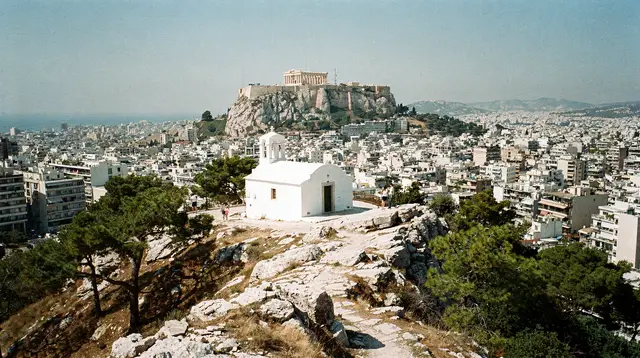
Filopappou Hill (also called Philopappos Hill), the pine-wooded hill directly southwest of the Acropolis, offers the most compelling frontal view of the Parthenon of any accessible public location. The standard viewpoint near the Filopappos Monument (a 2nd-century Roman monument on the hill’s summit) looks directly across to the west face of the Parthenon, with the full breadth of the hill and the rocky north cliff face visible.
Why this is the best Acropolis viewpoint: The Parthenon faces east, which means its west face receives the last light of the day (sunset) and the first golden light from the east bounces back on the west face at sunrise. From Filopappou, you are shooting roughly northeast — the Acropolis is at eye level or slightly above, and the foreground includes pine trees, wildflowers in spring, and occasionally the rooftops of Plaka below.
Sunrise timing: Arrive at the Filopappou viewpoint 20 minutes before sunrise. First light strikes the Acropolis hill 15–20 minutes before the sun clears the horizon; the Parthenon columns begin to glow amber in the pre-dawn grey. The best light window is 30 minutes: 10 minutes before sunrise through 20 minutes after.
Practical access: The hill is a public park, open 24 hours. The main path from Dionyssiou Areopagitou Street (the pedestrian walkway along the south slope of the Acropolis) reaches the summit in about 15 minutes of moderate uphill walking. The path is unlit; bring a phone torch for predawn arrivals.
Equipment: A wide-angle to mid-telephoto range (24–135mm equivalent) covers the main compositions. A tripod is useful for dawn and dusk work but not essential in good light.
Thissio pedestrian walkway — the Parthenon above the rooftops
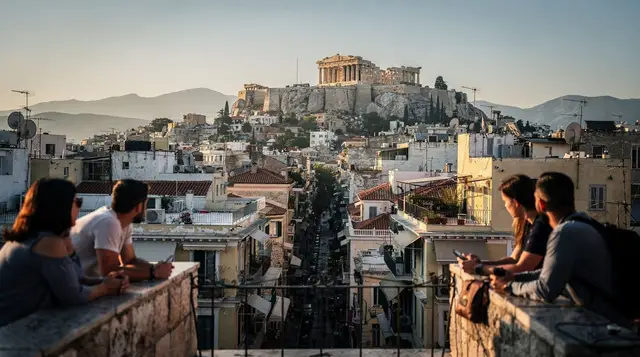
The long pedestrian boulevard running along the north side of the Acropolis hill — Apostolou Pavlou Street, connecting Thissio to Plaka — offers a 600-metre stretch of Acropolis views with urban foreground. This is the best location for the “Acropolis above city life” photograph: people walking on the wide promenade, café tables in the foreground, the Parthenon and Erechtheion above the rooftops of Monastiraki.
Best timing: Late afternoon (5–7 pm) when the promenade fills with Athenians, the café terraces are busy, and the Acropolis is lit by warm westerly light. The hour before sunset is ideal — the sun is low enough to illuminate the Parthenon columns from the side, revealing their texture and the subtle warmth of the marble.
Specific compositions along the walkway:
- At the Thissio end: the Hephaestion temple (Ancient Agora) visible through trees, with the Acropolis above — a rare foreground of one ancient monument looking toward another.
- Midway along: a long focal length (85–135mm) compresses the plane and fills the frame with the south face of the Acropolis — good for abstract textural shots.
- Near the Acropolis Metro station: the widest view of the hill and the best angle for including the ancient theatre of Herodes Atticus on the south slope.
Monastiraki Square — Byzantine church and Acropolis together
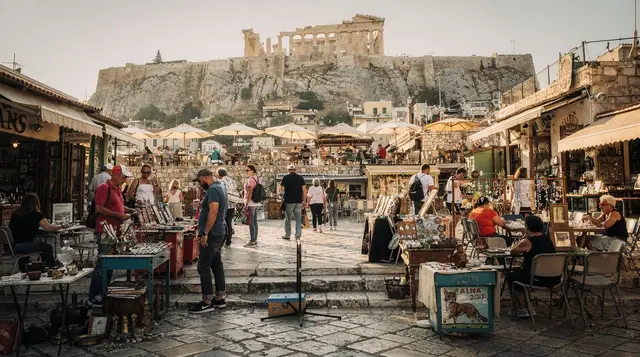
Monastiraki Square offers a composition unavailable anywhere else: the 10th-century Byzantine church of the Pantanassa in the foreground, the Tzistarakis Mosque (Ottoman, 1759) to the right, and the Acropolis with the Parthenon visible on the hill directly above. The juxtaposition of three civilisations in a single frame is uniquely Athenian.
Best timing: Early morning (8–9 am) before the square fills with vendors and tourists; the light comes from the east and illuminates the Byzantine church facade. Alternatively, blue hour (20–30 minutes after sunset) when the Acropolis illumination activates and the church and mosque are lit against a deep blue sky.
Lens: 35–50mm equivalent gives the most natural perspective. Wider angles include too much of the surrounding modern buildings; longer lenses compress the depth and lose the three-layer compositional effect.
Night photography: The Acropolis is illuminated nightly (activation approximately 30 minutes after sunset) and remains lit until midnight. Monastiraki Square at night with the illuminated Acropolis above and the lively flea market below makes a strong environmental portrait and street photography location.
Lycabettus Hill summit — the city panorama
Lycabettus Hill is Athens’ highest point at 277 metres and the only location where you can photograph the Acropolis from above — seeing it in the context of the city that surrounds it, with the Saronic Gulf as a backdrop.
What the view contains: The Acropolis appears as a rocky outcrop in the city’s southern quadrant. Beyond it: Piraeus harbour, the silver line of the sea, and on exceptionally clear days, the outline of the Saronic islands. To the north: the urban sprawl extending to the mountains (Parnitha, Pentelicon). Looking down: the rooftop pattern of central Athens, punctuated by church domes and the occasional flash of a rooftop pool.
Best timing for city panorama: Approximately 30–45 minutes before sunset, when the city transitions from harsh afternoon light to warm golden tones. The Acropolis, being lower than you, is backlit briefly (the sun sets behind you to the west) before the ambient light shifts to even warm gold across the entire scene.
Sunset photography specifically: See the dedicated Acropolis sunset photography guide for the detailed Lycabettus sunset shooting approach.
Access: Funicular from Kolonaki (open from 9 am; last car at midnight in summer). Walking path from Kolonaki (30 minutes uphill, moderate fitness required). A tripod is permitted at the summit viewpoint.
Lycabettus guided sunset experience — photography-friendly small groupThe south slope of the Acropolis at dusk
The area along Dionyssiou Areopagitou Street (between the Acropolis Museum and the Filopappou Hill junction) offers the best dusk photography position in Athens bar none. As the sun drops behind Filopappou Hill, the Acropolis south slope — including the Odeon of Herodes Atticus and the stoa of Eumenes — is in shade while the Parthenon above continues to glow. Within 20 minutes, the entire hill transitions to warm ambient light and then, post-sunset, to the architectural illumination.
The illumination transition shot: The single most coveted Athens photograph — the Parthenon glowing under architectural illumination against a deep blue or purple sky — requires precise timing. Set up your tripod on Dionyssiou Areopagitou Street 20 minutes after sunset. The sky will be deep blue (approx. 7–8 on a scale of blue saturation) for approximately 10–15 minutes before it goes black. The architectural lights activate roughly 30 minutes after sunset. The 15-minute overlap between blue sky and illuminated temple is the golden window.
Plaka rooftop cafés and restaurants
Several Plaka establishments have terraces or rooftop access with direct Acropolis views. For photographers, these serve a specific purpose: the mid-height viewpoint (3–5 storeys) puts you level with or slightly below the Acropolis hill, creating a “city level” view of the ruins amid the neighbourhood.
Best options: Restaurant terraces on Lysikratous Street and Mnisikleous Street offer good angles. The rooftop bar at the Herodion Hotel (directly below the south slope) is one of the closest viewpoints outside the archaeological site perimeter.
Timing: Sunset to blue hour. Most rooftop bars open from 5 pm and are busiest from 7 pm; arrive early for unrestricted shooting angles before the crowds arrive.
The Ancient Agora from Areopagus Rock
Areopagus Hill (the Hill of Ares, immediately north of the Acropolis entrance) is a bare limestone outcrop reached by steps carved directly into the rock. It is a site of ancient historical significance (the Apostle Paul addressed the Athenians here) and a practical photography viewpoint offering an unusual angle: looking south toward the Acropolis entrance (Propylaea) from below and to the east.
More importantly, looking west from Areopagus, the Ancient Agora spreads out below — the Hephaestion temple (one of the best-preserved ancient temples in Greece), the reconstructed Stoa of Attalos, and the complex of ruins that was Athens’ civic and commercial centre. A 24–35mm lens looking west-southwest captures the full extent of the Agora with the Thissio neighbourhood and Filopappou Hill beyond.
Best timing for the Agora shot: Late afternoon (4–6 pm) when the Hephaestion temple is side-lit from the west. The green hillside of the Ancient Agora contrasts with the honey-gold temple stone in warm afternoon light.
Guided photography tours
For visitors who want expert guidance on locations, light, and technique specific to Athens, a guided photography tour is a worthwhile investment. Athens has several photography-focused tour operators who limit group sizes and know exactly where to position you at each location for optimal light.
Athens photography tour — small group, expert guide, best light locations Personal photographer Athens — professional photos of your trip in the best spotsAthens Instagram photo tour — the scenic circuit
For visitors primarily interested in capturing social media-ready images of Athens’ most recognisable locations, an organised Instagram scenic tour covers the key spots in an efficient sequence.
Athens Instagram scenic tour — curated locations, best light, small groupPractical photography logistics
Tripod use: Tripods are permitted in public spaces and on the pedestrian Acropolis walkways. They are not permitted inside the Acropolis archaeological site itself (including on the hill) but are allowed at the summit viewing areas. The Acropolis Museum permits personal photography without flash but not tripods.
Drone restrictions: Drone photography is prohibited over the Acropolis and its buffer zone. The entire central Athens archaeological area is a restricted drone zone. Drones can be flown in open parks on the outskirts (Filopappou Hill has a grey area — check current regulations with the relevant authority before flying).
Crowds management: The Acropolis summit is photogenic but crowded. The best crowd-management strategy is an early morning entry (8 am) for golden-hour light and minimal tourists simultaneously. For viewpoints outside the site (Filopappou, Thissio walkway), early morning and sunset positions offer reasonable crowd management.
Weather: Athens has approximately 300 sunny days per year. The best photography weather — clean air, dramatic clouds, low humidity — comes in September–October after the summer heat breaks and following rain. November and March can produce extraordinary light with theatrical cloud formations.
For the dedicated sunset photography guide, see Acropolis sunset photography. For more Athens photography and scenic tours, see the photography hub.
Beyond the Acropolis: photo spots worth the extra trip
A few locations further from the centre reward photographers who have already covered the essentials above. Plaka and Anafiotika — the tiny Cycladic-style quarter tucked beneath the Acropolis rock — offer whitewashed lanes and bougainvillea that feel transplanted from a Greek island, best shot in the soft light of early morning before the crowds arrive. Cape Sounion, about 70 minutes south, adds the Temple of Poseidon silhouetted against the Aegean at sunset — a completely different frame from anything in the city, and worth combining with a coastal day trip. For street-level colour rather than ancient stone, the graffiti-covered walls of Psyrri and Exarchia are the best urban-art backdrops in the city; see the dedicated street art of Psyrri guide for specific walls and timing.
Cape Sounion sunset private photography-friendly tourFrequently asked questions about Athens photo spots
Where is the best place to photograph the Parthenon?
The best positions for photographing the Parthenon are: (1) Filopappou Hill viewpoint, looking northeast at golden hour; (2) Thissio pedestrian walkway, looking southeast in late afternoon; (3) Monastiraki Square, looking south for the three-civilisation composition; and (4) the summit of the Acropolis itself for structural close-up shots. Each gives a fundamentally different perspective.
What time is golden hour in Athens for photography?
Golden hour in Athens (the warm-light period just after sunrise and before sunset) varies by season. In summer (July): sunrise approximately 6:10 am, sunset approximately 8:45 pm. In October: sunrise approximately 7:20 am, sunset approximately 7:00 pm. The golden window is typically 30–45 minutes either side of sunrise and sunset. Athens’ clear summer air makes golden hour colour particularly saturated compared to cloudier northern European cities.
Can I bring a tripod to the Acropolis?
Tripods are not permitted inside the Acropolis archaeological site (including on the hill). They are permitted on public paths and viewpoints around the hill, including Filopappou Hill, the Thissio walkway, Monastiraki Square, and Dionyssiou Areopagitou Street. The Acropolis Museum also prohibits tripods.
Is sunrise or sunset better for Acropolis photography?
Both have merits. Sunrise from Filopappou Hill is quieter (virtually no tourists), the light is softer, and the air is cleaner after a night’s rest. Sunset from the Thissio walkway or rooftop bars has the blue-hour illumination transition. For pure photographic quality, sunrise often wins on clarity; for atmosphere and city energy, sunset is the choice.
Are there photography tours of Athens?
Yes — several operators run photography-specific tours ranging from 2-hour Instagram-focused walks to full-day professional photography workshops. These typically cover 4–6 key locations in optimal sequence for light, with group sizes of 4–8 people. The best tours also include the Plaka rooftop and the Monastiraki blue-hour positions.
Is it worth combining a photo walk with a visit to Plaka or Anafiotika?
Yes. Both neighbourhoods are a short walk from the main Acropolis viewpoints, so it costs little extra time. Early morning, before the day-trippers arrive, gives the cleanest shots of the whitewashed lanes of Anafiotika and the quieter corners of Plaka.
Can I get good Acropolis photos without a guided tour?
Yes — every viewpoint in this guide (Filopappou, the Thissio walkway, Monastiraki Square, Areopagus Rock) is a free public space accessible independently. A guided photography tour mainly saves you the trial-and-error of timing and positioning; it isn’t required to get strong results.
Popular Athens tours on GetYourGuide
Verified deep-linked GetYourGuide tours. Book through these links and we earn a small commission at no cost to you.
GetYourGuide does not provide product photos: on its activity cards, the picture illustrates the type of experience and is not the operator's own photo.