
Philopappos Hill walk: Acropolis views and ancient sites
Is Philopappos Hill the best place to see the Acropolis in Athens?
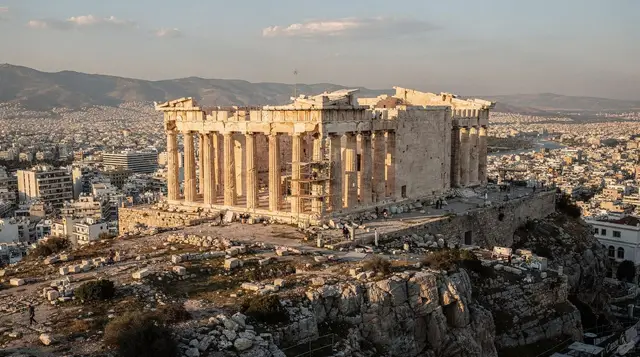
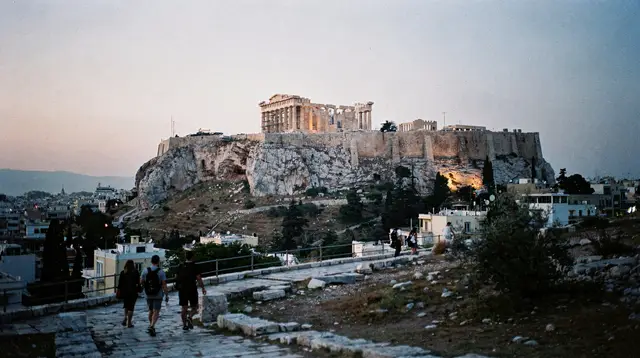
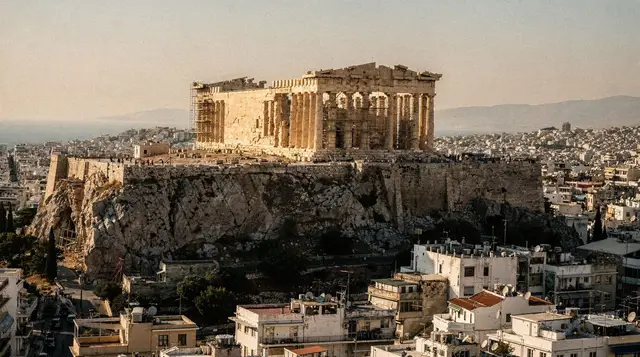
Philopappos Hill is one of the two or three best Acropolis viewpoints in Athens, with the Parthenon and Erechtheion visible together from the northwest at a distance that shows their proportional relationship clearly. The 20-minute walk to the summit is easy, free, and combines with the Pnyx hill (where Athenian democracy met) and the Socrates prison cave. Best at sunrise or late afternoon.
Athens from the other side
Most photographs of the Acropolis are taken from the east, looking up from Plaka or Monastiraki at the south slope. The view from the west — from Philopappos Hill — is different and, for many visitors, more satisfying: the Parthenon and Erechtheion are visible together on the summit, the Propylaea gateway frames the western approach, and the hill itself provides an elevated perspective that eliminates the cluttered urban foreground.
Philopappos Hill (officially called Mousseio Hill, though nobody uses that name) is the southernmost of the three hills west of the Acropolis: Filopappou at 147 metres, the Pnyx at 110 metres, and the Hill of the Nymphs at 105 metres. All three are accessible on foot from Thissio or Koukaki and form a coherent half-day walking circuit. None charges admission.
| Where | West of the Acropolis, above Thissio and Koukaki |
| Cost | Free |
| Time needed | 45 min–2 hrs depending on the circuit |
| Getting there | Metro Akropoli, walk via Apostolou Pavlou |
| Best time | Sunrise or late afternoon, avoid midday in summer |
The Philopappos Monument
At the summit, a large Roman-period funerary monument faces northeast toward the Acropolis. This is the Monument of Philopappos — built between 114 and 116 AD as the tomb and memorial of Gaius Julius Antiochus Philopappos, a Syrian prince of the Commagenian dynasty who had settled in Athens, become an Athenian citizen, and served as consul to Rome. He was, apparently, popular enough with Athenians that they granted him the summit of their own hill.
The monument stands about 12 metres high in its current (much-reduced) form. It is built in Pentelic marble, concave in plan, with three niches: the central niche shows Philopappos enthroned in his role as Roman consul; the flanking niches contain seated relief figures of his Commagenian royal ancestors. A frieze below the niches depicts Philopappos in his consular chariot.
The monument is in better condition on the northeast face (the face toward the Acropolis, which is the side that matters) than on the southwest. The carving quality is high, though weathering has softened many details. Standing at the base and looking northeast, with the Acropolis framed beyond, you understand the deliberate siting: the monument announced its subject’s prestige to anyone looking down from the Acropolis toward the hill.
The walk up
The standard approach is from Apostolou Pavlou, the pedestrianised street in Thissio that borders the Ancient Agora on its west side. From the Acropolis metro station (Line 2), walk south on Dionysiou Areopagitou for about 400 metres and turn right (west) onto Apostolou Pavlou. Continue until you see the signposted paths up the hill on your left.
The main path to the summit takes 15 to 20 minutes at a moderate pace. The paths are wide, paved in places and clearly defined. Several viewpoints along the way offer increasingly good Acropolis perspectives before you reach the summit.
An alternative approach is from the Koukaki neighbourhood to the south (streets off Garibaldi and Rovertou Gkali), which offers a slightly steeper but more direct ascent.
Shoes: Normal walking shoes work fine on the main paths. Trainers or sturdy sandals are adequate. Avoid the hill in rain — the marble and limestone sections can be slippery.
Water: There is no water on the hill. Bring a bottle from Thissio, where there are many cafes on Apostolou Pavlou.
Time needed: Summit and back from Thissio in 45 minutes if moving efficiently. Including time at the monument and the Pnyx circuit, allow 90 minutes to two hours.
The Pnyx: where democracy met
Immediately north of Philopappos Hill (roughly the same elevation, connected by paths), the Pnyx is the semicircular terrace cut into the hill where the Athenian ekklesia (the citizen assembly) met from roughly 500 BC through the Macedonian period. Every major Athenian political decision — whether to go to war, which citizens to ostracise, which alliance to pursue — was taken at votes held here.
The terrace is partially rock-cut, partially artificial fill retained by a massive stone wall. The bema (speaker’s platform) — a stepped rectangular rock outcrop at the centre — is the focal point: Pericles, Demosthenes, Themistocles and Kleon all spoke from here. The assembly met around 40 times a year; attendance required active citizenship (adult male Athenians); quorum for major decisions was 6,000. With a total citizen population of perhaps 30,000–40,000 adult males, this was participatory politics on a scale that required large outdoor infrastructure.
The Pnyx is free to enter and has no signage beyond a small information panel. The rock-cut bema is clearly identifiable; the retaining wall on the south gives a good sense of the earthwork scale. The view from the north edge of the Pnyx — toward the Acropolis directly northeast — is excellent.
The cave of Socrates’ prison
On the northeast face of Philopappos Hill, at the base of the slope, a rock-cut cave is traditionally identified as the place where Socrates was imprisoned while awaiting execution in 399 BC. The cave is accessible from a path below the hill’s main circuit.
The identification is not archaeologically confirmed — we have no ancient source that precisely locates the state prison (the Desmaterion) — but the tradition is old and the location is consistent with ancient descriptions of the prison being near the Agora and the south of the Acropolis. The cave is a real rock-cut structure, not a natural formation, which is consistent with a built facility.
Whether or not this is the genuine site, standing in the cool interior is genuinely affecting for anyone who knows the story of Socrates’s trial, imprisonment and death. The cave has no formal visitor access beyond walking in; it is often empty.
Best viewpoints on the hill
Several points on Philopappos Hill offer excellent Acropolis views, each slightly different:
Southwest shoulder (below the monument): Looking northeast, this gives the classic Philopappos view — Propylaea, Parthenon and Erechtheion in one frame with the city below. Best in late afternoon when the sun lights the west face of the buildings.
Summit (at the monument): The highest point, giving the longest view north over Athens toward Hymettus. The Acropolis is slightly more directly east from here; the Propylaea disappears behind the summit rock but the Parthenon is fully visible.
The Pnyx north edge: Slightly lower and closer to the Acropolis than the summit. The view is more compressed but more dramatic — the Parthenon appears very close and the east-west axis of the Acropolis is clearer from this angle.
For sunrise: arrive at the Philopappos summit 15 to 20 minutes before first light (around 6:00 am in summer). The Parthenon catches the first warm light from the east while the hill itself is still in shadow — one of Athens’s genuinely exceptional photographic moments, with no crowds and cool temperatures.
For sunset: the sun sets behind the viewer from the summit, meaning the west-facing Propylaea and Parthenon’s west end are progressively lit in warm light. After sunset, the Acropolis illumination system comes on at dusk.
Combining Philopappos with other sites
The hill sits naturally at the junction between Thissio (to the north) and Koukaki (to the east), which is a pleasant residential neighbourhood south of the Acropolis with good cafes and restaurants along Drakou and Veikou streets.
The most natural full-morning circuit: Metro to Akropoli station, walk the Acropolis from 8:00 am (ticket required), descend via the southwest path toward Thissio, walk Apostolou Pavlou, ascend Philopappos, walk to the Pnyx, descend toward Koukaki for a late breakfast or early lunch. This loop takes three to four hours total and covers an enormous amount of Athens’s ancient heart without backtracking.
The Athens Acropolis walking tour sometimes includes Philopappos Hill as an extension of the main Acropolis tour — useful if you’d like guide commentary on the Pnyx and the Philopappos Monument.
For the best views of Athens at altitude with a more dramatic climb, Lycabettus Hill (277 metres) to the northeast gives a 360-degree panorama but requires a steeper walk or the funicular. For the Ancient Agora adjacent to Philopappos, see the Ancient Agora guide.
See things to do in Athens and Athens itineraries for multi-day planning that incorporates the western hills circuit.
The third hill: Hill of the Nymphs
The least-visited of the three western hills carries the National Observatory of Athens on its summit — a working astronomical observatory founded in 1842, the oldest research institution in modern Greece, its neoclassical domed building visible from the Pnyx path. The Hill of the Nymphs itself has no formal viewpoint or monument to draw visitors, which is exactly why it stays quiet even when Philopappos and the Pnyx have a scattering of other walkers. It is best treated as a connecting path between the other two rather than a destination in its own right, though the shaded pine-covered slopes are a pleasant five minutes off the main route.
Comparing Athens’s free viewpoints
Philopappos is one of several no-cost ways to see the Acropolis from above, and each suits a different priority:
| Viewpoint | Distance from Acropolis | Best for | Effort |
|---|---|---|---|
| Philopappos Hill | 400m west | Closest, most detailed Parthenon view | 15–20 min easy walk |
| Lycabettus Hill | 2km northeast | Full 360° city panorama | Steep walk or funicular |
| Areopagus Hill (below the Acropolis) | Adjacent | Quick sunset stop, very crowded | 5 min, no real climb |
If you only have time for one, choose Philopappos for the Parthenon itself and Lycabettus for the city as a whole; the Lycabettus at dawn story covers that alternative in more personal detail.
For visitors who want a guide to handle the timing and the photography angles specifically, the private Athens photographer session can be booked to meet at Philopappos for the golden-hour window.
Frequently asked questions about Philopappos Hill
Is Philopappos Hill better than Lycabettus Hill for Acropolis views?
For the Acropolis specifically, Philopappos is superior — the Parthenon fills a larger part of the frame and you’re close enough to distinguish architectural details. From Lycabettus, the Acropolis is one element in a vast city panorama; the full city view is more dramatic but the Acropolis is less central. Both are worth visiting if you have time; do Philopappos if you’re choosing one.
Is the walk suitable for older visitors or those with limited mobility?
The main paved paths are manageable for reasonably fit older visitors. The steeper short sections near the summit can be avoided by using the longer switchback routes. The path to the Pnyx from the north side (from Thissio) is gradual. The cave path and some side trails involve rough ground and are not suitable for mobility-impaired visitors. Trekking poles are useful for the descent.
What is the best season to walk Philopappos Hill?
April, May, October and November give the best combination of wildflowers (spring) or autumn clarity, cooler temperatures and long daylight hours. Summer (July–August) is perfectly doable if you go early morning (before 8:30 am) or after 5:30 pm — midday in summer on the exposed upper paths is uncomfortably hot. Winter is fine on clear days; short daylight hours are the only constraint.
Are dogs allowed on Philopappos Hill?
Yes. The hill is a public green space and dogs on leads are welcome on all paths. It is, in fact, a popular morning walk route for residents of Thissio and Koukaki with dogs. No facilities (water, bags) are provided.
Is there a café or water on the hill?
No food or water facilities on the hill itself. Water and food are available at the cafes on Apostolou Pavlou in Thissio (north base) and on Veikou street in Koukaki (south approach). Bring a full water bottle before ascending, especially in summer.
Is Philopappos Hill safe to visit at sunrise?
Yes, the main paths are well used by early-morning walkers and runners even before dawn, and the route from Thissio is well lit until you start the ascent. It is nonetheless a quiet hillside with no staff or lighting once you leave the paved lower paths, so going with at least one other person is the more comfortable option for a pre-dawn climb.
Does Philopappos Hill get crowded?
Rarely. Even in peak season, the hill sees a fraction of Acropolis visitor numbers, since it requires an extra uphill walk and isn’t inside a ticketed site. The busiest moments are sunset in summer, when a modest number of photographers gather at the southwest shoulder — still nothing like the crowding at Lycabettus or the Acropolis itself.
Acropolis & ancient site experiences on GetYourGuide
Verified deep-linked GetYourGuide tours. Book through these links and we earn a small commission at no cost to you.
GetYourGuide does not provide product photos: on its activity cards, the picture illustrates the type of experience and is not the operator's own photo.
More tours on Viator
Top-rated experiences with verified reviews, bookable on Viator (a Tripadvisor company).
 Viator
Naxos Kayak Tour to Rina Cave with Snorkeling and Homemade lunch
FromEUR 135Check availability → Viator
1 Hour Private Photoshoot in Rhodes
FromEUR 170Check availability → Viator
SemiPrivate Trip on 50ft Traditional Wooden Boat with Greek Lunch
FromEUR 135Check availability → Viator