The rock above the city
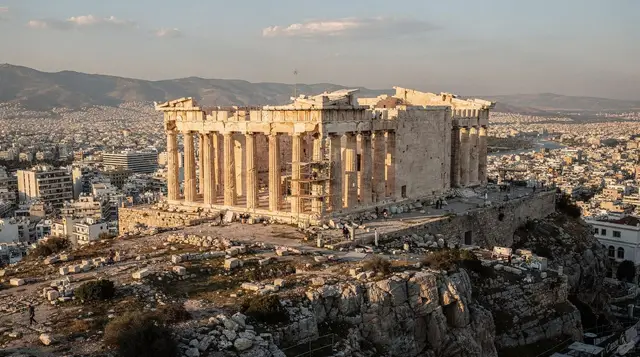
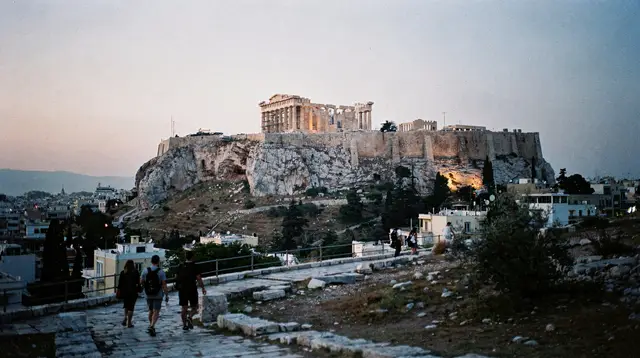
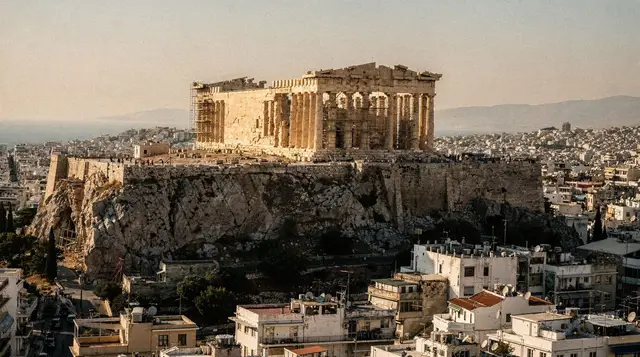
There are more impressive individual monuments in the world than the Parthenon — larger, better preserved, less surrounded by scaffolding. None of them carry quite the weight of the Acropolis. The rock has been a sanctuary, a fortress, a Christian church, a mosque and an Ottoman ammunition dump. It survived all of those reinventions. The 1687 Venetian cannonball that blew up the powder stored inside the Parthenon and collapsed its roof did the most damage; everything since has been archaeology and incremental restoration.
Standing on the Propylaea’s top step and looking east across the plateau for the first time is one of those moments that actually matches the expectation. The Parthenon is bigger than you think. The view back over the city — Monastiraki minaret, Lycabettus Hill’s chapel, the smudge of Piraeus beyond — is genuinely moving.
What undermines the experience is volume. On a summer afternoon, the 300-metre path from the main entrance gate to the Parthenon is thick with tour groups moving at a crawl. The solution is simple but requires commitment: arrive at or before 8 am.
| Adult ticket | €30 full, €15 reduced, all year |
| Opening hours | 8 am–8 pm (1 April–31 August); shorter hours the rest of the year, 8 am–5 pm from November to March |
| Nearest metro | Akropoli (Line 2), ~10 min walk up |
| Facilities | Cafés and toilets near the entrance; none on the plateau itself |
Tickets and entry options
The adult ticket costs €30 (reduced €15), all year round. Each site sells its own ticket: book them on the official Hellenic Heritage ticketing portal, and check there whether a multi-site ticket is offered. Free entry days include 6 March, 18 April, 18 May, the last weekend of September, 28 October, and the first and third Sunday of each month from November to March; a free day does not exempt you from reserving the Acropolis time slot.
Pre-booking online is strongly recommended in summer and at weekends. Walk-up queues at the main south entrance gate can run 45–90 minutes from mid-morning. Even with a pre-booked ticket, plan to arrive before the tour coaches unload at 9–9:30 am.
The pre-booked Acropolis ticket with reserved entry slot is the simplest option for independent visitors. For those who want narration without a live guide, the audio guide entry works well — the commentary is detailed and you can move at your own pace.
For an exceptional experience, early morning Acropolis and Museum access gets you onto the rock before general admission opens and combines it with a pre-opening guided session in the Acropolis Museum — genuinely worth it for serious history travellers.
The full detailed breakdown of every ticket type is in the Acropolis tickets guide.
What you actually see on the summit
The path from the main gate climbs to the Beule Gate (Roman period) and then to the Propylaea — the monumental marble gateway to the sanctuary, never quite finished due to the Peloponnesian War. The smaller temple to the right is the Temple of Athena Nike, returned in 2010 after 30-year disassembly for restoration; the surviving frieze reliefs show the Athenians defeating the Persians at Plataea.
The Parthenon (448–432 BC) is the dominant structure and occupies most visitors’ attention, but the Erechtheion to its north is in some ways more interesting. The south porch of the Erechtheion — the famous Caryatid porch, where six stone maidens serve as columns — is one of the most recognisable images in ancient architecture. The figures on site are replicas; five originals are in the Acropolis Museum, one is in the British Museum.
The north slope contains the Theatre of Dionysus (separate entry) — the world’s first theatre and the place where Sophocles and Aristophanes premiered their plays to an audience of 15,000. It is heavily restored but the scale reads clearly.
Walk to the west end of the plateau for views toward Thissio and the Ancient Agora below; the east end gives you Hymettus and the Attic plain. Both directions are worth the extra five minutes.
The Acropolis Museum
The museum at the foot of the south slope, opened in 2009, was purpose-built to house the sculpture programme of the Parthenon. The third-floor gallery is aligned precisely to the orientation of the Parthenon above and is lit by natural light through glass ceilings. The frieze sections that remain in Athens are displayed in sequence with cast substitutes filling the gaps where the Elgin Marbles now sit in London — a deliberately political arrangement that makes its point quietly.
Entry is €20 adult (€10 reduced) (combined entry with site is not discounted — they are separate tickets). The museum opens at 8 am in summer and is noticeably less crowded than the rock above, making it ideal for the middle part of a hot summer day when the Acropolis itself is uncomfortably exposed.
A guided tour of the Acropolis Museum makes the most of the collection — the room-by-room chronology of the sculptural programme is not immediately obvious without a guide.
Getting the best from a guided tour
A live guide changes what you see on the Acropolis significantly. The columns of the Parthenon have a slight inward tilt, the stylobate curves upward at the center, the column spacing varies — all intentional optical corrections that your eye processes unconsciously and that no amount of signage makes as clear as a single demonstration in place. The skip-the-line guided tour with an archaeologist-guide is the best single investment for a first visit.
For families, the Athens Acropolis for families itinerary at the Acropolis Museum has interactive elements that hold children’s attention better than the windswept rock above.
After the Acropolis
Coming down the south slope on Dionysiou Areopagitou street puts you directly in front of the Acropolis Museum. Turn right and you are in Koukaki within five minutes — good lunch options, shaded streets, the best neighbourhood to decompress after the sensory intensity of the summit. Turn left along the pedestrian promenade and you reach Thissio in 15 minutes, with the Ancient Agora on your left and unobstructed Acropolis views opening up behind you.
If you arrived via Metro Akropoli, the 3-day Athens itinerary suggests a logical sequence for the afternoon: Ancient Agora, then walk north through Monastiraki for a late lunch and rooftop views back to where you started.
Facilities, accessibility and what to bring
The plateau is uneven ancient marble, polished smooth by millennia of footsteps and genuinely slippery when wet — flat, closed-toe shoes with grip are not optional, whatever the season. A wheelchair-accessible route exists via a cliff-side lift near the Acropolis Museum entrance, but it operates on a limited schedule and is best confirmed in advance through the site office; the rest of the ancient path is not step-free. There is no shade anywhere on the summit, so a hat, sunscreen and water matter more here than at almost any other Athens site — the small kiosk near the entrance sells bottled water but nothing else worth relying on. Toilets exist only near the main gate and at the Acropolis Museum, not on the rock itself, so plan accordingly before the climb.
Photographing the Acropolis well
The classic shot — Parthenon front-on with clear blue sky — is best from the west end of the plateau in the first hour after opening, before the crowd of visitors fills the foreground. For a view that includes the city rather than just the ruins, the Lycabettus Hill summit and the rooftop bars around Monastiraki both look back at the rock rather than from it, and pair well with a same-day Acropolis visit. The dedicated Acropolis sunset photography guide covers the golden-hour angles from outside the site in more depth, useful once the site itself closes for the evening. Inside the fence, avoid photographing the Caryatid porch with flash — it is prohibited and, on the original marble figures inside the museum, actively enforced.
Reading the monuments before you go
The Acropolis rewards a little preparation. Visitors who arrive knowing what each building was for tend to spend less time photographing and more time looking. The Parthenon guide walks through the temple’s construction, its sculptural programme and the restoration work you will see under way. For the wider story of who was worshipped here and why, the gods of the Acropolis explains the sanctuary’s cults, and Greek mythology in Athens connects those myths to places you can visit elsewhere in the city. If you like to understand how the rock fits into the long arc of the city, the Athens history timeline places the Acropolis between the earliest settlement and the modern capital, while the birthplace of democracy explains why the civic life that unfolded below the rock mattered so much.
Planning the visit around your day
The Acropolis is rarely the only thing on a good Athens day, so it helps to decide early where it sits in your schedule. Early morning on the rock followed by the museum while the day heats up is the classic rhythm, and it leaves the late afternoon free for wandering. If you are still choosing between the two ends of the day, the blog post on Acropolis morning versus evening compares the light, the crowds and the mood, and the practical advice in avoiding Acropolis crowds is worth a read before you fix a time. Anyone building a longer trip can drop the rock into the Athens in one day itinerary or spread it more comfortably across the two-day itinerary.
Do not underestimate the effect of the season. The best time to visit Athens guide explains how the shoulder months change the experience, and the notes on Athens in summer heat are essential if you are travelling in the hottest weeks. Winter has its own appeal, with clearer air and far fewer people, which is covered in Athens in winter. A change of weather can also rearrange your plans, and Athens on a rainy day suggests where to go when the marble is too slick to enjoy.
Making the most of the time on the rock
Most people walk straight to the Parthenon and then drift back toward the exit. A better approach is to move slowly in a loop. Pause at the Propylaea to take in the scale of the gateway, spend real time at the Erechtheion, and leave the Parthenon for a second pass once the first rush has thinned. Stand still at the edge of the plateau for a few minutes and let your eyes follow the city outward: you will start to pick out the neighbourhoods, the hills and the sea, and the geography of Athens begins to make sense in a way that a map never quite achieves.
Bring patience for the crowds near the main monuments, and look for the quieter corners. The edges of the plateau are usually calmer than the central path, and the view from them is often better than the one everyone queues for. If you travel with a group that moves at different speeds, agree a meeting point near the Parthenon before you set off, because the paths are busy and mobile signal on the rock can be unreliable.
If you want the whole picture, combine the rock with the sites at its foot. The Ancient Agora shows the civic heart of the ancient city, the Roman Agora adds a later layer, and the Temple of Olympian Zeus shows the ambition of the city’s later rulers. Hadrian’s Library sits close by for anyone who enjoys wandering among ruins in a tighter setting. For the objects that once stood on the rock, the Acropolis Museum guide is the natural companion to this page, and Acropolis versus Acropolis Museum helps if you only have time for one of the two.
Where to stay and how to get around
Staying close to the rock turns the visit into something unhurried. Koukaki puts you a short walk from the museum and the main gate, while Plaka places you in the old streets right below the north slope. The where to stay in Athens guide compares the neighbourhoods more fully. For getting about, the Athens metro guide and the getting around Athens overview cover the practicalities, and cruise passengers should read the Piraeus to Acropolis transfer notes before choosing how to reach the site from the port.
Once you have seen the rock, there is plenty more to fill the afternoon. A relaxed route through the old streets is laid out in the Plaka walking tour, and the Athens self-guided walk strings several of the major sights into one comfortable loop. When the sun drops, the best photo spots in Athens suggest where to catch the rock lit up, and Philopappos Hill offers a quiet vantage point that looks straight across at the Parthenon.
Frequently asked questions about Acropolis
Do I need to book Acropolis tickets in advance? Yes, in peak season (April–October) and at weekends. Walk-up queues at the main south gate regularly run 45–90 minutes from mid-morning onward, and online booking costs nothing extra — it simply reserves your entry slot. Off-season weekday visits are more forgiving of a walk-up approach.
Is the Acropolis suitable for visitors with limited mobility? Partially. A cliff-side accessible lift exists near the Acropolis Museum, but the ancient path itself is uneven marble with no step-free alternative beyond that point, and the lift’s operating hours are limited. Contact the site in advance to confirm current access, and consider prioritising the fully accessible Acropolis Museum if mobility is a significant concern.