The square that holds the city together
Syntagma — Constitution Square — is not Athens’ most beautiful space. It is a large, sun-baked rectangle with a central fountain, framed by hotels, banks and the neoclassical facade of the parliament building that was once the royal palace. It is noisy, frequently the site of protests or public gatherings, and in summer delivers an unforgiving quantity of exposed paving with minimal shade.
It is also completely unavoidable and in its own way essential. Syntagma is where the city’s metro lines intersect (Lines 2 and 3), where the airport bus stops, where political life visibly happens, and where the symbolic heart of the modern Greek state is located. The parliament and the Tomb of the Unknown Soldier are here; the ceremonial guards — the Evzones — stand watch in front of them. The National Garden, the most useful green space in central Athens, begins immediately behind the parliament.
Understanding Syntagma is understanding how Athens works as a functioning city, as opposed to how it looks as an archaeological site.
The Changing of the Guard
The Evzones — the presidential guard — stand motionless at either side of the Tomb of the Unknown Soldier on Vasilisis Amalias in their distinctive uniform: a white pleated skirt (foustanella), white stockings, and shoes with large black pompoms. The uniform is a stylised version of the dress worn by the fighters in the 1821 War of Independence.
The Changing of the Guard takes place at the top of every hour. The ceremony lasts about two minutes and involves a precisely choreographed sequence of exaggerated high-stepping movements — the pompon-shod feet are lifted to waist height in slow motion — and a synchronised handoff between the two guards. It looks like nothing else and is genuinely worth watching.
The Sunday ceremony at 11 am is the full version: an entire platoon in formal dress marches down Vasilisis Sofias from the Evzone barracks to the square, with a regimental band, before the handover. It lasts about 30 minutes and draws a considerable crowd; arrive by 10:30 am for a clear view.
Watching the ceremony well
Position matters more than punctuality. The guards stay in place in front of the monument, and the best views come from the side rather than straight on, where you can follow the slow lift of the leg and the swing of the pompoms. Visitors who stand directly behind a crowd of phones see very little. If you want photographs, think about the light: the monument sits in front of the parliament facade, so contrasts can be harsh at midday, and a little patience for a gap in the crowd pays off more than a zoom lens.
Treat the guards with respect. They are soldiers on duty, not street performers, and they do not pose or respond. Keep a sensible distance, do not touch the uniform, and let children watch from the front so they can see the details. The ceremony is a good moment to explain to younger travellers why the uniform looks the way it does; the Athens with kids guide has more ideas for keeping a family interested in the centre. For the story behind the ritual and what it means to locals, the blog piece on the changing of the guard is a good companion read.
The Syntagma Metro station
The Syntagma Metro station is worth a deliberate visit. During excavation in the 1990s, workers uncovered a section of ancient road and a large cemetery — parts of the original city’s edge. Rather than relocate or cover the finds, the station was redesigned with a glass wall along the platform that displays the excavation in situ: amphora, pottery, skeletal remains and structural foundations all preserved and lit. It is one of the best free museums in Athens, passed through by thousands of commuters daily.
The station also has glass cases near the exits displaying individual artefacts found during the dig, with brief explanatory labels in Greek and English.
Syntagma is also the terminus for the X95 airport express bus, which runs 24 hours a day between the square and Athens International Airport (about 50–70 minutes depending on traffic, €5.50 one way). For visitors landing without a hotel transfer arranged, the X95 stop just off the square is usually the simplest first orientation point in the city — the airport to city guide covers timings and the alternative metro Line 3 route in detail.
The National Garden
The National Garden (Ethnikos Kipos) is the former royal garden behind the parliament building, covering 15 hectares of central Athens. It is the easiest place to escape the heat and crowds in the city centre: well-shaded paths, a small zoo, ponds with ducks and turtles, a children’s playground and an outdoor cafe. Entry is free.
From the south side of the garden, Zappeion — the late-19th-century neoclassical hall built for the first modern Olympics — is accessible. Its pine-shaded forecourt has benches and a cafe and is reliably cooler than the surrounding streets by several degrees.
The walk from Syntagma, south through the National Garden to Zappeion and then west toward the Panathenaic Stadium (where the 1896 Olympics were held), is one of the better morning walks in Athens: shaded, historically dense and largely free of tourist infrastructure.
Even if you do not plan a long walk, the garden is a useful reset between museums. Families often use it as a pause point with a playground and shade, and travellers on a hot day can treat it as a free alternative to a cafe terrace. In the Athens in summer heat guide the garden features among the practical ways to keep a sightseeing day workable, and the August heat survival story tells how one traveller leaned on shaded corners like this one.
Syntagma and the story of modern Athens
The square takes its name from the constitution that Greece demanded from its king in the nineteenth century, and the parliament building looking over it is a reminder that this is where modern Greek politics plays out in public. Demonstrations gather here, sometimes peacefully and sometimes with disruption to traffic and metro entrances, so it is wise to glance at local news if your plans depend on crossing the square at a fixed time. Most visits are untroubled, but a protest can close streets for a while and make the area noisy.
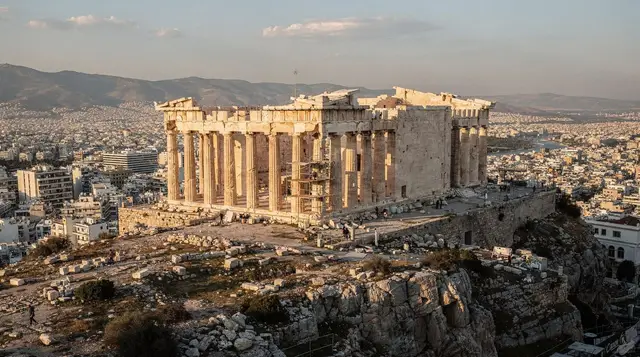
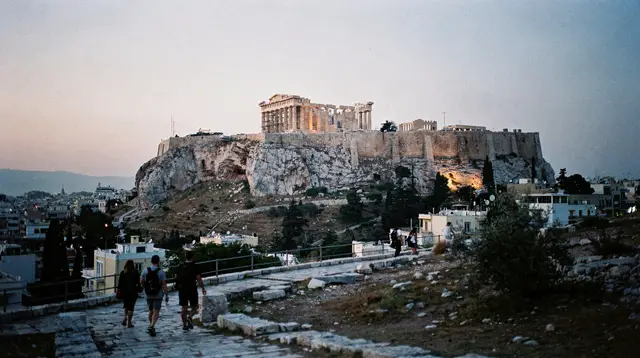
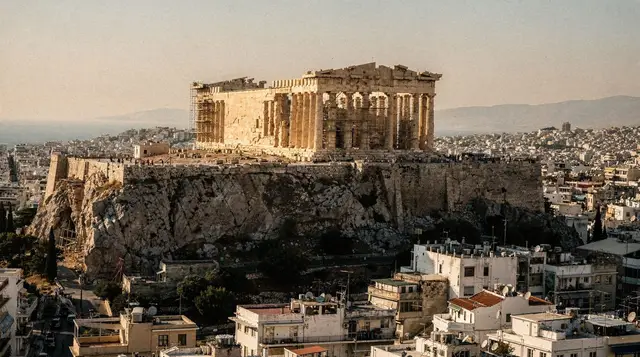
For a deeper sense of why Athens matters as a political idea rather than only a collection of ruins, the birthplace of democracy guide links the ancient story with the modern one, and the Athens history timeline places the royal palace, the independence era and the neoclassical city in order. Syntagma works as the modern chapter of a story that begins at the Acropolis.
Eating, coffee and small breaks nearby
The immediate edges of the square are built for hotels, banks and offices, so the food is more functional than inspired. For something with more character, walk a few minutes into Plaka or toward Monastiraki, where the best souvlaki in Athens and the neighbourhood tavernas are easier to find. The best tavernas guide is a good starting list if you want a proper sit-down meal after the morning walk.
For a quick coffee, the cafes around the square and on the garden side offer a place to sit and watch the city move. If you want to understand why a Greek coffee can take an entire hour, the Athens coffee culture guide explains the habit, and the Greek coffee ritual piece captures the mood. In the evening, the rooftops near the square offer a different view of the same neoclassical skyline; see the rooftop bars guide for ideas.
Using Syntagma as a transport pivot
Because the metro, the airport bus and many city routes converge here, the square is often the place where a trip changes gear: arriving from the airport, leaving for the port, or setting off toward a day trip. The Athens metro guide explains how the lines work together, and the getting around Athens guide compares the metro with buses, trams and walking. If you are heading to the sea, the Athens to Piraeus port guide covers the route from the centre to the ferries and cruise ships.
Travellers who arrive late or leave early will appreciate that this is one of the easiest places in the city to find your bearings. Keep your valuables close in the metro and around the busiest exits, as in any large transport hub; the is Athens safe guide gives a calm, realistic picture of what to watch for.
Making Syntagma part of a longer walk
The most rewarding way to use the square is as a joint in a longer route rather than a destination. A simple morning can begin at the guards, continue through the National Garden, and end at the Panathenaic Stadium or the Temple of Olympian Zeus before moving on to the Acropolis Museum or Hadrian’s Library. If you prefer to follow a ready-made route, the self-guided walk of Athens strings many of these stops together, and the Athens in one day itinerary shows where Syntagma fits when time is tight.
On a wet day the square loses much of its appeal, but the metro excavations and nearby museums keep the plan intact; the Athens on a rainy day guide suggests how to reshape a day around indoor stops. For general planning beyond this square, the Athens travel tips guide collects the habits that make a first visit smoother.
Shopping, banks and the practical city
The streets radiating from Syntagma toward Monastiraki and Kolonaki are where Athens does its practical retail. Ermou street runs west from Syntagma toward Monastiraki and is the main pedestrian shopping street — international brands at the Syntagma end, cheaper options as you go west, flea market territory by the time you reach Monastiraki.
Stadiou street and Panepistimiou (El. Venizelou) run northwest from Syntagma, parallel to each other, past the neoclassical trilogy of the National Library, Athens University and the Academy of Athens — three 19th-century buildings that constitute the finest examples of neoclassical architecture in the city. None is open to casual visitors but the exteriors are worth slowing down for.
Syntagma as a base
Syntagma is not the most atmospheric place to stay in Athens but it is the most connected. From the metro station, the Acropolis (Metro Akropoli, two stops on Line 2) is 8 minutes. Monastiraki is one stop west or a 12-minute walk along Ermou. Kolonaki is 10 minutes on foot east along Vasilisis Sofias.
How far things are from Syntagma
| Destination | Distance from Syntagma | How to get there |
|---|---|---|
| Acropolis | ~1.5 km | Metro Line 2, 2 stops (8 min), or 20-minute walk through Plaka |
| Monastiraki | ~800 m | 1 metro stop or 12-minute walk down Ermou |
| Kolonaki | ~1 km | 10-minute walk east along Vasilisis Sofias |
| Plaka | ~600 m | 10-minute walk south through the National Garden edge |
| Athens Airport | ~33 km | X95 bus (50–70 min, €5.50) or Metro Line 3 (~40 min) |
The where to stay in Athens guide makes the case for Syntagma-area hotels for visitors whose priority is transport convenience over neighbourhood atmosphere. For those prioritising walking access to the ancient sites, Koukaki and Plaka are better positioned. First-time visitors weighing up a compact itinerary around Syntagma and the historic centre can check the first-timers weekend itinerary or the Athens in 2 days plan for how the square typically fits into a short trip.
The Athens city highlights tour for first visitors typically starts or passes through Syntagma square — the guard ceremony and the Panathenaic Stadium are both standard inclusions on introductory Athens tours.
For a comprehensive morning orientation, the Athens highlights walking tour covers Syntagma, the neoclassical buildings, and the route toward the historic centre — a logical way to spend the first morning in the city before independent exploration.