
Delos guide: visiting the sacred island of ancient Greece
What is the island of Delos?
Delos is an uninhabited island near Mykonos in the Cyclades, and one of the most important archaeological sites in the ancient Mediterranean world. The mythological birthplace of Apollo and Artemis, it contains the ruins of a complete ancient city including the famous Terrace of the Lions. Access is by ferry from Mykonos only.
Delos: the island where Apollo was born
No island in the Aegean carries more mythological and historical weight than Delos. It was here, according to ancient belief, that Leto gave birth to the twin gods Apollo and Artemis — a sacred event that transformed a previously drifting, unstable island into solid ground fixed at the centre of the Cyclades. The myths are compelling, but the reality of what was built here over a thousand years is more compelling still.
| Where | Uninhabited island near Mykonos, Cyclades |
| Cost | Around €12 site entry, plus ~€25 return ferry from Mykonos |
| Time needed | Minimum 2–3 hours on-site, plus the ferry crossing |
| Getting there | Ferry from Mykonos Old Port only — no direct link from Athens |
| Best time | Morning departure (09:00) for cooler temperatures and fewer visitors |
Delos was, from around the 9th century BC to the 1st century BC, one of the most important cities in the Mediterranean world. At its peak it was home to 30,000 people, operated as the Aegean’s leading commercial port, and contained temples, theatres, markets, warehouses, and residential quarters of extraordinary quality. The city was sacked and looted in 88 BC by Mithridates VI of Pontus and never fully recovered. It was gradually abandoned, and no one has lived on Delos since.
Today the island is administered by the Greek Archaeological Service. It is uninhabited — no hotel, no permanent resident, no restaurant. The ruins cover the entire island. You arrive by ferry from Mykonos, spend time exploring, and leave. The lack of any tourist infrastructure is precisely what makes Delos so powerful: you are walking through an actual ancient city, not a curated reconstruction.
The archaeological site: what to see
The site is large — approximately 1.5 km long — and requires a minimum of 2 hours. A good site map is essential; the one provided at the entrance is adequate but a printed or downloaded version with more detail helps significantly.
The Terrace of the Lions
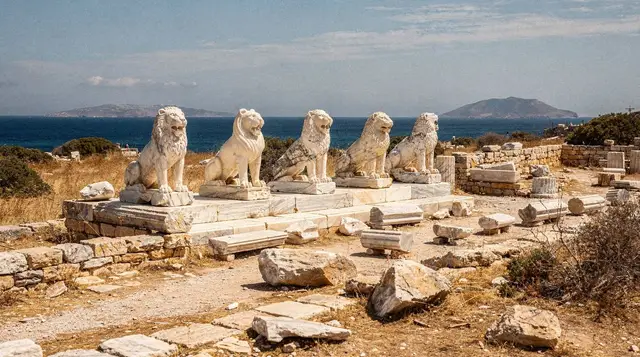
The most iconic sight on Delos. Nine (originally perhaps 16) marble archaic lions, carved in the 7th century BC, stand in a row facing what was once the Sacred Lake. They were dedicated by the island of Naxos and served as guardians of the sanctuary. The detail is remarkable — each lion is slightly different, and despite 2,700 years of exposure, the carving quality is still clearly visible. Several original lions are now in the Delos site museum to protect them from further erosion; replicas stand in their outdoor positions.
The Sanctuary of Apollo
The heart of the original sacred precinct: three temples dedicated to Apollo in different periods, plus a series of treasury buildings, stoas, and the remains of the Artemision (temple of Artemis). The layout is dense and requires the site map to follow, but the scale of what was here is immediately apparent. The huge marble base that once held a colossal statue of Apollo — among the largest ancient Greek statues ever made — still stands.
The Agora of the Italians
A vast colonnaded marketplace built in the 2nd century BC by Italian merchants who dominated Delos’s commercial life. The ruins of the arcade surrounding the open courtyard give a clear sense of the commercial activity that made Delos wealthy — slaves, grain, wine, oil, pottery, metalwork, all traded here.
The residential quarter and the House of Dionysus
The residential areas of Delos are remarkable because of the mosaic floors preserved in many houses. The most famous is the House of Dionysus (named for its mosaic of the god riding a panther), the House of Trident (with a trident mosaic), and the House of Masks (theatrical masks in mosaic). These are among the finest examples of Hellenistic domestic mosaic art surviving anywhere.
Walking through these houses — seeing where ancient merchants ate, slept, and entertained — gives Delos a human dimension that purely religious or civic sites often lack.
The theatre
A well-preserved ancient theatre cut into the hillside, capable of seating around 5,500 spectators. Performances were given here during the annual festivals celebrating Apollo. The view from the top tiers — the bay, the marble ruins, and Mykonos visible across the water — is one of the best views on the site.
The site museum
Adjacent to the ruins, the Delos Archaeological Museum holds the original lions from the terrace, the best mosaic panels removed for preservation, and a large collection of sculpture and decorative art from the excavations. The museum is small but dense. Allow 45–60 minutes.
How to get to Delos
From Mykonos: Delos is only accessible from Mykonos — there is no direct service from the mainland or from other islands. Small ferry boats depart Mykonos Old Port at 09:00 and 10:00, returning from Delos at 12:00 and 15:00. Round-trip fare is approximately €25. The crossing takes about 30 minutes.
Important: The last return boat from Delos is at 15:00. Miss it and you have a problem — there are no overnight facilities on Delos. Keep track of time.
Cruise option: Several operators offer sailing cruises from Mykonos that include Delos plus an afternoon at Rhenia for swimming. This combines the two best reasons to be on the water from Mykonos in a single day.
Delos and Rhenia sailing cruise with BBQ lunch from MykonosIf you want expert archaeological commentary at the site, book a guided version of the Delos trip.
Guided Delos day trip from Mykonos with archaeologist guidePractical information for 2026
Opening hours: Tuesday to Sunday, 09:00–15:00. Closed on Mondays — this is a detail worth checking, as a Monday visit to Mykonos with a planned Delos trip requires a schedule adjustment.
Admission: €12 per person. Combined ticket with the site museum available.
Getting to Delos from Athens: You cannot go directly. Travel from Athens to Mykonos first (fast ferry 3.5–4.5 hours from Piraeus, or 40-minute flight), then take the Delos ferry from Mykonos Old Port. Total journey time from Athens to walking around Delos: minimum 5–6 hours.
What to bring:
- At least 1.5 litres of water per person — there is nothing to buy on Delos
- High-SPF sunscreen and a hat — the site is almost entirely exposed
- Comfortable walking shoes — cobblestones, loose stone paths, uneven terrain throughout
- A downloaded or printed site map with building labels
- A camera battery charged to full — you will take many photographs
Why Delos matters: historical context
In 478 BC, Athens chose Delos as the headquarters of the Delian League — the alliance of Greek city-states that Athens used to consolidate its power after the Persian Wars. The treasury of the league was kept on Delos (before Athens moved it to the Acropolis in 454 BC). In 314 BC and 166 BC, Delos was declared a free port, which supercharged its commercial role.
At its peak in the 2nd and 1st centuries BC, Delos handled much of the eastern Mediterranean slave trade — estimates suggest 10,000 slaves were bought and sold daily in its markets, supplied by Cilician pirates. This commercial role made the island extraordinary wealthy and cosmopolitan. The religious traditions of Egypt, Syria, and Rome sat alongside the Greek sanctuaries. The Italian merchants who built the Agora of the Italians were just one of many international communities living here.
The sack by Mithridates in 88 BC killed 20,000 people. A second attack in 69 BC by pirates ended the city. The silence that followed preserved what we now walk through.
For the sailing day trip context, read the Mykonos Delos Rhenia cruise guide. For getting to Mykonos from Athens, see the Mykonos from Athens guide. For the broader Greek islands context, see the Greek islands from Athens guide and the best islands near Athens guide.
Delos compared with other Cycladic ruins
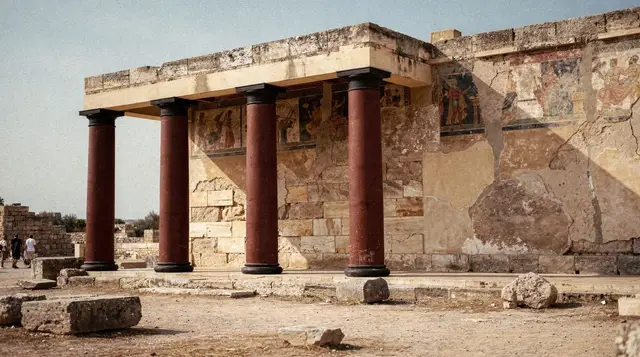
Delos is not the only ancient site you can reach from the Cyclades, but it is the only one that is a whole abandoned city rather than a single monument. Akrotiri on Santorini offers a Bronze Age settlement preserved under volcanic ash — atmospheric and well-presented, but roofed and much smaller in scope. Knossos on Crete is a single (heavily restored) palace complex, easier to reach and more crowded. Delos sits between the two: unrestored, sprawling, and reachable only as a genuine expedition rather than a quick stop. If your time in the islands is limited to one archaeological detour, Delos rewards travellers who want scale and solitude over polish; Akrotiri or Knossos suit those who prefer a shorter, more curated visit.
Combining Delos with a wider island trip
Because Delos can only be reached via Mykonos, most visitors fold it into a longer Cyclades stay rather than a single-purpose trip from Athens. If you are island-hopping, see the island hopping from Athens guide for how to sequence Mykonos with Santorini or Paros, and the Santorini from Athens guide if you’re weighing which island to add. Travellers based in Athens with only a few days spare sometimes ask whether Delos is worth the logistics of two ferries in a single day (Athens–Mykonos, then Mykonos–Delos–Mykonos) — it is demanding but doable if you take the earliest realistic Mykonos-bound sailing.
Frequently asked questions about Delos island
Can you stay overnight on Delos?
No. There are no hotels, guesthouses, or camping facilities on Delos. The last ferry back to Mykonos departs at 15:00. You must leave the same day you arrive. If you miss the last boat, you would need to arrange a private water taxi from Mykonos, which is expensive.
Is Delos crowded?
Less than you might expect for a site of this historical importance. The capacity constraint of two daily ferry departures limits the number of visitors significantly. If you take the 09:00 departure and arrive before the 10:00 group, you’ll have the early morning on the site with relatively few people. By 11:00–12:00 it becomes busier.
How difficult is the walk around Delos?
The terrain is uneven throughout — ancient stone paths, marble thresholds, loose rock on the hillsides. There are no ramps or paved tourist paths. Comfortable walking shoes or sandals with grip are essential. The theatre climb requires moderate fitness. Overall the site is accessible for most visitors but not suitable for wheelchairs or those with significant mobility limitations.
What is the best way to learn about Delos before visiting?
Bettany Hughes’s television documentaries on ancient Greece cover Delos well. The guide sold at the site entrance is the most comprehensive print resource available on the spot. Downloading a detailed site plan in advance (available from the Greek Ministry of Culture website) significantly helps navigation.
Why isn’t Delos better known internationally?
It is well known among archaeologists and classicists. Among general tourists, it suffers from being secondary to Mykonos in most travel coverage — Mykonos is written about for its beaches and nightlife, and Delos gets mentioned as an add-on. This keeps visitor numbers manageable, which is actually one of the site’s greatest current assets.
Is the Delos museum worth visiting?
Yes. The original lions from the terrace — the ones actually carved in the 7th century BC — are inside the museum. Seeing them at close range, reading the detail in the marble, is significantly more impressive than viewing the outdoor copies. The mosaic panels are also extraordinary. Budget 45–60 minutes for the museum in addition to the site.
Can I visit Delos as part of an Athens day trip?
Not directly. Delos has no ferry link to Athens or Piraeus — you must first reach Mykonos (by fast ferry or short flight), then take the separate Delos boat from Mykonos Old Port. It works as an add-on if you are already spending a night or more on Mykonos, but it is not realistic as a same-day round trip from Athens.
Should I book the guided tour or go independently?
Going independently with the site map is perfectly workable and cheaper, and most of the labelling at the major monuments is clear. A guided option earns its cost if you want the mythology and the Delian League history explained on the spot rather than pieced together from panels — the Sanctuary of Apollo and the Agora of the Italians in particular reward some verbal context that the on-site signage only partly provides.
Greek island adventures on GetYourGuide
Verified deep-linked GetYourGuide tours. Book through these links and we earn a small commission at no cost to you.
GetYourGuide does not provide product photos: on its activity cards, the picture illustrates the type of experience and is not the operator's own photo.
More tours on Viator
Top-rated experiences with verified reviews, bookable on Viator (a Tripadvisor company).
 Viator
Santorini Catamaran Cruise with Swim-Stops, Greek Meal and Sunset
FromEUR 150Check availability → Viator
Sailing trip to the Top Coasts of Crete, Daily/Multi-day
FromEUR 990Check availability → Viator
Private Overview of Santorini: Full-Day Customizable Experience!
FromEUR 200Check availability → Viator