
Knossos Palace guide: how to visit the Minoan site in 2026
How do you visit the Palace of Knossos?
Knossos is 5 kilometres south of Heraklion — 20 minutes by bus 2 from the city centre. Entry in 2026 costs €20 (single site) or €30 for a combo ticket with the Heraklion Archaeological Museum. Allow 2–3 hours. Go early (08:00) to beat the heat and tour groups. A licensed guide is worth the investment for context.
Knossos and the Bronze Age civilisation that built it
The Palace of Knossos was the administrative, religious, and economic centre of Minoan Crete — a Bronze Age civilisation that flourished on this island between approximately 2000 and 1400 BC, several centuries before classical Greek culture existed. At its peak, the palace complex covered 20,000 square metres and housed between 1,000 and 2,000 people. The surrounding city held an estimated 100,000 inhabitants, making it the first true metropolis of European prehistory.
The site was excavated beginning in 1900 by the British archaeologist Sir Arthur Evans, who spent four decades at Knossos, reconstructed significant portions of the palace in reinforced concrete, and largely invented the story of the Minoans as it is told today. Evans’s reconstruction is one of the most controversial decisions in the history of archaeology — vivid, accessible, and demonstrably wrong in several key details. Visiting Knossos means engaging with this tension: the ruins are partly the original Bronze Age structure and partly a twentieth-century Edwardian interpretation of that structure.
Both layers are fascinating. Understanding the difference makes the visit significantly richer.
| Where | 5 km south of Heraklion, Crete |
| Cost | Around €20 standalone, or €30 combo with the Heraklion museum |
| Time needed | Around 2–3 hours |
| Getting there | Bus 2 from Heraklion (20 min, around €1.70), or taxi (~€12–15) |
| Best time | Opening time, 08:00, to beat both heat and crowds |
Practical information for 2026
Address: 1 km from the Knossos village, approximately 5 kilometres south of Heraklion city centre.
Opening hours: Daily 08:00–20:00 (April–October), 08:00–15:00 (November–March). The site can be very hot in the afternoon — arrive early.
Admission 2026:
- Knossos only: €20 adults, €10 reduced (students, over-65s)
- Combo ticket (Knossos + Heraklion Archaeological Museum): €30 adults, €15 reduced
- Free: under-18s, EU students up to 25 with student ID
The combo ticket represents excellent value and the two sites are strongly complementary — the palace makes more sense once you have seen the original frescoes in the museum, and the museum artefacts mean more after you have seen where they came from. If time allows, visit the Heraklion Archaeological Museum first, then Knossos.
Getting there:
By bus: Bus 2 from Heraklion bus station (Plateia Eleftherias) every 20–30 minutes, 20-minute journey, €1.70. This is the easiest option without a car.
By taxi: approximately €12–15 from central Heraklion. FreeNow and Bolt operate in Heraklion.
By car: parking available near the entrance (free). Traffic on this road is significant in summer — taxis and buses are simpler.
Book a skip-the-line guided tour of Knossos Palace Book a Knossos self-guided audio tour with entry includedThe site: what you will actually see
The West Court and the kouloures
The main entrance brings you into the West Court, a large paved area that served as a public gathering space. Three circular pits (kouloures) are visible here — these were used for the disposal of sacred objects at the end of their ritual life. They contained pottery, frescoes, and food remains. Evans interpreted them as granary pits; later scholarship suggests the sacred disposal function is more likely.
The propylaea and the central staircase
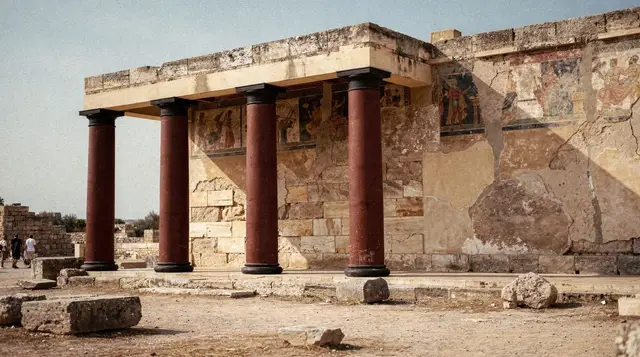
A formal entrance sequence — the propylaea — leads through columned corridors toward the central court. The columns here are among the most distinctive features of Minoan architecture: they taper downward (the opposite of Greek classical columns) and are painted in vivid terracotta red. The originals are Evans reconstructions in reinforced concrete and painted plaster. Whether you find them evocative or jarring will depend on your tolerance for creative interpolation in archaeological sites.
The Grand Staircase descends into the residential quarters on the east wing — it is considered one of the finest pieces of Minoan architecture to survive. Five flights of stairs with broad landings, lit by a light well, with frescoed walls. The original frescoes are in the Heraklion Archaeological Museum; what you see here are reproductions.
The Central Court
The rectangular central court — 50 by 25 metres — was the heart of the palace. Bull-leaping frescoes (reproductions) line the north side. The ceremony of bull-leaping, in which athletes vaulted over charging bulls, is one of the most discussed practices of Minoan culture: whether it was sport, ritual, or myth remains debated. The original fresco fragments in the museum clarify the imagery considerably.
The Throne Room
One of the most atmospheric spaces at Knossos, and the site of a significant controversy. A stone seat — Evans called it a throne — is set against the north wall of a small room, flanked by fresco griffins (reproductions). Evans interpreted this as the throne of King Minos. Subsequent scholarship suggests it may have been the seat of a high priestess rather than a king. The fresco scheme (griffins flanking a central seat) has closer parallels with religious imagery than royal imagery. You will not resolve this debate on your visit, but knowing about it makes the room more interesting.
The Queen’s Megaron and the dolphin fresco
The private residential area of the east wing includes the “Queen’s Megaron” — a suite of rooms around a light well with a famous dolphin fresco (reproduction). The original fresco in the museum is one of the highlights of Minoan art: delicate, naturalistic dolphins and fish rendered in blue and ochre. Evans assumed these rooms were female quarters based on the gentler imagery — the gender attribution is his invention.
The northern entrance and the bull relief
The northern entrance corridor is marked by a large relief fresco of a charging bull — the most visible example of the bull iconography that runs throughout the palace. This section of the palace is better preserved than average and gives a good sense of the original scale of the corridors and storage areas.
The Minotaur myth and the archaeology behind it
The legend of the Minotaur — the half-man, half-bull creature kept in a labyrinth beneath the palace of King Minos, fed with Athenian youths until Theseus killed it — is inseparable from any visit to Knossos, even though no literal labyrinth has been excavated. The likely archaeological basis is the palace’s own complexity: the multi-storey building’s maze of small interconnected rooms, corridors and light wells may have struck later visitors (and the Bronze Age Greeks who first told the story) as genuinely labyrinthine.
The recurring bull imagery throughout the site — the bull-leaping fresco, the bull reliefs at the northern entrance, double-axe (labrys) symbols carved into stonework — gave the myth its central symbols even if the literal monster and maze are invention layered onto a real, complicated building. Whatever the myth’s origin, walking the palace’s genuinely confusing floor plan makes the ancient association with a labyrinth easy to understand.
The Evans reconstruction debate
Arthur Evans spent his personal fortune and 35 years at Knossos. Without him, the site would have been badly looted and largely destroyed. He also made a series of decisions — reconstructing walls, adding new superstructure, repainting frescoes, attributing spaces to functions based on personal interpretation — that many archaeologists since have found difficult or impossible to reverse.
The reconstructed sections are visually striking and genuinely help visitors understand the palace’s original scale. They are also, in parts, demonstrably speculative. The red columns are a reasonable guess. The upper floor layouts are more contested. The attribution of spaces (“King’s Chamber,” “Queen’s Megaron,” “Throne Room”) reflects Edwardian assumptions about palatial hierarchy that may have no bearing on actual Minoan society.
A good guide or audio tour — rather than just wandering — is the most effective way to navigate this ambiguity. The licensed guide tours offered at the site or booked in advance explain which elements are original, which are Evans reconstructions, and where interpretation ends and imagination begins.
Knossos versus the Archaeological Museum
The two sites are not alternatives — they are complements. The museum holds the original frescoes (the palace has high-quality reproductions), the Linear A tablets, the famous Snake Goddesses, the Phaistos Disc, and thousands of other objects excavated from Knossos and other Minoan sites. Walking the palace is the physical experience of the scale and layout. Seeing the museum objects is where the culture becomes vivid.
The recommended order: Visit the Heraklion Archaeological Museum in the morning (allow 2 hours), then take bus 2 to Knossos in the afternoon (arrive by 15:00 to have the site in calmer afternoon light and avoid the worst heat). This order means the frescoes and artefacts in the museum are still in your mind when you stand in the spaces they came from.
The combo ticket (€30) covers both sites and saves €10 versus buying separately.
Book a guided tour of the Heraklion Archaeological MuseumGetting to Crete and Heraklion from Athens
Knossos is reached via Heraklion, Crete’s largest city. From Athens:
- Flight from Athens to Heraklion (HER): 55 minutes, from €35 each way
- Overnight ferry from Piraeus to Heraklion: 8.5 hours, from €30
The Crete from Athens guide covers logistics and the relative merits of flight versus ferry. Knossos is an easy day from central Heraklion with no car required.
For a broader view of Crete’s archaeological sites, see also the destinations section for Knossos and Heraklion.
Frequently asked questions about visiting Knossos Palace
How long should I spend at Knossos?
Two to three hours for a thorough self-guided visit with an audio guide. A guided tour typically runs 90 minutes to two hours. If you are an enthusiast of Bronze Age archaeology, three hours or more is easily justified. Budget walkers who just want to see the highlights in an hour will find the audio guide redundant — the site is large but the key spaces can be visited in 60 minutes.
Do I need a guide at Knossos?
Not strictly — the site is well signposted and an audio guide covers the key areas. But the Evans reconstruction controversy, the difference between original and reproduced frescoes, and the correct interpretation of key spaces are difficult to unpick alone. A licensed guide adds substantial depth. This is one site where the guided experience is noticeably better than unguided.
Is Knossos appropriate for children?
Yes, with the right framing. The Minotaur myth is immediately accessible to children aged 8 and above. The labyrinth association (the word “labyrinth” may derive from “labrys,” the double-headed axe that appears repeatedly in Minoan iconography), the bull-leaping frescoes, and the underground storage rooms all hold young imaginations well. The site is walkable for most ages.
What is the best time of day to visit Knossos?
Opening time (08:00) for cool air and thin crowds. By 10:00 in July and August, the site is crowded and very hot — the reconstructed areas offer almost no shade. If you cannot go early, visit in late afternoon (16:00–17:00) when the tour buses have departed. Avoid 10:00–15:00 in summer.
Is Knossos close to other Cretan archaeological sites?
Within easy day-trip range of Heraklion: Phaistos (1 hour by car, a second major Minoan palace with better preserved original structure and no Evans reconstruction), Gortyn (the former Roman capital of Crete, 46 kilometres south of Heraklion), and Malia (30 kilometres east, a third Minoan palace less visited than Knossos). A hire car and two to three days gives enough time for all of these.
Is photography permitted at Knossos?
Yes, photography for personal use is permitted throughout the site without restriction. Drone photography requires a separate permit from the Greek Ministry of Culture. Tripods are not permitted in peak season.
How much walking is involved at Knossos, and is it shaded?
The palace complex is large and involves a fair amount of walking on uneven ancient stone surfaces, ramps and some stairs, spread across roughly 1–1.5 km if you cover the main circuit. Shade is limited — a handful of trees near the entrance and some covered sections of the reconstructed wings, but most of the central court and outer areas are fully exposed. In July and August this makes an 08:00 start genuinely important rather than optional; by 11:00 the stone surfaces radiate heat on top of direct sun.
Greek island adventures on GetYourGuide
Verified deep-linked GetYourGuide tours. Book through these links and we earn a small commission at no cost to you.
GetYourGuide does not provide product photos: on its activity cards, the picture illustrates the type of experience and is not the operator's own photo.
More tours on Viator
Top-rated experiences with verified reviews, bookable on Viator (a Tripadvisor company).
 Viator
Naxos Kayak Tour to Rina Cave with Snorkeling and Homemade lunch
FromEUR 135Check availability → Viator
1 Hour Private Photoshoot in Rhodes
FromEUR 170Check availability → Viator
SemiPrivate Trip on 50ft Traditional Wooden Boat with Greek Lunch
FromEUR 135Check availability → Viator