The palace that made a myth
The story of the Minotaur — half-man, half-bull, imprisoned in a labyrinth beneath the palace of King Minos, fed Athenian tribute, finally killed by Theseus — is one of the oldest myths in the western imagination. Knossos, 5 km south of Heraklion, is the Bronze Age palace complex that the myth grew around. Whether the legend preserves a memory of actual events — the bull cult, the complex’s maze-like plan, Minoan dominance over Aegean trade — is a question archaeologists have argued for 120 years without resolution. What is certain is that this palace was real, enormous, and at its peak around 1700–1450 BC was the largest building in the Aegean world.
Knossos is the most visited archaeological site in Greece after the Athenian Acropolis. That should not put you off — the site is large enough to absorb crowds, and if you arrive at opening time you will have the best sections almost to yourself. What it does mean is that practical planning matters.
What to know before you arrive
Entry to Knossos palace costs €15. The combined ticket with the Heraklion Archaeological Museum costs €20 and is valid for 3 consecutive days — strongly recommended, since many of the best finds from the palace are in the museum rather than on site. The palace is open daily: 8 am–8 pm April–October, 8 am–3 pm November–March.
The Number 2 bus from Heraklion city bus station (Bus Terminal A, near the Venetian harbour) runs frequently and costs €1.50 each way. The journey is about 20 minutes. A taxi from the city centre is €10–12. There is a car park at the entrance.
The site has limited shade. Bring water, sunscreen, and a hat. There is a café at the entrance; the options inside are limited to one kiosk.
A skip-the-line guided walk is worth booking ahead for the May–September period — the guided entry bypasses the ticket queue, which regularly exceeds 45 minutes at peak times, and a knowledgeable guide is genuinely useful here. The site’s spatial complexity and Arthur Evans’s controversial restorations require context that a guidebook rarely provides efficiently.
For those who prefer to go independently, the audio guide with admission covers the major areas with enough archaeological context to make the visit coherent.
Knossos has almost no signage and the reconstructions are contested: a private guided tour with skip-the-line entry is the difference between walking past painted concrete and understanding what Evans rebuilt and why.
What you are looking at: the palace layout
Knossos is not a single building. It is a palace complex that evolved over roughly 600 years, and the remains you walk through represent multiple construction phases. The Central Court (approximately 27 x 52 metres) is the organising axis — most of the palace’s major elements are arranged around it.
On the west side of the Central Court: the Throne Room, the Pillar Crypts, and the main storage magazines. On the east side: the domestic apartments, the Hall of the Double Axes, and the Queen’s Megaron with its famous dolphin fresco copy.
The Throne Room is small — it seats perhaps 16 people on the stone benches along the walls — and the original alabaster throne (the oldest throne in Europe according to Evans, a claim that is archaeologically supportable) sits in situ. The antechamber contains a copy of the lustral basin fresco. The room’s scale, or rather its intimacy, surprises nearly everyone.
The Grand Staircase on the east side descends four flights into the domestic quarter and is the finest piece of Minoan architecture at the site. Evans restored it using concrete pillars; the original stucco and timber elements do not survive. The engineering logic — a light well at the centre delivering air and light to the lower floors — is impressive.
The storage magazines along the west wing contain rows of enormous pithos jars (some 1.5 metres tall), used to store oil, wine, grain, and other commodities. The sheer number of them — dozens of rooms, each with multiple jars — makes concrete the palace’s function as an economic redistribution centre for western Crete.
Evans and the restorations
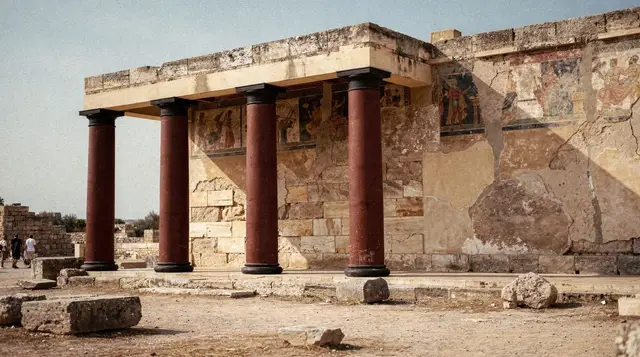
Arthur Evans excavated Knossos from 1900 to 1931 and spent most of his personal fortune on the work. He also partially reconstructed several areas using reinforced concrete and painted the rebuilt sections with fresco reproductions. The result is polarising and has been controversial among archaeologists since the 1930s.
The practical effect for visitors: several sections of Knossos look like a 1920s vision of a Minoan palace — bright ochre columns (painted upside-down, narrower at the base than the top, which is genuinely Minoan), blue and red fresco panels, multilevel terraces. This does help visualise the original scale and appearance. It also obscures the boundary between confirmed archaeology and Evans’s interpretation.
The honest approach is to treat the reconstructed sections as hypotheses illustrated in concrete, and to visit the Heraklion Archaeological Museum to see what the original frescoes — the bull-leaping scene, the Prince of the Lilies, the Ladies in Blue — actually look like. The museum copies at Knossos are faithful in detail but not in condition.
Combining Knossos with Heraklion
The most efficient sequence for a single day: arrive at Knossos at 8 am, spend 2–2.5 hours on site, take the bus or taxi back to Heraklion, have lunch in the old town, and visit the Archaeological Museum in the afternoon (closed Mondays, open until 8 pm in summer).
The combined Knossos and museum entrance tour handles the logistics and sequencing if you want to cover both in one guided visit. The city, Knossos, and archaeological tour extends this to include Heraklion’s old town and Venetian harbour — a full-day format that covers the essential Heraklion experience.
For those arriving in Crete on a day trip from Athens, the Knossos palace guide has the detailed site map and visit planning. The Athens to Crete guide covers how to structure a short visit around both Knossos and the museum.
Beyond the palace walls
The area immediately around the palace has been inhabited since at least 7000 BC. The Minoan settlement of Knossos that surrounded the palace — estimated at 80,000–100,000 people at its peak, which would make it the largest Bronze Age city in the Aegean — has been only partially excavated. The Villa of Dionysos, the Royal Road that runs northwest from the palace (the oldest road in Europe), and several smaller Minoan houses are accessible around the main ticket area.
The palace itself collapsed catastrophically around 1450 BC — earthquake, invasion, internal collapse, or some combination are all debated. The site continued in use into the Greek and Roman periods; a Roman villa is visible on the west side of the approach road.
From Heraklion, Knossos is the obvious first stop. If you have a hire car and more time, the palace of Phaistos (65 km southwest) is the second-largest Minoan site and was not reconstructed — different in character, less visited, in many ways more honest. For the full Crete context across east and west of the island, the 7-day Athens and Crete itinerary gives a framework that fits both in.
Knossos with children
The Minotaur myth is Knossos’s single best asset for family visits — children who know even the basic story of the Labyrinth engage with the site in a way that dry archaeology alone rarely achieves. The reconstructed sections, controversial among archaeologists, actually work in children’s favour: the painted columns and rebuilt staircases give a concrete sense of what a palace looked like, rather than asking a child to imagine a full building from a few foundation stones. Go early to avoid both the heat and the coach crowds, bring water, and expect a visit of about 90 minutes to two hours with a child’s attention span rather than the full 2.5 hours an adult might spend.
Getting the most from the reconstructed sections
A common visitor mistake is either accepting Evans’s concrete reconstructions as straightforward fact or dismissing them entirely as fake. Neither is quite right. Look for the areas where original stonework and Evans’s additions meet — often visible as a colour or material change — and treat the reconstructed sections as one influential archaeologist’s best guess rather than certainty. The Knossos palace guide breaks down which specific areas are original versus rebuilt in more detail, useful reading before or after your visit.
How to walk the site without getting lost
Because the palace grew in phases and has no single obvious entrance route, it helps to decide on a loop before you start. Begin at the Central Court, which gives you a fixed point, then take the west side first while the light is soft and the crowds have not yet arrived. The Throne Room and the storage magazines sit together, so you can see them in one pass. Cross the court afterwards to the east side, descend the Grand Staircase, and finish in the domestic quarter, where the lower floors are cooler and a little shaded. Trying to follow the numbered route markers strictly is less useful than keeping the court in view and moving around it.
Pause often. The most rewarding moments at Knossos are small: a light well that explains how rooms without windows were lit, a doorway whose proportions tell you how people moved through the building, a pithos jar that makes the scale of storage tangible. Visitors who hurry from highlight to highlight tend to leave remembering only the painted concrete.
Why the myth still matters here
The Minotaur story is the reason many people come, and it is worth reading or retelling before you go. The tale of Theseus, the Athenian tribute and the labyrinth links Crete directly to Athens, which is why it fits so naturally into a trip that starts on the mainland. If you want the wider mythological background, the Greek mythology in Athens guide shows how the same cast of heroes and gods appears across the capital’s monuments, and the Athens history timeline helps place the Bronze Age palace in the longer story of the Greek world.
At the site itself, the myth is best treated as a lens rather than a fact. Standing in a maze of corridors and small rooms, it is easy to see why later Greeks imagined a labyrinth here. What you are really looking at is an administrative, religious and economic centre, and that is the more surprising story.
Pairing the palace with the museum and other collections
Seeing Knossos and then the original finds in the Heraklion Archaeological Museum guide turns two good visits into one coherent one. The palace gives you space and architecture; the museum gives you faces, colours and craftsmanship. If you have time on the mainland as well, the National Archaeological Museum in Athens lets you compare Minoan art with the later Mycenaean and classical traditions, and the site of Mycenae shows what came after the Minoan world.
Planning Knossos into a wider Greek trip
Many visitors reach Knossos as part of a longer journey that begins in Athens. The Crete from Athens guide explains how the island fits around a mainland stay, while the best day trips from Athens page is a useful comparison if you are deciding how to divide your time between Crete and the Attica region. For a trip that links the islands, the Greek islands from Athens guide and the Athens in 5 days with day trips itinerary give a sense of how much each stop deserves. Travellers who want to continue to other Cretan highlights can look at Chania on the western side of the island, or the dramatic coastline near Spinalonga.
A few practical habits that make the visit better
Carry a small bottle of water and refill it before you enter, since the interior offers little. Wear shoes with good grip, because the stone paths and steps are uneven and can be slippery. Keep your phone for photographs only at the moments that matter, and spend the rest of the time looking. If you are visiting with a guide, ask them to point out where original material ends and reconstruction begins; once you can see that line, the whole palace reads more clearly. Finally, leave a little time at the end to sit and look back across the Central Court, which is the best way to feel the scale of what stood here.
Frequently asked questions about Knossos
Is Knossos worth visiting if I’ve already seen the Heraklion Archaeological Museum? Yes — the museum holds the finest original artefacts and frescoes, but only at Knossos do you get the actual scale and layout of the palace: the Central Court, the Grand Staircase, the storage magazines with their giant pithos jars. The two experiences complement rather than duplicate each other, which is why the combined 3-day ticket makes sense.
Are Arthur Evans’s reconstructions accurate? Partially, and this is genuinely debated among archaeologists. Evans used contemporary evidence (fresco fragments, structural remains) to guide his reconstructions, but he also made interpretive choices — the bright ochre and red colour scheme, in particular — that go beyond what the physical evidence alone can support. Visit with the understanding that the reconstructed sections are informed hypothesis, not certainty, and the site becomes more interesting rather than less.