Where Minoan civilisation comes into focus
You can read about the Minoans anywhere. You can look at photographs of the reconstructed frescoes, the bull-leaping scenes, the snake goddesses with their raised arms and flounced skirts. Until you stand in the Heraklion Archaeological Museum and see the originals — case after case of artefacts from a Bronze Age civilisation that peaked around 1700 BC — you have not quite understood what was here.
Heraklion is not a conventionally beautiful city. It was bombed heavily in 1941, rebuilt in concrete, and has the slightly battered energy of a working Mediterranean port. The Venetian harbour with its fortress, the Lions’ Square fountain, the old market street of 1866 — these are real pleasures. But the reason you come to Heraklion is the museum and the palace 5 km to the south, and it is worth saying that directly.
The flight from Athens takes about 50 minutes and costs €30–80 depending on how far in advance you book with Aegean or Sky Express. The ferry from Piraeus takes 9 hours on the overnight Minoan Lines or ANEK services (deck passage from €35, cabin from €75) and arrives at dawn — useful if you want to save a night’s accommodation and start early.
The Heraklion Archaeological Museum
The museum on Eleftherias Square is one of the great museums of Europe. It holds the most comprehensive collection of Minoan art in existence, spanning from the Neolithic period to the post-Palatial era — roughly 5,000 years of Cretan civilisation compressed into 27 galleries.
The highlights that most visitors aim for: the Phaistos Disc (Gallery 3) — a clay disc impressed with undeciphered symbols, the only known example of its script, found at Phaistos in 1908; the bull-leaping fresco (Gallery 14) from Knossos showing acrobats vaulting over a charging bull; the Snake Goddess figurines (Gallery 4); and the extraordinarily delicate gold bee pendant from the Chrysolakkos cemetery at Malia. The Minoan sarcophagus from Agia Triada (Gallery 14), painted in full colour with ritual scenes, is the finest surviving Minoan painted object.
Entry to the museum is €15 (free the first Sunday of each month from November to March). Allow 2–3 hours minimum. The museum is closed on Mondays.
A guided museum walk cuts through the volume of objects and context effectively — a good guide will explain the Linear A/B distinction, the palace period chronology, and why the bull-leaping fresco is probably not depicting what it looks like. The audio guide with admission is the alternative if you prefer to set your own pace.
Knossos palace: what to know before you go
Knossos is 5 km south of Heraklion city centre — a €10–12 taxi ride or a short bus journey on the Number 2 bus from the city bus station (Bus Terminal A, near the port). Entry to the palace alone is €15; a combined ticket with the Heraklion Archaeological Museum is €20 and valid for 3 days.
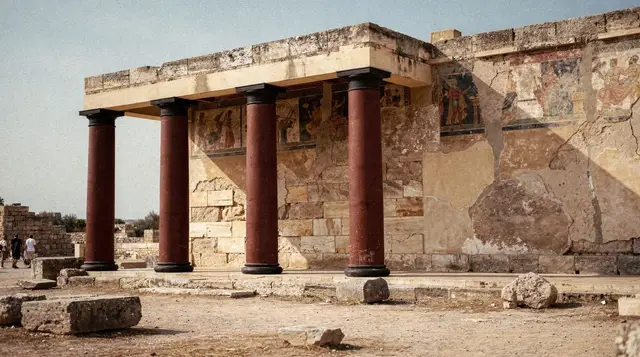
The palace complex covers roughly 20,000 square metres and dates primarily from the New Palace period (1700–1450 BC), though occupation layers go back to 7000 BC. The British archaeologist Arthur Evans excavated from 1900 and controversially restored sections using reinforced concrete, painting the reconstructed elements in colours derived from fresco fragments. The reconstructions are polarising — they give non-specialists something to visualise, but the line between genuine archaeology and early 20th-century imagination is not always clear.
What is not reconstructed: the scale of the site, the complexity of the drainage and storage systems, the sheer number of rooms. The Throne Room, with its original stone throne (the oldest in Europe, according to Evans), is small and surprisingly intimate. The Grand Staircase that descends to the domestic quarters is the finest piece of Minoan engineering you will see. The storage magazines with their enormous pithos jars — some taller than a person — make immediately concrete the economic scale of the palace as a redistribution centre.
A skip-the-line guided walk is worth booking in advance for the July–August period when queues at the gate exceed 45 minutes. The guide context is genuinely useful at Knossos — the site is large enough that without explanation, the reconstructed sections can mislead as much as inform. For those who want more control over timing, the audio self-guided admission is a solid middle ground.
Go at 8 am when the gate opens. By 10 am the coach groups have arrived and the site is crowded. By noon in summer, the heat and the crowds combine to make it exhausting. Two hours early is all you need.
The city: Venetian walls, market, and the harbour
The Venetian walls that ring Heraklion’s old centre are among the best-preserved in the Mediterranean. The Venetians took the island in 1204 and held it until 1669 — 465 years that produced the walls, the fortress at the harbour mouth (the Koules), the Lions’ Square Morosini Fountain (1628), the Loggia on 25 Avgoustou Street, and the Basilica of San Marco (now an exhibition space). The old town inside the walls repays an hour’s wandering.
The central market street (Odos 1866, running south from Lions’ Square) sells herbs, honey, local cheeses (graviera, myzithra), dried thyme, raki, and olive oil. It operates Monday to Saturday morning; arrive before noon.
The harbour area on Sofokli Venizelou promenade is pleasant in the evening — the Venetian Koules fortress is lit after dark, the restaurants along the waterfront are a notch better than the tourist tavernas in the lanes above. Seafood is the reliable choice; the Cretan salad (dakos, not Greek salad) and staka butter for bread are things to try.
The Heraklion food and city tour combines the market, local producers, and the old town in a format that works well if you arrive in Heraklion on a market day.
Heraklion as a base for eastern Crete
Heraklion is well positioned for day trips. The Lassithi Plateau and Diktaean Cave — supposedly the birthplace of Zeus — is 90 minutes by car. Agios Nikolaos and Spinalonga are about 70 km east along the north coast motorway.
The palace of Phaistos (65 km southwest, free entry) is the second-largest Minoan palace and, unlike Knossos, was not reconstructed — the actual ruins are what you see, and many archaeologists consider the site more honest for it. The views over the Mesara plain toward the Asterousia mountains are exceptional.
For those coming from Athens with limited time, the Crete from Athens guide covers how to structure a first visit between Heraklion and Chania.
How to link the museum and the palace
The two sites answer each other, and the best order is a matter of taste. Seeing the museum first means you meet the frescoes, the pottery and the seals as objects, so that when you reach the palace the empty rooms already have furniture in your head. Seeing Knossos first gives you the architecture and the setting, and the museum then fills those rooms with the things that once lived in them. Either way works; what does not work is doing both in a single hot afternoon. If you can, give each its own morning or its own half-day.
For the palace itself, the dedicated Knossos palace guide walks through the site room by room, and the Knossos destination page covers the setting and how it fits into a wider Crete trip. For the other half of the pair, the Heraklion Archaeological Museum guide explains how to move through the galleries without burning out on the first three rooms. Read both before you go and the visit becomes far more than a walk past labels.
A relaxed second day in the city
Once the headline sights are done, Heraklion rewards slow wandering. Start at Lions’ Square with a coffee, drift through the old centre toward the harbour, and let the afternoon take care of itself. The city is at its best when you stop treating it as a checklist: a long lunch, a walk along the sea wall toward the Koules fortress, an hour in a bookshop or a bakery, and a late dinner among locals rather than in the lanes that cater only to day-trippers.
If you enjoy eating your way around a place, the Cretan table is a good reason to stay an extra evening. Look for places where the menu is short, the bread arrives without being asked for, and the oil on the plate tastes of something. The island’s cooking leans on greens, cheese, honey, snails, lamb and good fish, and it is simple enough that quality shows immediately. For a comparison with the mainland, the Athens food tours guide gives a sense of how the same Greek habits play out in the capital, and the Chania food tour guide does the same for the western end of Crete.
Pairing Heraklion with the rest of Crete
Heraklion is the natural entry point, but it does not have to be the only stop. Visitors who want landscape after all that archaeology often head west to Chania, whose beaches and gorge walks balance the museum days. The Samaria Gorge hike guide, Balos lagoon guide and Elafonissi beach guide are the three most common additions, and each is a long day that needs planning in its own right. To the east, Spinalonga offers a very different, quieter kind of history.
If you are building a longer trip, the Athens and Crete in 7 days itinerary shows how to share your time between the capital and the island without feeling rushed. For travellers who want Crete as an add-on to a Greek holiday rather than the main event, the island hopping guide and the best islands near Athens put Heraklion in the context of the other options.
Practical notes
Heraklion’s Nikos Kazantzakis International Airport (HER) is 4 km east of the city centre — a €12–15 taxi or a 15-minute bus ride on the Number 1 bus (€1.50). Most of the mid-range hotels are within walking distance of the museum and the harbour, in the Dedalou/Korai area inside the walls.
The ferry port is in the city centre, on the north coast road. Overnight ferries depart at around 8–9 pm and arrive in Piraeus at around 6–7 am. Booking a cabin (€30–40 supplement on the base fare) makes the crossing comfortable.
For context on the wider island and how Crete fits into a Greece trip, the islands from Athens overview and the Athens to Crete connections guide cover the logistics in full.
Heraklion or Chania: choosing your Crete base
Crete’s two main cities cover different priorities, and travellers with limited time often need to pick one rather than splitting nights between both.
| Heraklion | Chania | |
|---|---|---|
| Main draw | Archaeological Museum + Knossos | Old town, Venetian harbour, southwest beaches |
| City character | Working port city, less polished | Photogenic, more tourist-oriented |
| Airport | Direct flights from Athens, ~50 min | Direct flights from Athens, similar timing |
| Best for | History-focused visitors, Knossos day | Old-town wandering, beach day trips (Balos, Elafonissi) |
| Day trip range | Lassithi, Agios Nikolaos, Phaistos | Balos, Elafonissi, Samaria Gorge |
Travellers with a full week often do both — Heraklion for Knossos and the museum, Chania for the old town and southwest beaches — connected by a scenic 90-minute drive along the north coast.
Nightlife and evening in Heraklion
Heraklion is not primarily a nightlife destination, but the streets around Korai and Handakos, close to the old town, have a decent concentration of bars that fill with a mixed local and student crowd (the city has a large university population). It’s a more low-key, less curated evening scene than Chania’s harbour-front bars — better for a relaxed drink than a big night out.
Frequently asked questions about Heraklion
Is Heraklion or Chania the better first stop in Crete? It depends on your priority. Heraklion is the right choice if the Archaeological Museum and Knossos matter most to your trip — both are unmissable and close together. Chania suits visitors who want a beautiful old town as their base and easy access to the island’s best beaches. With a week or more, doing both is the strongest option.
How much time do I really need in Heraklion? Two full days covers it properly: one for Knossos in the morning and the Archaeological Museum in the afternoon, one for the old town, Venetian harbour and market. A rushed single day is possible but means choosing between the museum and a relaxed look at the city itself.