
Self-guided Athens highlights walk: the 5km route
What is the best self-guided walk in Athens?
Start at Syntagma Square, walk through Ermou Street to Monastiraki, head south on the Dionysiou Areopagitou pedestrian boulevard to the Acropolis, then loop back through Plaka and Anafiotika. The full circuit is around 5km and takes 3–4 hours excluding site visits.
Walking Athens on your own terms
The good news about exploring Athens on foot is that the city’s most significant sites sit within a remarkably compact area. From Syntagma Square to the Acropolis is barely 1.5 kilometres. From the Acropolis to Kerameikos is another 1.5 kilometres. The entire classical core of the city — everything from the ancient Agora to the Roman Agora, from Plaka to Thissio — fits within a 2.5-kilometre diameter.
This guide maps a 5-kilometre self-guided circuit that covers the major highlights in a logical sequence, minimises backtracking, and includes specific street names and turn-by-turn directions so you can follow it without a paid tour. Total time is 3–4 hours at a comfortable pace, excluding any site entrance fees you choose to pay.
| Distance | Around 5km, looped |
| Time needed | 3–4 hours walking, plus site visits |
| Cost | Free to walk; site tickets extra (around €20–30 each for the major sites) |
| Start / end | Syntagma Square, looping back near Monastiraki metro |
| Best time | Early morning (8–9am) for light and cooler temperatures |
Stage 1: Syntagma to Monastiraki (1km, 15 minutes)
Begin at Syntagma Square, which is both the city’s transport hub and a site in its own right. The square’s name means “constitution” — it was here that King Otto was forced to grant Greece its first constitution in 1843, under pressure from the military and the public. The Hellenic Parliament building facing the square was originally the Royal Palace, completed in 1843 and converted after the monarchy was abolished in 1974.
In front of the Parliament, the Tomb of the Unknown Soldier is guarded around the clock by Evzones in traditional uniform. The changing of the guard takes place every hour on the hour (the full ceremonial change happens on Sundays at 11am). The ritual is worth pausing for — the slow, high-step march and the deliberate formality are unlike any other changing of the guard in Europe.
Walk west along Ermou Street, Athens’s main pedestrian shopping street. It is commercial and unremarkable for most of its length, but at the midpoint you will find the Kapnikarea Church marooned in the middle of the street — a Byzantine church from the 11th century that survived because the German archaeologist who discovered it in 1834 asked King Ludwig I of Bavaria to spare it from the demolition that was clearing Athens for its Neoclassical makeover. The church is small, dark, and Byzantine-beautiful inside.
Continue west to Monastiraki Square, the entry point to the old bazaar district.
Stage 2: Monastiraki and the Ancient Agora (500m, 30–60 minutes)
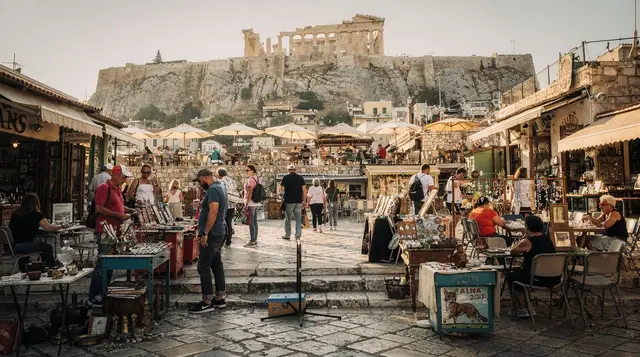
Monastiraki is one of Athens’s most visited squares and one of its most authentically chaotic. The flea market on Avyssinias Square (just north of the square, up Ifestou Street) sells second-hand furniture, old coins, vinyl records, and hardware with no apparent taxonomy. On Sundays it expands considerably.
From the south side of Monastiraki Square, look up Adrianou Street east into Plaka, and look south toward the Ancient Agora — the civic heart of ancient Athens, where citizens voted, argued, traded, and attended theatrical performances. Socrates taught here. Paul of Tarsus preached here in 50 AD. The Stoa of Attalos (rebuilt in the 1950s) houses the Agora Museum and its original colonnade is one of the finest examples of reconstructed ancient architecture in Greece.
Entering the Ancient Agora costs €20. If you are not buying tickets, you can see the site from the elevated Adrianou Street on the north edge, which gives a good view of the Hephaisteion — the best-preserved ancient temple in Greece, its columns and roof still largely intact after 2,400 years.
Stage 3: Along Dionysiou Areopagitou to the Acropolis (1km, 15 minutes)
From the south edge of Monastiraki, pick up Dionysiou Areopagitou Street, the pedestrian boulevard that runs along the base of the Acropolis hill. This is one of the finest urban promenades in Europe: 3.5 kilometres of car-free stone pavement, flanked on one side by the vertical walls of the Acropolis and on the other by the gardens of the Filopappou Hill.
Walking east along Dionysiou Areopagitou, you pass the:
- Odeon of Herodes Atticus (161 AD) — a Roman theatre still used for summer concerts, its stone seating now supplemented by modern chairs
- Stoa of Eumenes — the long colonnade connecting the Odeon to the Theatre of Dionysus
- Theatre of Dionysus — the world’s first purpose-built theatre (6th century BC), where Aeschylus, Sophocles, Euripides, and Aristophanes premiered their plays
- Acropolis Museum entrance — the modern museum at the east end of Dionysiou Areopagitou, worth an hour or two if ancient sculpture is your interest
The Acropolis itself is accessed via the path that turns left off Dionysiou Areopagitou, climbing steeply past the Beule Gate to the Propylaia. Entry costs €30 all year. The Acropolis tickets guide covers all options.
Stage 4: Areopagus and the free Acropolis view (200m, 15 minutes)
Opposite the Acropolis entrance, a rough path climbs a rocky outcrop called the Areopagus (Mars Hill). This is entirely free and provides one of the best close-range views of the Propylaia and Parthenon from a level that photographs well. The Areopagus is also the site where Paul of Tarsus gave his speech “To an Unknown God” in 50 AD, and where the ancient Athenian murder court sat — Orestes was tried here for killing his mother Clytemnestra (in mythology, at least).
The rock surface is steep and polished smooth, so the grip warning applies here especially.
Stage 5: Plaka and Anafiotika (1.5km, 60–90 minutes)
From the Areopagus, descend back to Dionysiou Areopagitou and turn right (east) past the Acropolis Museum. Then turn north onto Makrygianni Street and enter Plaka from the south via the stepped lane at Lysikratous Street.
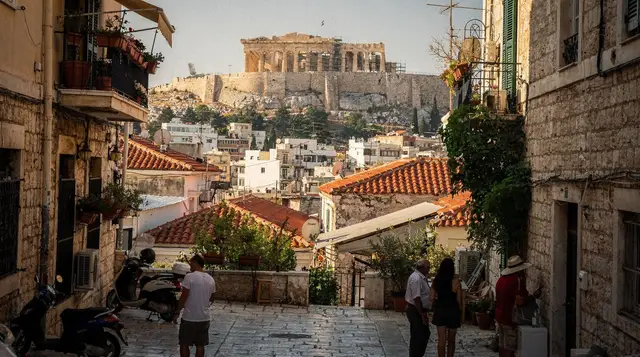
Follow the full Plaka and Anafiotika walking route described in the dedicated guide. The key stops are the Monument of Lysikrates, the Tower of the Winds, and the climb up to Anafiotika — the tiny Cycladic village built into the Acropolis’s northern face.
From Anafiotika, the path circles back west and descends to Adrianou Street, completing the Plaka loop.
Stage 6: Return via Thissio (1km, 15 minutes)
Walk west along Adrianou Street past Monastiraki and continue into Thissio, the quiet neighbourhood on the western side of the Acropolis. Apostolou Pavlou Street (the western continuation of Dionysiou Areopagitou) runs through Thissio with a row of excellent cafés and restaurants facing the hill. This is a good place to stop for coffee and look back at the route you have just walked.
The full circuit brings you back to Monastiraki, five minutes from the Monastiraki metro station.
Adding a guided tour to this route
Self-guided is rewarding but context-thin. The best walking tours guide lists the options for adding professional narration to all or part of this route.
The most efficient hybrid approach: take a two-hour group introduction tour on your first morning to orient yourself and absorb the major historical narrative, then use this self-guided route to revisit the areas that interested you most on day two. The Athens highlights walking tour covers the same arc as this self-guided route but in a tighter timeframe with expert commentary.
For the hidden corners — the parts of Psyrri and upper Anafiotika that do not appear on standard tourist maps — the hidden gems tour is excellent as a complement to the self-guided highlights circuit.
Self-guided or guided: how to decide
Neither approach is objectively better — they solve different problems, and many visitors end up doing both across a two- or three-day stay.
| Self-guided (this route) | Guided walking tour | |
|---|---|---|
| Cost | Free (site tickets separate) | Paid, usually with skip-the-line access |
| Pace | Entirely your own — linger or skip freely | Fixed group pace, set stops |
| Context | What you read beforehand or on-site plaques | Live narration, questions answered on the spot |
| Best for | Return visitors, budget travellers, early risers | First-time visitors, history enthusiasts, hot afternoons with shade breaks planned in |
| Flexibility | Total — reroute anytime | Fixed itinerary and schedule |
If this is your only day in Athens and you want the fullest possible context on the Acropolis and Agora without doing your own reading first, book a guided walk. If you already have a rough sense of the history — or you did the reading in the mythology guide — this free route delivers nearly the same ground at your own rhythm.
What you will see for free
A significant portion of this walk is genuinely free:
- Syntagma Square and the changing of the guard
- The Kapnikarea Church interior (free entry)
- The Monastiraki flea market
- Views of the Ancient Agora from Adrianou Street
- The full length of Dionysiou Areopagitou promenade
- The Areopagus viewpoint
- All of Plaka and Anafiotika’s street-level neighbourhood
- Thissio café strip views of the Acropolis
The only costs are the ticketed site entrances — Ancient Agora (€20), Acropolis (€30), and Acropolis Museum (€20). Each site is booked on the official Hellenic Heritage ticketing portal; check there whether a multi-site ticket is offered.
Practical tips
Start time: 8am in summer, 9am in spring or autumn. The route faces east in the morning (good light on the Acropolis) and west in the late afternoon (good light on the Areopagus and Thissio).
Water: there are free drinking water taps at Monastiraki Square and near the Acropolis ticket office. Bring a refillable bottle.
Food: eat lunch in Thissio (Stage 6) rather than Plaka. The Apostolou Pavlou café strip is excellent value and the view of the Acropolis from a seated table is hard to beat.
Getting around Athens beyond this walk: the getting around Athens guide covers the metro, tram, and bus network.
Frequently asked questions about the self-guided Athens walk
Is 5km a long walk in Athens?
On flat surfaces it would take under an hour. In Athens, with climbs to Anafiotika and the Areopagus, plus inevitable stops, plan for 3–4 hours. The elevation gain is modest (about 100m total) but concentrated in a few steep sections.
Can I do this walk with a pushchair?
Partially. The Dionysiou Areopagitou promenade, Adrianou Street, and Thissio are all flat and paved. Anafiotika, the Areopagus climb, and the stepped lanes of upper Plaka are not accessible with a pushchair. You can skip those sections and still complete the majority of the route.
What is the best map app to use?
Google Maps covers Athens well and includes the pedestrianised areas. Maps.me works offline. The official Athens tourism app also has walking routes. Download before you arrive — mobile data in the Acropolis site area can be patchy during peak hours.
Are there toilets on the route?
At the Acropolis Museum, inside the ticketed sites, and at the major cafés. There are no standalone public toilets on the route itself. Plan accordingly.
How does this walk compare to a hop-on hop-off bus?
Very differently. The hop-on hop-off covers a wider geographic area but stays on main roads and gives you only an aerial or passing view of sites. This walk puts you inside the neighbourhoods and at eye level with the architecture. The two complement each other if you have two days; if you have one day, this walk covers more of what makes Athens interesting.
Can I combine this with the mythology tour?
Yes. The Greek mythology Athens guide ties each site on this route to the gods and stories connected to it, so you can read it alongside this route and add the mythological layer yourself. Or take the mythology walking tour separately.
Is the route safe to walk after dark?
The main stretch along Dionysiou Areopagitou and through Plaka is well lit and busy most evenings, and walking it after sunset for the illuminated Acropolis view is popular and generally safe. Monastiraki and the flea market area are quieter and less well lit at night; stick to the main pedestrian streets and avoid empty side alleys in Psyrri late at night, as you would in any big city.
Do I need to book anything in advance for this walk itself?
No — the walk itself needs no booking. The only advance planning worth doing is the Acropolis entry ticket, which is time-slotted and sells out on peak days; see the Acropolis tickets guide. Everything else on the route (Syntagma, Monastiraki, Plaka, Thissio, the Areopagus) is walk-up and unticketed.
Athens experiences on GetYourGuide
Verified deep-linked GetYourGuide tours. Book through these links and we earn a small commission at no cost to you.
GetYourGuide does not provide product photos: on its activity cards, the picture illustrates the type of experience and is not the operator's own photo.

More tours on Viator
Top-rated experiences with verified reviews, bookable on Viator (a Tripadvisor company).
 Viator
Sea Kayak Epidavros - Ancient Sunken City Tour
FromEUR 80Check availability → Viator
Best of Santorini Sightseeing Guided Tour 5h
FromEUR 108Check availability → Viator
Meteora: Morning Half Day Sightseeing and Monasteries Tour
FromEUR 35Check availability → Viator