
Athens night walking tour: the after-dark city guide
Are Athens night walking tours worth it?
Yes — the flood-lit Acropolis seen from the Areopagus or Filopappou Hill at dusk is one of the best free sights in Greece, and Plaka fills with Athenians eating outdoors until midnight. Night walking tours typically depart at 7:30–8pm and last 1.5–2 hours.
Why Athens transforms after dark
Athens runs on Mediterranean time, which means its best hours are not 10am but closer to 8pm. By evening, the midday heat has broken. The tourists in the main sites have returned to their hotels. The cafés and tavernas on Adrianou Street and in Thissio are filling with Athenians who eat late and stay out later. And above it all, the Parthenon is flood-lit against a deep blue dusk sky — arguably the most dramatic single view available in Greece without hiking equipment.
A night walking tour in Athens is not a gimmick or a second-rate alternative to daytime exploration. It is a genuinely different city at night, and the things that make Athens extraordinary during the day — the scale of the ancient monuments, the density of layers in the old town, the particular theatre of Plaka at full social function — read differently in artificial light and evening atmosphere.
| Departs | Around 7:30–8pm |
| Duration | 1.5–2 hours |
| Cost | Free viewpoints, or a guided tour for a fee |
| Terrain | Stepped lanes in Plaka and Anafiotika |
| Book ahead | 2–3 days in June–August; last-minute fine off-season |
What night walking tours cover
Most guided night walking tours in Athens run between 7:30pm and 10pm, lasting 1.5 to 2 hours. The routes concentrate on three areas that are compelling after dark: the Acropolis viewpoints, the Plaka lanes, and the Anafiotika neighbourhood.
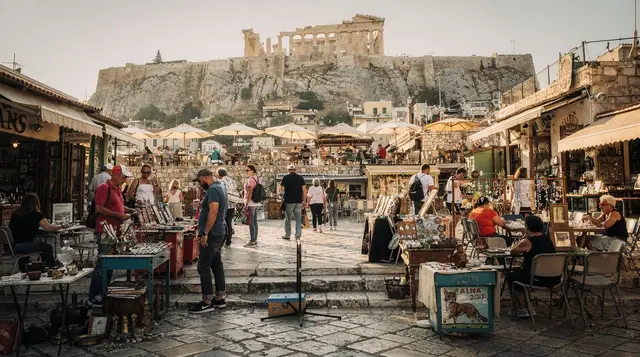
The Athens night walking tour is the most-booked evening option. The route typically begins at Monastiraki Square, where the flea market stallholders are packing up and the bar terraces are filling, and moves south through Plaka toward the viewpoints below the Acropolis. The guide covers the mythology and history of the illuminated monuments — the Parthenon, the Erechtheion, the Propylaia — from below, which is a different and in some ways more evocative experience than seeing them from inside the site during the day.
The second popular option is the Plaka and Anafiotika night walk, which focuses specifically on the old town. This tour enters Anafiotika after dark — when the tiny Cycladic neighbourhood is lit by a handful of wall lamps and the cats that colonise every surface are more visible than any human residents — and then descends through the quieter eastern lanes of Plaka before finishing in the busier restaurant quarter. This is the tour for travellers who want atmosphere and neighbourhood texture rather than a historical lecture.
The Acropolis floodlights come on about an hour after sunset and change every viewpoint in the centre: a private night guided tour can wait for that moment rather than working to a fixed group schedule.
The flood-lit Acropolis: where to see it
The Acropolis flood-lighting system has been in place for decades and is one of the most visited light installations in Europe, even if almost no one calls it that. The lights come on at dusk and run until midnight, giving roughly four to five hours of evening viewing in summer.
The best free viewpoints:
Filopappou Hill (Monument of Philopappos): the single finest view of the Parthenon, framing the west face at a distance of about 400 metres. The path up from Dionysiou Areopagitou takes about 20 minutes. The top has a monument to a Roman consul from the 2nd century AD, but the view is why you climb.
Areopagus Hill: the rocky outcrop directly opposite the Acropolis entrance. Steep, free, and staggeringly close — you are level with the Propylaia from here. Best for the northwest face.
Mnisikleous Street steps: a long staircase in upper Plaka where locals sit in the evening and look south-west at the illuminated hill. No climbing required, excellent for drinks.
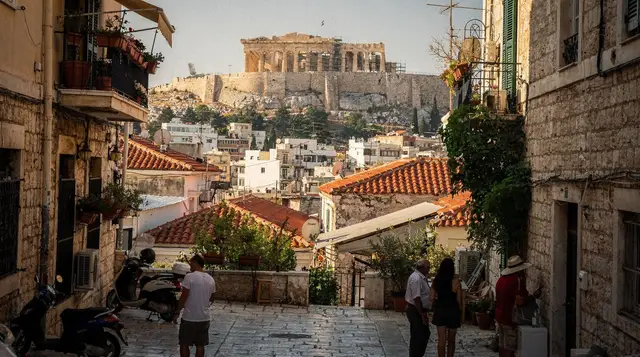
Adrianou Street (Monastiraki end): the western stretch of Adrianou gives a framed view of the Acropolis over the rooftops of Monastiraki. This is the view on a thousand postcards, and it is best at dusk when the sky is still blue behind the hill.
Thissio café strip (Apostolou Pavlou Street): sitting at a café table on this street at night, with the Acropolis to your left and the Ancient Agora behind a fence to your right, is one of the most pleasant ways to spend an Athens evening. Technically not a viewpoint but effectively a very comfortable one.
Comparing the free viewpoints
| Viewpoint | Climb | Best for | Crowds |
|---|---|---|---|
| Filopappou Hill | ~20 min uphill | The single best framed Parthenon shot | Moderate, spreads out |
| Areopagus Hill | Steep, short, rock scramble | Closest, most dramatic angle | Busy at sunset, thins later |
| Mnisikleous steps | None | Sitting with a drink, no effort | Moderate, local mix |
| Adrianou Street | None | The classic postcard view | Busy, but wide street |
| Thissio café strip | None | Comfort — table service with the view | Moderate |
If you only have time for one, Areopagus Hill gives the most drama for the least effort; Filopappou Hill rewards the extra walk with the better-composed photograph.
Plaka at night
Plaka at 9pm on a summer evening is different in every way from Plaka at 11am. During the day it is hot, busy, and commercially oriented — gift shops, restaurants shouting lunch menus, tour groups stopping for photographs. In the evening it is cooler, the outdoor tables are full of families eating rather than tourists snacking, and the lanes away from Adrianou Street have the quiet intimacy of a village.
The best evening route through Plaka starts at Kidathineon Street, which runs east-west through the heart of the neighbourhood and has the highest concentration of good tavernas. Walk east to the Monument of Lysikrates — the cylindrical choragic monument built in 335 BC, which is atmospheric in evening light — then climb north through the stepped lanes of Shelley Street and Thespidos Street into Anafiotika.
At night, Anafiotika is extraordinary in a specific way that resists easy description. The settlement has no street lighting in its upper reaches, which means the whitewashed walls are lit only by ambient light from the city below and the occasional house window. The contrast with the noise of Plaka 200 metres downhill is absolute. This is where many visitors to Athens have their strongest emotional response to the city — not at the Acropolis, which is magnificent but expected, but at this tiny island transplanted to a cliff face above a capital city.
Psyrri after dark
Psyrri is one of Athens’s main nightlife districts and functions as a continuation of the night walking tour experience for travellers who want to keep going after the official route ends. The bars and music venues on Sarri Street, Agion Anargyron Street, and around Iroon Square begin filling at 10pm and run until 3 or 4am.
The street art that makes Psyrri interesting during the day (see the Athens street art tour guide) takes on a different quality at night — lit from below by bar doorways and street lamps, the murals are partially visible, partially in shadow, in a way that makes them seem more dramatic and less like public decoration. If you have done the street art tour during the day, revisiting the same streets in the evening is worth the ten-minute walk from Monastiraki.
Night photography tips
The Acropolis flood-lighting is consistent and bright enough to photograph with a modern smartphone in night mode. From the Areopagus or Filopappou Hill, a 2–5 second exposure (use the timer to avoid camera shake) on a dedicated camera will produce the postcard view with good shadow detail.
Plaka and Anafiotika are harder to photograph at night — the lanes are dark and the light sources are mixed and warm. This is not a failure of technique but an accurate record of what those streets actually look like. Film photographers particularly favour the upper Plaka streets for exactly this quality.
Planning your night
A workable evening schedule for a first-time visitor:
5:30pm: Acropolis Museum (open until 8pm on Friday; standard closing is 8pm in summer across most days — confirm current hours before going)
7:30pm: Join the night walking tour from Monastiraki
9:30pm: Dinner in Plaka or Thissio
11pm: Drinks at a Thissio café or a Psyrri bar
For context on how the evening sites connect to the daytime mythology and history, see the Greek mythology Athens guide and the Athens history timeline.
The best walking tours in Athens guide explains how to combine a daytime highlights tour with the evening walk for a full-day Athens experience.
What to wear and bring
Plaka and Anafiotika’s lanes are cobbled and, in places, unevenly stepped — comfortable closed shoes matter more than they do for a flat daytime stroll along Adrianou Street. A light layer is worth carrying even in summer, since Filopappou and Areopagus Hill catch a breeze that flat streets don’t. In winter, the same walk works well but dress for temperatures several degrees cooler than daytime — see the Athens in winter guide for month-by-month expectations. A phone with night mode covers most photography needs; a small torch is useful only for the unlit upper reaches of Anafiotika.
Extending the evening: rooftop bars and a proper Athenian night out
If the walking tour and dinner in Plaka aren’t enough evening, Athens’ rooftop bar scene picks up exactly where the walk leaves off — many of the best rooftops overlook the same flood-lit Acropolis from a table with a cocktail rather than a viewpoint bench. See the Athens rooftop bars guide for options near Monastiraki and Plaka that need no more than a short walk from the night-tour route. For a livelier finish, the Athens nightlife guide covers Psyrri’s bars and clubs in more depth than a single evening’s detour allows.
Lycabettus Hill sunset tour — the highest Acropolis viewpoint in the cityFrequently asked questions about Athens night walking tours
Are Athens night walking tours safe?
Yes. Athens is one of the safer European capitals for pedestrians at night. The Plaka, Monastiraki, and Thissio areas are busy until midnight and beyond with a mix of tourists and locals. Psyrri is lively and safe; standard urban precautions apply. The empty upper lanes of Anafiotika at 11pm are quiet but not unsafe — they are residential streets used by people returning home.
Can I do the night walking tour if I have a young child?
The standard night tour runs 7:30–9:30pm, which is manageable for children who stay up late. The terrain includes some stepped paths in Plaka, so a pushchair is not practical. Some operators offer family-specific evening tours — ask when booking.
What is the temperature in Athens at night in summer?
In July and August, Athens at night rarely drops below 25°C and sometimes stays above 30°C after midnight. This is warm but significantly more comfortable than the 38–40°C daytime peak. Light clothing remains appropriate throughout the night in high summer. In May, June, September, and October, evenings are genuinely pleasant at 20–25°C.
Do I need to book a night tour in advance?
In June–August, yes — popular tours sell out two to three days ahead. In shoulder season (May, September, October) you can often book the day before. In winter (November–March), walk-in availability is common but tour frequency reduces significantly.
Is the Acropolis lit every night?
Yes, the flood-lighting runs every evening year-round from dusk until midnight (with some exceptions during maintenance periods). The intensity and colour temperature of the lights has changed over the years — the current system uses LED fixtures that produce a cooler, brighter light than the older sodium lamps.
What is the difference between the night walk and the daytime highlights tour?
The night walk is atmospheric and neighbourhood-focused — it is about the experience of the city in the evening. The daytime highlights tour is more informative — it is about the history, mythology, and architecture of the sites. They complement rather than duplicate each other. If you have two days in Athens, doing one of each is not redundant.
Can I combine the night walk with rooftop drinks afterward?
Yes, and it’s a natural pairing — several of the best rooftop bars near Plaka and Monastiraki are a five-to-ten-minute walk from where a typical night tour ends, and many keep the same flood-lit Acropolis in view from a table instead of a hillside bench.
Is Lycabettus Hill part of the night walking tour route?
Not usually — Lycabettus is taller and further from the Plaka/Acropolis cluster, and is normally treated as a separate excursion, often timed for sunset rather than after dark. It offers the highest viewpoint over the whole city, including the Acropolis in the distance, so it’s worth doing on a different evening rather than trying to fit it into the same night.
Athens experiences on GetYourGuide
Verified deep-linked GetYourGuide tours. Book through these links and we earn a small commission at no cost to you.
GetYourGuide does not provide product photos: on its activity cards, the picture illustrates the type of experience and is not the operator's own photo.
More tours on Viator
Top-rated experiences with verified reviews, bookable on Viator (a Tripadvisor company).
 Viator
Sea Kayak Epidavros - Ancient Sunken City Tour
FromEUR 80Check availability → Viator
Best of Santorini Sightseeing Guided Tour 5h
FromEUR 108Check availability → Viator
Meteora: Morning Half Day Sightseeing and Monasteries Tour
FromEUR 35Check availability → Viator