
Best souvlaki in Athens: the definitive guide for 2026
Where is the best souvlaki in Athens?
Kostas on Agias Irinis Square in Monastiraki is the most-cited classic — pork souvlaki wraps since 1950, cash only, closing when it runs out. Thanasis on Mitropoleos is the busy Monastiraki reference point. In Psyrri, Kalamaki Kolonaki-style counters offer a more relaxed format. Expect to pay €3.50–5 for a wrap in 2026.
The souvlaki debate is not trivial
Ask ten Athenians where to eat the best souvlaki in the city and you will receive ten different answers, delivered with a conviction that suggests geopolitical stakes. The disagreements are real and principled: pork or chicken, thin pita or thick, tzatziki or plain yoghurt, fried potato inside the wrap or on the side, wood-charcoal grill or gas.
These distinctions matter because souvlaki is not a luxury food. It is the city’s daily protein — the thing people eat for lunch standing up, for dinner at midnight, for recovery at 02:00 after a night in Psyrri or Monastiraki. Quality variation at this price point is felt acutely and remembered.
This guide works through the main areas and specific counters, explains the relevant vocabulary, and gives you a framework for forming your own opinion.
| Where | Monastiraki, Psyrri, Koukaki |
| Cost | Around €3.50–5.50 per wrap; €2–2.50 per kalamaki skewer |
| Time needed | 10–20 minutes standing, or a full lunch stop |
| Payment | Cash still preferred at classic counters; card increasingly accepted |
| Best time | Lunch (12–3pm) for the freshest meat; late night for the local ritual |
The vocabulary you need
Souvlaki: grilled meat on a skewer. In Athens, the default meat is pork. Can be eaten off the skewer (kalamaki) or wrapped in pita.
Kalamaki: souvlaki served on the skewer, without pita, usually eaten standing at the counter. Two or three kalamakia with a cold beer constitutes lunch.
Gyros: meat cooked on a vertical rotisserie, sliced off in thin strips. Pork is standard; chicken is available everywhere; lamb is less common.
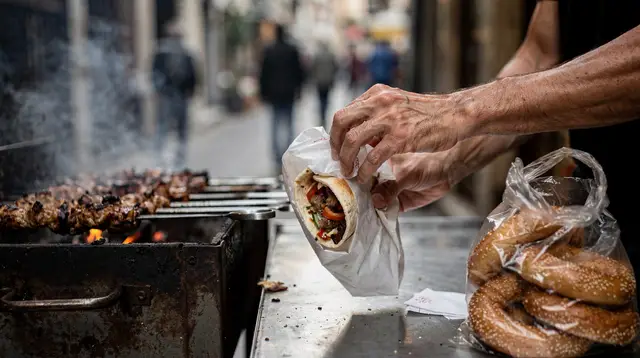
Pita: the flatbread used to wrap souvlaki or gyros. In Athens, pita is grilled briefly on the charcoal — it should have light char marks and be warm and pliable. The Thessaloniki version is thicker and doughier; Athens pita is thinner and crispier.
Souvlaki wrap (pita me souvlaki or pita me gyros): the whole package — pita, meat, tomato, onion, fried potato strips, tzatziki. This is what most visitors mean when they say souvlaki. Price: €3.50–5 in 2026 at good quality counters; up to €7–8 at tourist-facing spots.
Kalamaki piato / gyros piato: the plate version — souvlaki or gyros served on a plate with chips, salad, and pita on the side. €9–14.
Monastiraki: the souvlaki district
Monastiraki is the souvlaki capital of Athens by concentration if not necessarily by quality ceiling. The stretch of Mitropoleos from the square toward the flea market holds half a dozen competing counters, all visible from the street, all serving pork-dominant menus.
Kostas on Agias Irinis Square is the most discussed souvlaki counter in Athens. Ioannis Kostas opened it in 1950; his family still runs it. The format has not changed: pork souvlaki wrapped in thin pita with tomato, parsley, and a swipe of mustard. No tzatziki. No chips inside the wrap. No frills. The queue begins before noon and the counter closes when the meat runs out — typically by 14:00–15:00. Cash only. Wrap: €3.50.
Whether this is the best souvlaki in Athens is genuinely contested. The mustard-instead-of-tzatziki formula alienates tzatziki partisans. The closing time makes it inaccessible for evening visitors. But the pork quality and the charcoal work are excellent, and the 70-year continuity of a single recipe is meaningful.
O Thanasis at the corner of Mitropoleos and Monastiraki Square is the high-volume, tourist-facing reference point. The meat is competent, the prices are fair, and the terrace seating makes it visible. The spetsofai (sausage and pepper stew) is the underrated order here — better than the standard souvlaki.
Savvas next door to Thanasis serves a gyros that locals often prefer to the neighbour: the pita is slightly thicker, the meat better seasoned. The wrap is €4–4.50.
Psyrri: the working-class version
One block north of Monastiraki in Psyrri, the souvlaki counters cater more to the market workers and neighbourhood residents than to tourists. The format is similar but the atmosphere is different — faster, more direct, less decorated.
Tranzistor on Pallados Street serves pork kalamakia and wraps to a mixed crowd of designers, print-shop workers, and market traders. The charcoal work is excellent; the pita is grilled to the correct char; the tzatziki has the right thickness. Wrap €4.
Kalamaki counters in Psyrri — there are several unnamed ones around Theatrou and Agias Theklas — operate on the kalamaki-first philosophy: you order skewers, they bring them to you at a counter, you eat standing. A kalamaki costs €2–2.50. Three with a Mythos beer is the standard lunch format.
Koukaki: south of the Acropolis
Koukaki developed a souvlaki scene of its own as the neighbourhood densified with residents and visitors. The counters here tend to be newer, slightly more design-conscious, and with slightly higher prices — wraps at €4.50–5.50.
Souvlaki Story near Petrou Ralli has developed a reputation for sourcing pork from named Greek farms and serving it with quality accompaniments — house-made tzatziki, tomatoes from Crete in season, pita from a local bakery. The product justifies the 50-cent premium.
The wrap anatomy debate
No aspect of souvlaki generates more local opinion than what goes inside the pita. The Athens standard is: tzatziki spread on the pita, meat, tomato, onion, fried potato strips. But every element is contested:
Tzatziki vs mustard. Kostas uses mustard; almost everyone else uses tzatziki. Both are correct within their own tradition.
Fried potato inside vs on the side. Inside is the Athenian default. On the side is the Thessaloniki influence. Visitors from the north often request separate chips; Athenians consider this eccentric.
Thick pita vs thin pita. The Athens pita is thinner and grilled harder. Thessaloniki pita is thicker and softer. Athens tourists from northern Greece will occasionally complain about the pita.
Tomato: chopped or sliced. Chopped tomato distributes better. Sliced tomato is more photogenic. The counter’s choice tells you something about its priorities.
What makes good souvlaki
The variables that distinguish excellent from acceptable souvlaki are:
-
Meat quality and cut. The best counters use pork neck (svinahals), which has enough fat to stay juicy on the skewer. Leaner cuts dry out quickly. Ask where the pork comes from — counters that source from named Greek farms tend to serve better meat.
-
Charcoal work. Gas grills exist and produce acceptable souvlaki. Charcoal grills produce better souvlaki — a faint smokiness, a superior char, a flavour difference that becomes obvious after a few comparisons.
-
Pita freshness. Pita should be grilled to order, not sitting in a stack. The char marks should be fresh. Stale pita is the most common failure mode at tourist-facing counters.
-
Tzatziki quality. Should be thick enough to cling to the pita, strained of excess whey, seasoned with garlic and dill. Watery tzatziki is the sign of a corner-cutting operation.
For a guided introduction to these distinctions with tasting context, a street food tour covers three or four souvlaki stops with a guide who can explain the differences.
Athens Street Art and Food TourThe Acropolis and street food combination is another option that contextualises the souvlaki counter within Athenian history — a guide who connects a 2,000-year-old monument to a 70-year-old souvlaki counter finds unexpected threads:
Athens Acropolis and Street Food TourSouvlaki at night
Unlike the morning breakfast counters, souvlaki operations run late. Most counters in Monastiraki and Psyrri stay open until midnight; some open at noon and close at 03:00, specifically targeting the post-nightlife crowd. The midnight souvlaki is a genuine Athenian institution — a wrap eaten standing outside a lit counter after a long night, functioning as both sustenance and punctuation.
The quality at late-night counters is variable — the pork has often been sitting rather than cut fresh — but the atmosphere is excellent. For a full nightlife guide to Athens, the companion piece covers the evening from aperitivo to last orders.
Browse all Athens food and drink experiences or read the Greek street food guide for context on the broader landscape. For the Varvakios central market where much of the pork and lamb originates, the market guide gives useful producer context. A food tour in Athens is a practical way to compare several souvlaki counters back-to-back with expert guidance. The best tavernas in Athens covers the sit-down meat dishes that use the same quality cuts. Explore Monastiraki, Psyrri, and all Athens destinations.
How souvlaki fits a wider Athens food day
Souvlaki rarely stands alone in a real day of eating in Athens. A common local pattern: Greek coffee and a pastry mid-morning (see the Athens coffee culture guide), a souvlaki wrap standing up around 1–2pm, and a proper sit-down taverna dinner later. If you’re building out a food-focused day, pair a Monastiraki souvlaki stop with a walk through Plaka beforehand, or with the Central Market if you’re there in the morning when the market is liveliest. Readers planning where to eat generally in the city should also see where locals actually eat in Athens for a broader, less tourist-facing list.
Souvlaki vocabulary: a quick reference
| Term | What it means | Typical price |
|---|---|---|
| Kalamaki | Skewer only, no pita, eaten standing | €2–2.50 |
| Souvlaki wrap | Pita, meat, tomato, onion, potato, tzatziki | €3.50–5.50 |
| Gyros wrap | Rotisserie-sliced meat, same wrap format | €3.50–5 |
| Piato (plate) | Meat with chips, salad, pita on the side | €9–14 |
Frequently asked questions about souvlaki in Athens
How much does souvlaki cost in Athens in 2026?
A souvlaki wrap (pita with meat, tomato, onion, tzatziki, and chips) costs €3.50–5 at quality counters in Monastiraki and Psyrri. Tourist-facing spots near the main Acropolis entrance or Syntagma Square charge €5–8 for the same thing. A kalamaki (skewer without pita) costs €2–2.50.
Is pork the only option for souvlaki in Athens?
Pork is the default and the most common. Chicken souvlaki is available at most counters and is popular with visitors who prefer lighter meat. Lamb appears occasionally but is more typical in northern Greece or on the islands. Veal and mixed meat options exist at some counters.
Can I eat souvlaki in Athens as a vegetarian?
A fully vegetarian souvlaki is not traditional, but most counters can make a pita wrap with just chips, tzatziki, tomato, and onion — the halloumi version exists at a small number of more modern counters. The Athens vegetarian and vegan guide covers plant-based options more thoroughly.
What is the difference between souvlaki and gyros in practice?
Souvlaki is cut into cubes and grilled on a skewer; gyros is cooked as a large block on a rotisserie and sliced off. Gyros tends to be juicier and slightly fattier from the rotisserie cooking; souvlaki has a more pronounced charcoal char. Both are wrapped in pita with the same accompaniments. Most experienced souvlaki eaters have a preference for one over the other.
Do souvlaki counters in Athens take card payments?
Increasingly yes, but cash is still preferred at older counters — Kostas on Agias Irinis Square is cash only. Most modern counters now accept card. Bringing €10–20 in cash is a useful insurance policy for the classic operations.
Which neighbourhood has the best souvlaki: Monastiraki, Psyrri or Koukaki?
Monastiraki has the highest concentration of well-known counters and the most competition-driven quality. Psyrri is faster and more local, with a working-crowd atmosphere. Koukaki is newer and slightly pricier but sources more carefully. None is objectively “best” — they represent different versions of the same food.
Is souvlaki safe to eat from street counters in Athens?
Yes — Athens street food counters operate under standard EU food-safety rules, and the busiest counters turn over meat quickly, which is itself a good hygiene signal. As with any food destination, avoid counters with visibly old-looking pita stacks or meat that has clearly been sitting for hours.
Athens food experiences on GetYourGuide
Verified deep-linked GetYourGuide tours. Book through these links and we earn a small commission at no cost to you.
GetYourGuide does not provide product photos: on its activity cards, the picture illustrates the type of experience and is not the operator's own photo.
More tours on Viator
Top-rated experiences with verified reviews, bookable on Viator (a Tripadvisor company).
 Viator
The Greek Food Experience (Max 8 persons)
FromEUR 108Check availability → Viator
Cretan Wines & Olive oil tour - The treasures of Crete
FromEUR 120Check availability → Viator
Kalamata- Olive oil & Wine Tour with traditional lunch
FromEUR 110Check availability → Viator