
Athens food tours: the complete insider guide
What is the best food tour in Athens?
The Original Athens Food Tour (t28591) through Monastiraki, Psyrri and the central market is the most popular, covering 10+ tastings including spanakopita, loukoumades and cured meats. For a street-food focus, the Street Food Tour (t399343) covers souvlaki, gyros and tiropita in under three hours.
Why Athens is one of Europe’s best food-tour cities
Athens does not advertise itself the way Paris or San Sebastian does, yet its food scene is just as deep and far more affordable. A guided food tour punches through the surface — past the tourist-trap gyros joints on Mitropoleos and the cliché menus around the Acropolis — and into the neighbourhoods where Athenians actually eat.
In a single morning or evening you can cover the Varvakios central market at full cry, pull a lukewarm cheese pie from a bakery drawer in Monastiraki, eat loukoumades drizzled with Attica honey in Psyrri, and wash it all down with rakomelo at a corner ouzeri. A guide who grew up here will explain why the olive oil in one dish is from Kalamata and in the next from Crete, why the lamb is always sourced from the islands in spring, and how Greeks read a menu that changes entirely with the seasons.
There is no bad time to join a tour, but the window between October and May, when the city is cooler and less crowded, makes walking the market lanes genuinely comfortable. Summer tours work best in the early morning or after 18:00, before the heat peaks.
| Where | Monastiraki, Psyrri, Varvakios market, and Plaka |
| Cost | around €35–45 (street food) to €70–100 (evening food and wine) per person |
| Time needed | 2–3.5 hours depending on format |
| Booking | 5–7 days ahead in June–September, 2–3 days in shoulder season |
| Best for | first-time visitors, food-focused travellers, one-day itineraries |
Comparing the main tour formats
| Format | Length | Cost | Best for |
|---|---|---|---|
| Original market-to-Psyrri tour | ~3.5 hrs | €65–75 | the fullest single introduction |
| Street food focus | 2–3 hrs | €35–45 | tighter budgets or schedules |
| Evening food and wine | 3–4 hrs | €70–100 | a relaxed, wine-forward night |
| Acropolis and street food combo | 3–4 hrs | varies | one-day visitors wanting culture + food |
The original Athens food tour: Monastiraki to Psyrri
The benchmark experience, running since 2013, covers around ten tastings over roughly three and a half hours.
Original Athens Food TourThe route typically begins in the Monastiraki flea-market area, where a bakery supplies your first hit of fresh koulouri — a sesame-coated ring bread sold from street carts since Ottoman times. From there the group moves through the covered lanes of Varvakios, the central meat and fish market on Athinas Street, where a guide unpacks the geography of Greek seafood: red mullet from the Aegean, clams from Chalkidiki, salt-cod fritters that date to pre-refrigeration necessity.
The Psyrri leg covers the neighbourhood’s mix of old-school tavernas and newer small-plate spots. Tastings typically include spanakopita, tiropita, taramosalata, grilled loukaniko sausage, and the fried dough pillows known as loukoumades — served here with thyme honey and crushed walnuts rather than the sugar-syrup version sold at tourist counters. Most tours finish around 13:00 or in the early evening, so you leave satisfied but not stuffed.
Prices in 2026 run around €65–75 per adult, with vegetarian alternatives available on request.
Street food focus tours
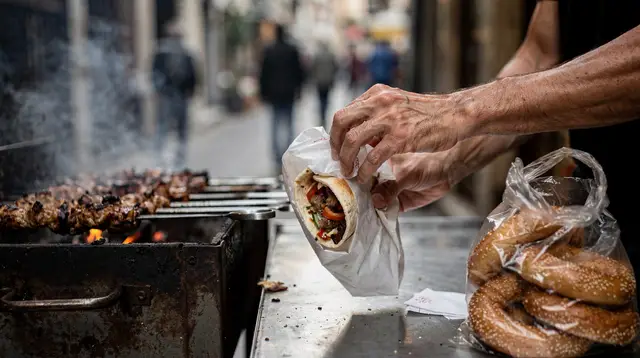
If you have less time or a lighter budget, a street-food-only tour strips the experience back to its essentials — souvlaki, gyros, tiropita, and the question of whether pita bread should be thick or thin (there is no neutral answer among Athenians).
Athens Street Food TourThese tours typically run two to three hours and cost €35–45 per person. They are better suited to the afternoon or early evening, when the street counters are busiest. The Monastiraki-to-Psyrri strip is the usual route, though some operators extend into Koukaki south of the Acropolis, a neighbourhood that has become a magnet for artisan food producers since 2018.
For a deeper local angle — less tourist infrastructure, more residential-neighbourhood flavour — the local food tour variant ventures into the covered market arcades off Eolou Street and through the produce vendors of Kaningos Square.
Evening and food-and-wine combinations
Athens at night changes register entirely. Restaurants open late — 21:00 is considered early — and the pace slows from hustling market energy to long, unhurried meals.
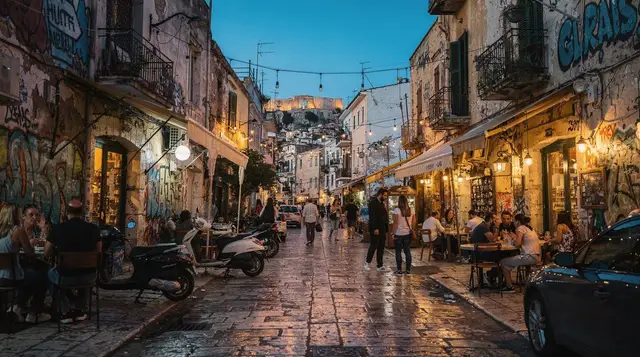
Evening food tours tend to pair tastings with pours: a glass of Assyrtiko with grilled octopus, Xinomavro with slow-cooked lamb, Moschofilero with a plate of fava from Santorini. The best evening options route through Plaka for the setting — cobblestones, neoclassical architecture, the lit Acropolis above — before moving to a working taverna in Psyrri for the main sit-down course.
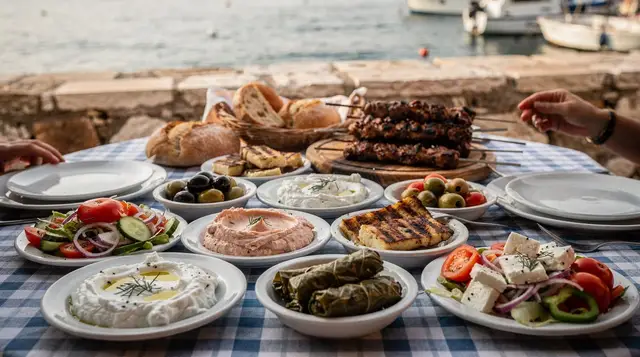
Athens Food and Wine Night TourFor dinner in Plaka with guided context around the mezedes tradition, the evening Plaka dinner experience covers appetisers you would not necessarily order yourself: htipiti (roasted pepper and feta dip), kolokithokeftedes (courgette fritters), and grilled halloumi dressed with lemon and oregano.
Expect to spend €70–100 per person for an evening food-and-wine combination, which typically includes two to three glasses of wine alongside six to eight tastings.
Acropolis and street food combinations
Some tours use the Acropolis neighbourhood as the narrative spine, framing food history within Athenian history. The result can feel gimmicky if the food stops are superficial, but the better operators genuinely integrate the two: a stop at a preserved Byzantine church leads into a bakery that has been using the same wood-fired oven for decades; the Acropolis viewpoint is followed by a cold glass of fresh-squeezed orange juice and a cheese pie from a stall that has been there since the 1970s.
Athens Acropolis and Street Food TourThese hybrid tours are particularly good for visitors who only have one full day in Athens and want to cover both cultural and culinary ground without switching operators.
What to look for in an Athens food tour
Group size. Athens’s best food stops are small — a bakery counter, a market butcher, a hole-in-the-wall ouzeri. Tours of more than twelve people quickly become unwieldy. Look for operators who cap groups at ten to twelve.
Guide background. A guide who grew up in Athens, cooks at home, or has worked in the food and hospitality sector will give you context that a script-reader cannot. Ask how long the guide has been running tours and whether they can answer follow-up questions about recipes, suppliers, and sourcing.
Timing. Morning tours (starting 09:00–10:00) catch Varvakios at its liveliest and the bakeries freshest. Evening tours (starting 18:00–19:00) access a different city: slower, warmer in atmosphere, more wine-forward.
Dietary needs. Greek food is structurally accommodating for vegetarians — the Orthodox fasting tradition has produced centuries of excellent plant-based cooking — but you should notify the operator in advance. Vegan options exist but require more planning; gluten-free is harder given the bread-and-pastry emphasis of many stops.
Combining tours with independent exploration
A food tour is an introduction, not a conclusion. Use it to build a shortlist of places to return to independently. Athenians revisit the same bakery every morning; they have a preferred butcher in Varvakios; they know which kafeneio makes the best Greek coffee in their neighbourhood. After a tour you will have the vocabulary to find your own favourites.
For deeper independent exploration, the best tavernas in Athens guide covers the sit-down dining layer, while Greek street food addresses specific dishes and where to find them without a guide. The Varvakios central market guide is worth reading before any market-routed tour. Wine-focused visitors should pair a food tour with one of the Athens wine tasting experiences for the full food-and-drink picture. The Athens cooking classes guide is the natural next step for visitors who want to cook what they eat on a tour. If your itinerary also includes a day trip, note that many island destinations near Athens — Aegina in particular — have their own strong, low-key food traditions built around the day’s catch, worth a mention to your guide if seafood is a priority.
Browse all food and drink experiences, explore Athens and all Athens destinations, or see what to do in Athens by category.
Frequently asked questions about Athens food tours
How many tastings are included in a typical Athens food tour?
Most full food tours include eight to twelve individual tastings — enough to constitute a full meal if you pace yourself. Street-food-only tours are lighter, covering four to six items. Evening food-and-wine tours tend to offer fewer but larger plates, plus two to three glass pours.
Do I need to eat before joining an Athens food tour?
No. Most operators ask guests to arrive hungry. A full morning food tour through the market and Psyrri covers enough calories for a substantial lunch. Arriving having already eaten a large breakfast makes the later tastings feel like an obligation rather than a pleasure.
Are Athens food tours suitable for children?
Yes, with caveats. The walking distances are moderate (2–4 km) and the food is largely child-friendly. Evening tours with a wine focus are better suited to adults. Check the operator’s minimum age policy — most tours are suitable for children aged eight and up.
What neighbourhoods do Athens food tours typically cover?
Most tours combine at least two of the following: Monastiraki (the flea market and street-food strip), Psyrri (the working-class-turned-creative neighbourhood north of the market), the Varvakios central market on Athinas Street, and Plaka (the historic quarter below the Acropolis). Some extended tours reach Koukaki or Exarchia.
How far in advance should I book an Athens food tour?
In high season (June–September) and around Easter, book at least five to seven days ahead, particularly for small-group tours. Morning slots fill faster than afternoon ones. In the shoulder season (October–May), two to three days’ notice is usually sufficient, though booking ahead always guarantees your preferred time slot.
Is tipping expected on Athens food tours?
Tipping is not obligatory but is warmly appreciated. A standard tip of €5–10 per person for a half-day tour, given directly to the guide at the end, is the norm among guests who enjoyed the experience. Some operators include a note about this in their confirmation email.
Which Athens food tour should I book if I only have one day?
The Acropolis and street food combination is the most efficient choice, since it covers cultural sightseeing and a genuine tasting circuit in a single booking rather than splitting your one day between two separate activities.
Are Athens food tours worth it compared to eating independently?
For a first visit, yes — a guide’s context (which butcher, which bakery, why the lamb changes by season) is hard to replicate on your own in a short trip. On a return visit, many travellers skip the tour and use the best tavernas and street food guides to revisit favourites independently.
Athens food experiences on GetYourGuide
Verified deep-linked GetYourGuide tours. Book through these links and we earn a small commission at no cost to you.
GetYourGuide does not provide product photos: on its activity cards, the picture illustrates the type of experience and is not the operator's own photo.
More tours on Viator
Top-rated experiences with verified reviews, bookable on Viator (a Tripadvisor company).
 Viator
The Greek Food Experience (Max 8 persons)
FromEUR 108Check availability → Viator
Cretan Wines & Olive oil tour - The treasures of Crete
FromEUR 120Check availability → Viator
Kalamata- Olive oil & Wine Tour with traditional lunch
FromEUR 110Check availability → Viator