
Argolis day trip from Athens: Mycenae, Epidaurus and Nafplio
What does a full Argolis day trip from Athens include?
The classic Argolis day trip covers the Bronze Age citadel of Mycenae, the ancient theatre at Epidaurus, and the Venetian old town of Nafplio — three distinct experiences in one driving loop of around 250 km from Athens.
The Argolis circuit: Greece’s greatest day trip
| Where | Argolid peninsula, Peloponnese — Mycenae, Epidaurus, Nafplio |
| Cost | Around €55–85 self-drive incl. tolls/entries, or €70–95/person guided |
| Time needed | A full day (around 10–11 hours door to door), 3.5 hrs of that driving |
| Getting there | Self-drive via A7 motorway, or an organised full-day tour from Athens |
| Best time | Start at Mycenae’s opening; spring/autumn for comfortable heat |
The Argolid peninsula offers a concentration of historical weight that very few regions in the world can match. In one driving day from Athens you cover 35 centuries: the Bronze Age citadel of Mycenae (destroyed around 1100 BC), the classical theatre of Epidaurus (350 BC), and the beautifully preserved medieval-Venetian streets of Nafplio (18th–19th century). The contrast between these layers — Bronze Age cyclopean walls, a perfect Hellenic theatre, and a Baroque Venetian streetscape — is what makes the Argolis circuit so enduringly satisfying.
This guide covers the full circuit in depth. If you want a shorter overview of just the three sites without the Argolis context, see the Nafplio, Mycenae and Epidaurus day trip guide.
The route from Athens
The most efficient route from central Athens:
- A7 motorway south-west toward Corinth (60 minutes)
- Continue south on E65 toward Argos (further 40 minutes)
- Mycenae turn-off at Fichtia junction, 8 km west to the site
- Mycenae to Epidaurus: 45 minutes via the mountain road through Ligourio
- Epidaurus to Nafplio: 35 minutes south
- Nafplio to Athens: 1.5–1.75 hours via Corinth on the A7
Total driving: approximately 3.5 hours, covering 250 km of loop.
Site by site
Mycenae: the citadel of Agamemnon
Mycenae was the most powerful city in the eastern Mediterranean between approximately 1600 and 1100 BC. Homer’s Agamemnon, the commander of the Greek forces at Troy, ruled from here. The citadel occupies a strategic ridge between two mountains, and even in partial ruin the scale is awe-inspiring.
What not to miss:
The Treasury of Atreus (also called the Tomb of Agamemnon) lies on the road just below the main site entrance — a 14-metre-high beehive-shaped tholos tomb built without mortar, its lintel stone estimated at 120 tonnes. Walk inside for 5 minutes and let your eyes adjust. This is one of the best-preserved ancient structures in Greece.
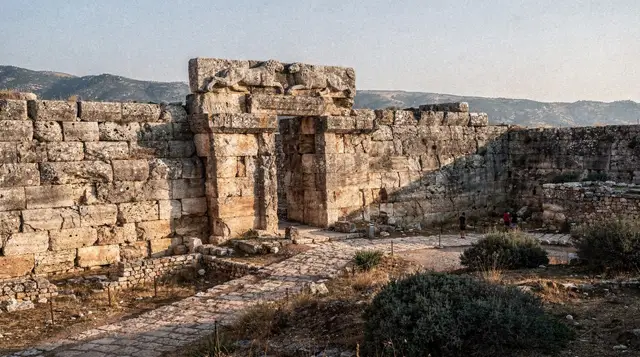
The Lion Gate (1250 BC) is the oldest monumental sculpture in Europe. The two lions carved above the entrance lintel have lost their heads but their posture — forelegs on an altar, framing a central column — is unmistakable.
The Treasury/grave circles: Grave Circle A (inside the Lion Gate) is where Heinrich Schliemann excavated in 1876 and found the gold death masks that sent him the famous telegram declaring he had “gazed upon the face of Agamemnon.” The originals are in the Athens National Archaeological Museum; the site has good interpretive panels.
Allow 90 minutes for the site, Treasury of Atreus and on-site museum. The museum is good — arrive early before tour coaches arrive between 09:30 and 10:30.
Epidaurus: the most perfect theatre in the ancient world
The drive from Mycenae to Epidaurus takes 45 minutes through the Argive hills — pleasant mountain driving.
The theatre at Epidaurus, built around 350 BC and designed by Polykleitos the Younger, seats 14,000 spectators and has acoustic properties that remain unexplained. Stand at the orchestra centre and drop a coin, then walk to the top rows: you’ll hear it clearly. The theatre is so well-preserved (it was buried under landslide debris and only excavated in the 1880s) that it still hosts performances today — the Athens–Epidaurus Festival runs July and August.
Don’t rush past the sanctuary: The broader Asclepion (healing sanctuary) surrounding the theatre includes the foundations of the Temple of Asclepius, the tholos (circular building of unknown function, possibly the most complex building in antiquity), extensive hospital facilities (enkoimeterion — where patients slept waiting for divine healing dreams), and several smaller temples. The site museum has original architectural elements and is underrated. Budget the full 90 minutes.
Entry: €12 (site and museum combined).
Nafplio: the most beautiful town in the Peloponnese
From Epidaurus, Nafplio is 35 km south. The town was Greece’s first modern capital (1828–1834) and retains the atmosphere of that period: Venetian and Ottoman architecture, a neoclassical parliament building, and a seafront promenade beneath the Palamidi fortress.
Old town: The pedestrianised lanes of Nafplio’s old quarter are flat and extremely pleasant for a post-ruin walk. The main street (Vasileos Konstantinou) leads to Syntagma Square, where there’s a Venetian arsenal (now the archaeological museum), a mosque (now an exhibition space), and excellent café-restaurants.
Palamidi: The Venetian fortress on the ridge above the town has 999 steps to the summit (people count them). Views are excellent; the climb takes 20–30 minutes and is very steep. Go up if you have energy; skip it if you don’t — the town is satisfying without the climb.
Bourtzi: The islet fortress in the middle of the harbour bay. Short boat trips run from the harbour in season (15 minutes, approximately €10 return).
Lunch: Nafplio has some of the best food in the Peloponnese. Harbour-front tavernas serve good seafood; the side streets have better value. Budget €15–€25 per person for a full lunch.
Allow a minimum of 2.5 hours in Nafplio; 3–3.5 hours is better.
Organised tours for the full Argolis day Nafplio, Mycenae and Epidaurus full-day tour This covers all three sites with a licensed guide and handles transport — the most comprehensive single option.
Nafplio, Mycenae and Epidaurus small-group tourThe small-group format (typically 8–15 people) means more guide access and less waiting at sites.
Car hire vs organised tour
Car: Maximum flexibility — you choose how long to spend at each site, can stop for photos, and explore Nafplio’s backstreets without a schedule. Hire car €40–€70, tolls €5 each way on the A7. Comfortable for 1–4 people.
Organised tour: A licensed guide dramatically enriches Mycenae especially — the Bronze Age history and mythology are complex without context. Tour cost €70–€95 per person including all entries.
Costs for the full day
| Item | Approximate cost |
|---|---|
| Car hire + tolls | €55–€85 |
| Full-day organised tour | €70–€95 per person |
| Mycenae entry | €12 |
| Epidaurus entry | €12 |
| Lunch in Nafplio | €15–€25 per person |
Practical advice
Sequence: Always start with Mycenae (first opening, cooler, morning light on the Lion Gate). Epidaurus midmorning. Nafplio from early afternoon.
Heat: All three sites are exposed in summer. Mycenae is the most brutal — the ridge site has almost no shade. July–August visitors should be at Mycenae by 08:30 and at Nafplio (where there’s shade) for the hottest part of the day.
What to pack: Water, sun protection, walking shoes (Mycenae is rocky), and a light layer for evening in Nafplio.
Extending to two days: If you want to explore Nafplio properly — Palamidi fortress, the Peloponnesian Folklore Foundation museum, dinner, a morning swim — overnight in Nafplio turns this into a genuinely luxurious itinerary. Several excellent guesthouses operate in the old town.
Also see the best day trips from Athens for a comparison with other top excursions.
Full circuit vs the shorter Nafplio-Mycenae-Epidaurus version
This guide covers the complete Argolis experience with extra time at each stop; if your day is more constrained, our Nafplio, Mycenae and Epidaurus day trip guide covers a tighter, more efficient version of the same three sites. The difference is mostly about pacing rather than content — both cover the same core stops, but this guide assumes you want the fuller 2.5–3 hours in Nafplio and time to properly explore the Epidaurus sanctuary rather than just the theatre.
Weighing the drive against the payoff
Three-and-a-half hours of driving is a genuine commitment, and it’s worth being honest about the trade-off before booking. What you get in return is a day that very few single excursions anywhere can match: Bronze Age Mycenae, classical Epidaurus, and Venetian Nafplio, each utterly different in character. Compare that against a shorter half-day option like the Ancient Corinth trip if your energy or schedule is tighter — Corinth alone requires far less driving and still delivers a strong ancient-history day, just without Nafplio’s town atmosphere or Epidaurus’s theatre.
Frequently asked questions about the Argolis day trip
Which is the most important site — Mycenae or Epidaurus?
They’re significant in different ways. Mycenae is older (Bronze Age) and feels more raw and dramatic — the weight of Homer and Schliemann hangs over the site. Epidaurus is architecturally more refined and the theatre alone is worth the visit. Most visitors find Mycenae more emotionally powerful and Epidaurus more beautiful.
Is Nafplio worth more than a quick stop?
Very much so. Many visitors treat Nafplio as a lunch stop and miss the town’s charm. The old quarter is genuinely lovely and deserves 2.5–3 hours. If you’re pressed for time, skip the Palamidi climb but walk the seafront promenade and Syntagma Square fully.
Should I visit the Nafplio Archaeological Museum?
The museum (in the Venetian arsenal on Syntagma Square) has good Mycenaean-era finds and a comprehensive prehistoric collection. Budget 45 minutes if time allows. It’s a good complement to the Mycenae site museum.
Is the Argolis circuit suitable for self-driving?
Yes — the roads are good, signposting is clear in Greek and English, and parking at all three sites is easy and free. The A7 motorway to Corinth is excellent. The mountain road between Mycenae and Epidaurus is well-surfaced but winding.
Can I combine the Argolis circuit with Corinth?
Adding the Ancient Corinth day trip to the Argolis loop makes for an extremely long day (4 sites). Most travellers prefer keeping Corinth as a separate half-day. If you want to fit everything, Corinth is best placed as a morning stop before Mycenae, but budget an early departure (06:30) and a late return.
What’s the right entry order for Mycenae?
Go to the Treasury of Atreus first (on the approach road, before the main car park). Then enter the main site via the Lion Gate. End with the on-site museum. This sequence follows the natural road approach and avoids backtracking.
Is this trip realistic without a car, using only tours?
Yes, and for most visitors it’s actually the simpler choice — an organised full-day tour handles the driving, timing and site logistics, and a licensed guide adds real value at Mycenae in particular, where the Bronze Age history is dense without context. Self-driving mainly wins on flexibility, especially if you want extra time in Nafplio or plan to overnight there.
How exhausting is this day trip, honestly?
It’s a full, long day — around 10–11 hours door to door with three sites and considerable walking on uneven ancient ground, plus the drive. It’s very rewarding but not a leisurely day. If that pace sounds like too much, consider spreading Mycenae and Epidaurus over one day and Nafplio as a separate overnight, per the two-day option below.
Best day trips from Athens on GetYourGuide
Verified deep-linked GetYourGuide tours. Book through these links and we earn a small commission at no cost to you.
GetYourGuide does not provide product photos: on its activity cards, the picture illustrates the type of experience and is not the operator's own photo.
More tours on Viator
Top-rated experiences with verified reviews, bookable on Viator (a Tripadvisor company).
 Viator
Santorini Catamaran Cruise with Swim-Stops, Greek Meal and Sunset
FromEUR 150Check availability → Viator
Meteora Sunset with Monastery & Hermit Caves Tour in Small Group
FromEUR 35Check availability → Viator
Meteora Small Group Hiking tour with Transfer and Monastery Visit
FromEUR 35Check availability → Viator