Greek Orthodox Easter in Athens: what to expect and when to go
What is Greek Orthodox Easter like in Athens?
Greek Orthodox Easter is the most important celebration in the Greek calendar. In Athens, Holy Saturday midnight mass with candlelit processions is the centrepiece, followed by lamb roasting and egg cracking through Sunday. The city is electric but many businesses close for 4–5 days. Book accommodation months ahead.
Why Greek Orthodox Easter is unlike any other celebration in Europe
Greek Easter (Pascha) is the single most important religious and cultural event in the Greek calendar — more significant than Christmas, more emotionally charged than any secular holiday. It is deeply Orthodox in its theology but experienced by even secular Greeks as the defining ritual of collective identity.
For a visitor in Athens during Holy Week, it offers something genuinely rare: access to a living religious tradition that has been observed in more or less the same form for over a thousand years, in a city where those roots go back further still. The candlelit midnight procession, the moment of Anastasi (Resurrection) when every light in the city is extinguished and then thousands of candles are lit from a single flame, and the explosion of fireworks across the Athens basin is one of the most visceral and beautiful experiences in European travel.
It requires planning — and some tolerance for disruption to normal tourism logistics — but Greek Orthodox Easter in Athens is worth building a trip around.
| Where | any neighbourhood church, plus the Metropolitan Cathedral and Plaka for the largest processions |
| Cost | free to observe; book restaurant/hotel Easter lunch separately, often €40–70/person |
| Time needed | the full Holy Week, or at minimum Holy Friday evening through Easter Sunday |
| Booking | accommodation 2–4 months ahead; Easter Sunday restaurant meals weeks ahead |
| Best time | 11:30pm Holy Saturday for the Anastasi midnight service |
When does Greek Orthodox Easter fall?
Greek Orthodox Easter follows the Julian calendar for calculating the date, which means it frequently falls on a different date from Western Easter (which uses the Gregorian calendar). The gap ranges from 0 (same week) to 5 weeks later.
Dates to know for upcoming years:
- 2026: Sunday, 12 April (same date as Western Easter)
- 2027: Sunday, 2 May
- 2028: Sunday, 16 April
The calculation is complex (it must fall after Passover under Orthodox rules), which means Greek Easter can fall from early April to early May. Check the specific date before booking.
Holy Week in Athens: day by day
Palm Sunday (Kyriaki ton Vaiion)
The week opens with Palm Sunday, marked by church services across Athens and the distribution of woven palm crosses. The mood is quiet and anticipatory rather than festive. Monastiraki and Plaka are calm; the city feels like it is drawing breath before the week’s intensity.
For visitors: A good day for ordinary sightseeing — the Acropolis and museums are open and relatively uncrowded. Athenians focus on church in the morning and family lunch in the afternoon.
Holy Monday, Tuesday, Wednesday
The midweek days of Holy Week are observed primarily by regular church-goers. Shops, restaurants, and tourist sites remain open. The atmosphere in the city is normal, with a slightly subdued quality — fewer delivery trucks, longer family meals, more church bells than usual.
The Epitaphios is prepared: Each neighbourhood church prepares the Epitaphios — an ornate canopied bier draped in flowers symbolising Christ’s tomb. Preparation continues through midweek; by Wednesday night, every neighbourhood church has its decorated Epitaphios ready.
Holy Thursday (Megali Pempti)
Church services include the reading of the 12 Gospels at night — a 3-hour ceremony of extraordinary solemnity and beauty. The Megali Pempti evening service at the large churches near Syntagma and in Plaka is accessible to visitors who wish to observe.
Red eggs (kokkina avga) are traditionally dyed on Holy Thursday. The smell of hard-boiled eggs coloured with natural red dye (symbolising the blood of Christ and the joy of Resurrection) emanates from bakeries and households across the city.
Holy Friday (Megali Paraskevi) — Epitaphios Procession
Holy Friday is the most publicly visible day of Holy Week in Athens. During the day, churches are open and the Epitaphios (decorated bier) is displayed for veneration. Athenians — dressed formally — visit their neighbourhood church throughout the day.
The Epitaphios procession begins at around 9 pm in most neighbourhood churches. The ornate flower-draped bier is carried through the streets, preceded by priests in gold vestments, boys carrying lanterns, and the entire congregation holding candles. In Plaka and Monastiraki, multiple parish processions cross paths in the narrow streets — the smell of incense, the sound of Byzantine chant, the flickering candlelight in a 2,500-year-old neighbourhood is overwhelming in the best sense.
Where to see the procession: The Plaka neighbourhood has some of the most atmospheric processions, winding through lanes too narrow for cars. Larger, more ceremonial processions depart from the Metropolitan Cathedral (Mitropoli) near Monastiraki. Both are openly accessible to visitors; simply observe from the pavement and follow the procession’s route.
Practical note: Most restaurants and shops close by 9–10 pm on Holy Friday. Book a late dinner at a restaurant that stays open or plan to eat early.
Holy Saturday (Megalo Savvato) — Midnight Resurrection
The holiest night of the Greek year.
At 11:30 pm on Holy Saturday, Athenians gather outside their neighbourhood churches — in the streets, on pavements, in any open space near a church — holding unlit white candles. The interiors of the churches are packed and standing-room only, but the congregation extends well outside in an informal gathering that has no European equivalent in its combination of religious intensity and communal warmth.
At midnight (Anastasi), the priest emerges from behind the iconostasis bearing the Holy Flame. “Christos Anesti” (Christ is Risen) rings out, and the single flame passes from candle to candle, rippling through the crowd in under a minute. Within seconds, the entire street is illuminated by thousands of individual flames held by hands that include grandmothers in black, teenagers on their phones, toddlers held up to see the light, and visitors from every part of the world.
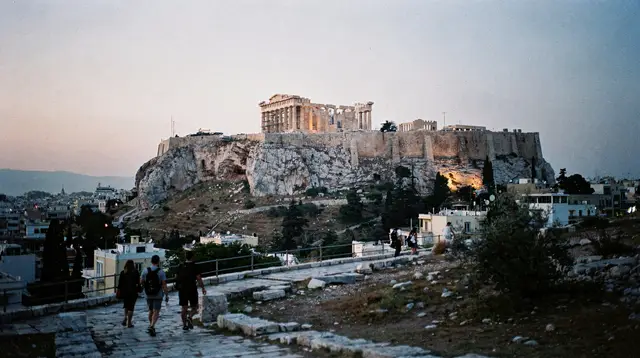
At the same moment: fireworks. Athens has no organised city fireworks — every neighbourhood lights its own, simultaneously, in a spontaneous explosion across the entire basin. The Acropolis is illuminated. The Saronic Gulf reflects explosions from Piraeus. From Lycabettus Hill, the effect is a 360-degree ring of fireworks around the horizon.
For visitors: Simply go to any neighbourhood church at 11 pm and join the gathering. No ticket, no registration, no language barrier — a candle (bought from a kiosk or given by a kind parishioner) and presence are all that is needed. The standard exchange: “Christos Anesti” (Christ is Risen) — “Alithos Anesti” (Truly He is Risen).
Easter Sunday (Pascha)
After the midnight Anastasi, Athenians return home for the Mayiritsa soup — a lamb offal and rice soup traditionally eaten to break the Lenten fast. By sunrise, lamb preparations begin.
Easter Sunday lunch is the most important meal of the Greek year. Whole lambs on the spit (souvlaki) are turned in courtyards, parks, and beaches across Attica from 8 am onwards, ready for the 2 pm family feast. The National Garden, Filopappou Hill park, and open spaces throughout Athens fill with family groups tending fires and lambs.
Tsougrisma (egg cracking): The red-dyed eggs from Holy Thursday are cracked at the Easter table. Each person taps their egg against another’s, saying “Christos Anesti.” The person whose egg survives uncracked is said to have good luck for the year.
For visitors: Athens’ Easter Sunday requires adapting. Most restaurants are closed; those open are fully booked by local families weeks ahead. The most practical approach is to either book a hotel with Easter Sunday lunch service (many hotels near the Acropolis offer this for a set price), or join a guided Easter experience that includes the feast.
If you want to taste Greek home cooking without relying on a restaurant that may be closed, a hands-on session such as a Greek cooking class that ends with a shared dinner gives you a sense of the dishes behind the Easter table. Check ahead for the schedule around the holiday itself, as availability can change during Holy Week.
Holy Week at a glance, day by day
| Day | What happens | Visitor note |
|---|---|---|
| Palm Sunday | quiet church services, palm crosses distributed | good day for normal sightseeing |
| Holy Mon–Wed | Epitaphios prepared in each parish | city runs close to normal |
| Holy Thursday | 12 Gospels reading; red eggs dyed | evening services open to observers |
| Holy Friday | Epitaphios displayed, then processions from ~9pm | most restaurants close by 9–10pm |
| Holy Saturday | Anastasi midnight service and fireworks | the single most important night |
| Easter Sunday | Mayiritsa soup, whole lamb roasted, egg cracking | book lunch well ahead or self-cater |
Filling the quieter days of Holy Week
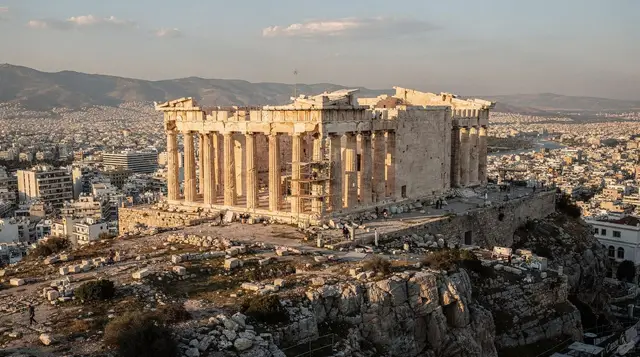
The early part of the week is the natural moment for the sights that are harder to enjoy once the holiday closures begin. The Acropolis is best handled with the Acropolis tickets guide and the Parthenon guide open on your phone, and the Acropolis Museum guide will help you decide whether to see it before the holiday hours kick in. If you would rather have the context before you go, Athens history timeline explains why the city’s religious and civic traditions feel so layered.
For a gentler pace, the Plaka walking tour fits well with the subdued mood of Holy Monday to Wednesday, and the self-guided walk through Athens lets you stop whenever you hear chanting from a church. The ancient Agora and the Temple of Olympian Zeus are good open-air options if you want to keep the days unhurried before the long weekend.
On a quiet midweek day, a street food walk through the city centre is an easy way to eat well before the holiday closures arrive, and it pairs naturally with an afternoon of slow wandering.
If this is your first visit, the Athens travel tips and the best time to visit Athens guides put an Easter trip in the wider context of the year, and the Easter in Athens blog story gives a first-person view of the week.
Where to base yourself for the best experience
Plaka is the strongest base for Holy Week — its narrow lanes concentrate several parish processions within a short walk, and the neighbourhood’s proximity to the Acropolis means daytime sightseeing and evening ritual sit side by side. Monastiraki, home to the Metropolitan Cathedral, sees the largest and most formal procession, useful if you want scale rather than intimacy. For the widest possible view of the citywide fireworks at the Anastasi moment, climbing Lycabettus Hill beforehand rewards you with a 360-degree view over the entire Athens basin as every neighbourhood lights up at once — arrive at least 45 minutes early, since the funicular and paths get busy.
Practical considerations for visiting Athens at Easter
Accommodation: Book 2–4 months ahead. Athens hotels fill for Holy Week because Greeks from the diaspora return home for Easter. The week of Holy Friday through Easter Sunday is the least available hotel week of the entire year after New Year.
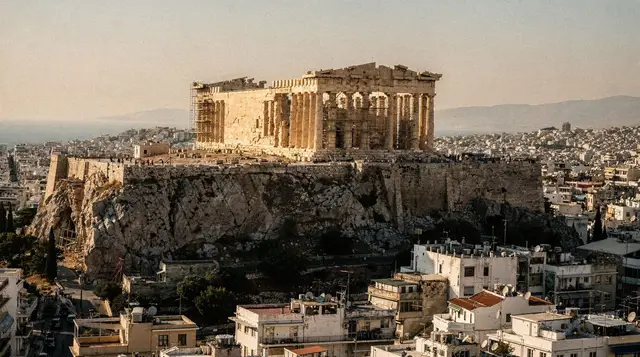
Closures: Holy Friday and Easter Sunday are major holidays; most shops, many restaurants, and some sites reduce or eliminate hours. The Acropolis Archaeological Site typically remains open, but confirm when booking. National Archaeological Museum and most state museums are open on Saturdays but may close Holy Friday and Easter Sunday.
Transport: Athens metro, buses, and trams run reduced schedules on Holy Friday and Easter Sunday. Taxis (Beat app) continue operating. Piraeus ferries run on a holiday schedule — check before planning an Easter island trip.
Food: Bakeries and some street-food vendors (souvlaki) operate through Holy Week. The best approach is a self-catering option for Holy Friday evening and Easter Sunday if you haven’t booked restaurant meals far in advance.
Weather: Easter in Athens (April–May depending on year) is reliably mild and often beautiful — average highs of 18–22°C, occasional showers. The spring wildflowers are at their peak. It is one of the loveliest seasons climatically.
Acropolis combo ticket — visit archaeological sites before Holy Week crowds peakGetting around and staying fed
Because public transport and restaurant hours shift around the holiday, it helps to read getting around Athens and the Athens metro guide before you travel, and to check where to stay in Athens when you choose your base. For the days when restaurants are shut, the Greek street food guide and the Central Market guide point to simple options, while best tavernas in Athens is worth bookmarking for the evenings when places are open.
Easter beyond Athens
For Greeks, Easter often means leaving Athens for villages. If you have flexibility, Easter in a smaller Attic village or on a Saronic island has an intimacy that the city cannot match. On Aegina and Hydra, Epitaphios processions pass through car-free harbours lit only by candles — an extraordinary atmosphere. Hydra’s Easter is particularly celebrated and draws Greeks from Athens specifically.
For the island perspective, see Greek islands from Athens.
Frequently asked questions about Greek Orthodox Easter in Athens
Is Greek Orthodox Easter always on a different date from Western Easter?
Not always — the dates can coincide (as in 2026) or be separated by up to 5 weeks. The difference arises because the Orthodox Church uses the Julian calendar and an additional rule that Easter must fall after Passover. Check the year you are travelling specifically.
Do I need to be Christian or Orthodox to attend the Anastasi midnight service?
No. The Anastasi is a public event in the streets and immediately outside every church. Visitors of any faith or none are present and entirely welcome as observers. No one will ask your religion. Simply stand near a church at 11:30 pm and participate in receiving the Holy Flame if offered.
What does “Christos Anesti” mean and when do I say it?
“Christos Anesti” means “Christ is Risen.” You say it (or hear it) at the moment of midnight on Holy Saturday, after the Holy Flame is distributed, and throughout Easter Sunday as a greeting. The response is “Alithos Anesti” — “Truly He is Risen.” Greeks will be genuinely touched if visitors use it.
Can I find restaurants open on Easter Sunday in Athens?
Some major hotels and a minority of tourist-facing restaurants in Plaka and Monastiraki stay open on Easter Sunday, but they book up weeks or months ahead. Most neighbourhood restaurants are closed — this is the family lunch of the year and staff are with their families. Book your Easter Sunday meal at your hotel when you book your room.
Are the archaeological sites open during Holy Week?
The Acropolis Archaeological Site and most major state-managed sites remain open throughout Holy Week. Holy Friday and Easter Sunday may see reduced hours. The Acropolis Museum is closed on Orthodox Easter Sunday; on the other days of Holy Week, check the hours on the museum’s official website. Check each site’s official website for the specific year’s schedule before visiting.
What is the weather like in Athens at Easter?
Generally mild and pleasant — average highs of 18–22°C, average lows of 12–14°C. Spring wildflowers are blooming on the hillsides around the city. Rain is possible (April averages 9 rainy days) but rain events are usually brief. It is one of the most climatically pleasant times to be in Athens.
Do I need to arrive early for the Holy Saturday midnight service?
Yes — for a good vantage point at a well-known church such as the Metropolitan Cathedral or a popular Plaka parish, arrive by 11pm. For a quieter neighbourhood church with a more intimate feel, 11:15–11:30pm is usually still fine, since these gatherings are informal and extend well into the surrounding streets.
Is Easter a good or bad time to visit the Acropolis?
Both, depending on the day. Palm Sunday through Holy Wednesday sees normal or even reduced crowds, making it a genuinely good window. Holy Friday and Easter Sunday themselves may have reduced hours, so plan Acropolis visits for earlier in the week and keep Holy Friday evening and Easter Sunday free for the religious and family events instead.
Popular Athens tours on GetYourGuide
Verified deep-linked GetYourGuide tours. Book through these links and we earn a small commission at no cost to you.
GetYourGuide does not provide product photos: on its activity cards, the picture illustrates the type of experience and is not the operator's own photo.