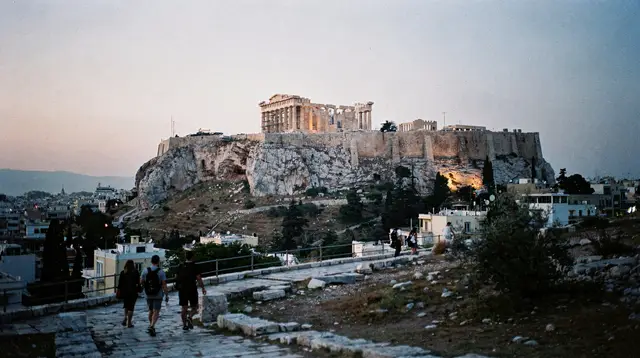
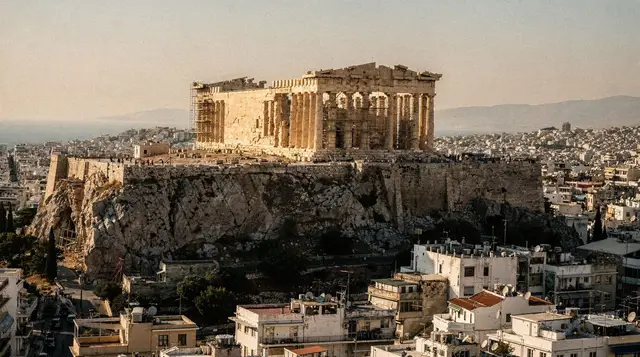
Acropolis in the morning vs late afternoon: which is better?
The question comes up in every Athens planning conversation: “What’s the best time to visit the Acropolis?” The most common advice you’ll read is “go early.” That’s mostly right, but “early” needs qualification — and the late afternoon visit has genuine advantages that often get overlooked. Here’s the full picture.
| Best overall | Opening hour, around 8 am in summer |
| Best for photos | Late afternoon, roughly 5–7 pm |
| Hottest, most crowded | Midday, 11 am–4 pm — avoid if possible |
| Booking | Timed-entry ticket required in advance, any slot |
| Museum | Separate ticket, air-conditioned, good midday refuge |
Morning vs afternoon vs midday, side by side
| Opening hour (8–10 am) | Midday (11 am–4 pm) | Late afternoon (5–7 pm) | |
|---|---|---|---|
| Crowds | Lowest of the day | Heaviest, large tour groups | Thinning, more manageable |
| Temperature | Cool, comfortable | Hottest, can be harsh in summer | Cooling down |
| Light quality | Directional, warm, textured | Flat, marble reads pale | Golden, marble reads warm/amber |
| Best for | First-time visitors, comfort | Avoid unless it’s your only slot | Photography, unhurried atmosphere |
The opening hour visit
The Acropolis opens at 8 am in summer (May through October) and the first hour is measurably different from any other time of day. The practical advantages are significant:
Crowd levels are at their lowest. Tour groups that organise early arrivals typically arrive after 8:30; the individual visitors who read the same “go early” advice tend to stagger in from 8 to 9. Being at the entrance at 8 am, or joining an early tour that meets the site opening, means the first 30 to 45 minutes on the hill have a specific quiet that you won’t find again until the site closes.
The temperature is manageable. In June, by 10 am the sun is already strong on the exposed limestone. By noon it can be genuinely unpleasant. At 8 am, the air is cool, the shadows are long, and the heat of the day hasn’t arrived.
The light is directional and warm. This matters more than most visitors realise. The slanted morning light from the east creates texture on the marble columns — you can see the surface of the stone, the wear patterns, the slight variations in colour — in a way that the flat overhead light of midday completely flattens.
The early morning Acropolis tour — the early morning site and museum combination — builds in this timing deliberately, and the guides use the morning quiet to linger at key points (the Erechtheion, the view from the south edge, the interior of the Propylaea gate) that crowd management makes impossible later in the day.
Practical requirement: book your ticket in advance. The pre-booked timed-entry ticket is essential regardless of what time you’re going, but particularly in the morning when the on-site ticket booths may have already queued up before opening. See the Acropolis tickets guide for the full booking process.
The late afternoon visit
Here the calculus changes. Late afternoon — roughly 4:30 to 6:30 pm in summer, when the site closes at 8 pm — has its own distinct advantages.
The light goes golden. This is the genuinely important one. The Parthenon, the Propylaea, and the Erechtheion are all built from Pentelic marble — a particular white marble quarried from Mount Pentelicus northeast of Athens, which has a slightly warm, slightly creamy tone. Under the overhead light of midday, this marble reads as white. In the low afternoon and early evening light of summer, it goes a deep, rich gold that looks almost amber at the peak. The photographs you’ve seen of the Parthenon at its most beautiful were almost certainly taken in this light.
The crowd composition changes. Mid-morning and midday see the largest organised tour groups. By 5 pm, many of the large groups have moved on to the rest of their programmes, and the crowd thins somewhat, though it never disappears entirely.
You’re already warmed up for the evening. Finishing the Acropolis at 6 or 7 pm means you step directly into the Plaka or Thissio early evening, when the light is still beautiful on the streets below and the dinner and bar scene is beginning to stir. The Athens wine and cheese experience with Acropolis views in the evening, or simply finding a rooftop terrace in Monastiraki immediately after leaving the site, is a particularly satisfying end to an afternoon visit.
The downside: it’s still hot in the early afternoon hours before you arrive, and the crowds from mid-morning don’t fully clear until later. If you arrive at 4:30, you’re arriving just as the late-morning visitors are leaving and before the site quiets. The optimal window is probably 5 to 6 pm on a summer day.
The combo approach
If your schedule allows for it, the smartest strategy is actually to split the Acropolis experience over two visits:
- Morning (8–10 am): the site itself, before heat and crowds build, using a timed-entry ticket. Walk the main areas, see the Propylaea, the Parthenon, the Erechtheion, look out from the south edge over Anafiotika and Plaka below.
- Late afternoon: the Acropolis Museum, which is separate from the site, fully air-conditioned, and best visited in the afternoon when you’re ready for something slower. Then find a rooftop terrace for the sunset view of the hill you were standing on that morning.
This approach is built into the Athens 2-day itinerary and even more comfortably into the 3-day itinerary.
The evening visit
After 7 pm in June and July (the Acropolis closes at 8 pm, sometimes extended in peak summer), the crowds thin significantly. This is a genuinely excellent time to visit if you can secure a timed-entry slot. The light is spectacular, the temperature is comfortable, and the site has a particular evening atmosphere that morning visitors never experience. The risk: available slots are the first to book out. Book several weeks in advance if this is the timing you want.
What actually matters most
For first-time visitors: go as early as your body clock will allow. The 8 am opening is the sweet spot. For photographers or anyone who prioritises the visual experience over logistics: late afternoon between 5 and 7 pm. For the genuinely curious who want to avoid Acropolis crowds without strict timing: go on a weekday rather than a weekend, and avoid public holidays when entrance is free (and consequently swamped).
What the light actually does
To understand why timing matters so much at the Acropolis, it helps to know what the marble is doing in different light conditions.
The Parthenon and the other structures on the hill are built from Pentelic marble — quarried from Mount Pentelicus, about 16 kilometres northeast of Athens. Freshly cut, this marble is almost pure white. Over 2,500 years of weathering, oxidation, and exposure, the iron content in the stone has emerged to give the columns and cornices a warm, slightly golden patina. This is the colour you see in photographs of the site that have been taken with intent.
Under the flat overhead light of midday (roughly 11 am to 4 pm in summer), this warm tone is partially flattened. The columns read as beige or grey-cream. Under the slanted light of early morning or late afternoon, the warm undertone activates — the stone goes gold, then amber at the richest point before sunset. The shadows become dramatic. The texture of the marble surface becomes visible.
This is not a matter of photography preference. It’s a matter of how the site actually looks in person. The Acropolis in morning or late afternoon light is a visibly different and more beautiful place than the Acropolis at noon. If the visual experience matters to you — and why wouldn’t it — this is the strongest argument for timing your visit correctly.
How the Acropolis Museum fits in
The Acropolis Museum is a distinct ticket and a distinct building — it sits at the foot of the hill on the Dionysiou Areopagitou pedestrian street, not on the hill itself. It’s fully air-conditioned and excellent as a midday refuge when outdoor sightseeing becomes uncomfortable.
The optimal sequence is: visit the site in the morning or late afternoon, visit the museum in the opposite half of the day. If you go to the site first thing in the morning (8–10 am), spend the midday hours at the museum, then return to one of the rooftop bars in Monastiraki for the sunset view looking back at the hill you were standing on that morning.
Read the full avoiding Acropolis crowds guide for strategies beyond timing — including which entry gates to use, where crowds cluster within the site, and how to sequence the Acropolis with the five nearby sites covered by the combo ticket. The Acropolis tickets guide covers everything about purchasing in advance.
A note on the winter visit
For completeness: the Acropolis in winter (November through February) has its own specific character. The site is almost empty by summer standards, the light is often extraordinary — soft and cool rather than harsh — and the temperature is comfortable for walking without the heat stress of summer. The marble reads differently under winter light: cooler, more austere, less golden, but more clearly detailed.
The Acropolis Museum in winter is a genuine pleasure — no queues, no wait at the Caryatid gallery, and the curators seem more willing to engage with visitors when the pressure of summer crowds is absent. If a winter visit to Athens is in your plans, the morning visit to the hill itself becomes even more compelling than in summer because the entire timing argument inverts: there’s no heat to escape, no crowd to beat, and the soft winter morning light on the Parthenon is consistently beautiful.
Whether you’re visiting in January or July, the core advice holds: go early, go with a ticket already booked, and stay long enough to sit somewhere on the hill and simply look at the city below. The Acropolis is not primarily a checklist item. It’s a place worth spending real time in.
Frequently asked questions about Acropolis in the morning vs late afternoon
Can I visit the Acropolis twice on the same ticket, once in the morning and once in the evening? No — a standard timed-entry ticket is valid for a single entry at your booked slot. If you want both the morning site visit and the late-afternoon light, you’ll need to book two separate timed-entry slots (or combine one site visit with the separately ticketed Acropolis Museum for your second stop).
Does the Acropolis stay open later in summer than in winter? Yes. Summer hours (roughly April through October) typically run to around 8 pm, giving a genuine late-afternoon golden-light window, while winter closing time is considerably earlier, often mid-afternoon. Always check the current posted hours before planning an evening visit, since they shift seasonally and around public holidays.
Acropolis & ancient site experiences on GetYourGuide
Verified deep-linked GetYourGuide tours. Book through these links and we earn a small commission at no cost to you.
GetYourGuide does not provide product photos: on its activity cards, the picture illustrates the type of experience and is not the operator's own photo.