Athens and Santorini: 7-day city and island itinerary
How this itinerary works
Athens and Santorini is Greece’s classic combination: the city gives you 3000 years of history, the island gives you one of the most dramatic landscapes on Earth. Seven days splits neatly into three in Athens and four on Santorini — long enough in each place to relax rather than sprint. Getting there: the high-speed ferry from Piraeus to Santorini’s Athinios port takes 5–7 hours (€40–65 economy; €80–120 for a cabin on overnight sailings). The domestic flight from Athens to Santorini airport takes 45 minutes and costs €50–120 depending on season and booking lead time. Both work — the ferry is an experience; the plane is faster.
| Where | Athens (3 nights) + Santorini (4 nights) |
| Cost | roughly €900–1,600 per person for the week, excluding flights to Greece |
| Time needed | 7 days, 3+4 split works best |
| Getting there | Ferry from Piraeus (5–7hrs) or 45-min flight to Santorini |
| Best time | Late May–June or September for lighter crowds and lower heat |
If seven days feels tight for both a city and an island done properly, our How many days in Athens do you actually need? guide and the Athens itinerary planning overview help you weigh a longer stay or a different split against this one.
Days 1–3: Athens
Day 1 — Acropolis and the ancient city
Arrive in Athens and go straight to the essentials: the Acropolis at first light (07:30 at the gate for an 08:00 opening), 90 minutes on the hill, then 75 minutes in the Acropolis Museum. Afternoon in the Ancient Agora and Monastiraki. Evening in Psyrri.
Pre-book your Acropolis ticket before you leave home:
Pre-booked Acropolis ticket — no walk-up queueFor a guided visit:
Guided Acropolis tour with skip-the-line accessSee our Acropolis tickets for the €40 multi-site pass value.
Day 2 — Neighbourhoods and food culture
Athens Central Market breakfast, a guided food tour of the city’s markets and mezze bars, then Kolonaki and Lycabettus Hill in the afternoon. Evening wine tasting with an Acropolis view:
Original Athens food tour — markets, mezze, and local producers Athens wine and cheese with Acropolis viewsDay 3 — Cape Sounion and a final Athens evening
Morning at leisure in Plaka or Anafiotika. Afternoon and evening: Cape Sounion sunset excursion — one of Greece’s most dramatic ancient sites:
Cape Sounion sunset small-group tour from AthensSee our Cape Sounion sunset trip guide for independent transport options. Return to Athens for a final dinner.
Days 4–7: Santorini
Getting to Santorini (Day 4 morning)
By ferry (recommended): Blue Star Ferries and SeaJets run from Piraeus to Santorini (Athinios port) daily. The high-speed SeaJet catamaran takes 5 hours (€50–90 economy; book at seajets.gr). The Blue Star conventional ferry takes 7–8 hours but has cabins for overnight sailings — a great option if you depart at 22:00 on Day 3 and arrive at 06:00 on Day 4, saving a day. See our Santorini from Athens guide for full route details.
By plane: Olympic Air and Aegean Airlines fly Athens (ATH) to Santorini (JTR) daily, 45 minutes, €50–120. The convenience is hard to argue with in a 7-day itinerary.
Arrive in Santorini by midday. Athinios port is the arrival point for ferries — a dramatic cliffside harbour with frequent buses to Fira (€2, 20 minutes). From Fira, buses or taxis to your accommodation. Check in, freshen up, recover from the journey.
Day 4 afternoon — First look at Fira (14:00–20:00)
Fira is Santorini’s capital — a cascade of white-cube buildings on the caldera rim, 300 metres above the sea. The views are immediately extraordinary: the flooded volcanic caldera in front, the black cliffs dropping sheer to the water, the islands of Nea Kameni (the still-active volcanic cone) and Thirassia in the middle distance.
Walk the caldera edge from Fira south toward Firostefani and Imerovigli — one of the great evening walks in the Mediterranean. The path is well-paved and relatively flat. Allow 90 minutes at a relaxed pace for the round trip to Imerovigli.
Dinner in Fira: the restaurants along the caldera edge are dramatically overpriced for what they serve. Walk one block back from the rim into the town centre for similar food at half the price. Budget €35–50 for two.
Day 5 — Oia and the famous sunset (full day)
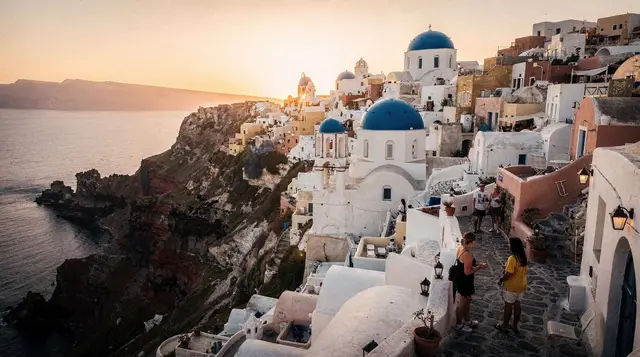
Oia is 12 km north of Fira (bus €2, 25 minutes). The village is Santorini’s most photographed location: blue-domed churches, windmills, cave houses built into the caldera cliffs, and a sunset that draws hundreds of people to the ruined castle (Kasteli) every evening.
Morning in Oia (09:00–13:00): Arrive before 10:00 and you have the lanes to yourself. The main street (Nikolaos Nomikou) runs along the caldera edge through a series of viewing terraces and photogenic blue domes. Browse the good local shops (Santorini wines, handmade jewellery, locally made textiles) before the tour groups arrive. Breakfast at one of the small cafés looking toward Thirassia.
Afternoon — Caldera catamaran cruise (13:00–19:00): A catamaran sailing cruise of the caldera is the signature Santorini experience — and one of the few that genuinely lives up to its reputation:
Santorini caldera catamaran cruise with meal and drinksThe cruise typically circles the caldera, stops at the volcanic hot springs (Palea Kameni), swims at several caldera sites including the Red Beach, and includes a Greek mezze meal and open bar. The view of the Oia cliff from the water — the entire village stacked up the cliffside — is a completely different perspective from the one you have from inside it.
Oia sunset (19:30–21:00): Return to Oia by 19:00 (the cruise usually ends in Fira or Ammoudi Bay). The sunset from the Kasteli ruins is exceptional but the crowd is substantial — arrive by 19:30 for a good position and accept the social theatre of watching several hundred people photograph the same event simultaneously. It is, despite all of this, genuinely beautiful.
Day 6 — Santorini wine, villages, and Akrotiri (full day)
Morning — Inland villages and the wine road (09:00–13:00): Santorini’s interior is dramatically different from its caldera-edge face: the volcanic plateau is covered in vines trained in low spirals (the distinctive Santorini basket-weave pruning that protects against the strong winds). The white Assyrtiko grape grown in this volcanic soil produces one of Greece’s finest white wines — dry, mineral, and unlike anything from continental vineyards.
The wine and village tour of Santorini covers the island’s best wineries and the highlights of Oia and the local culture:
Santorini highlights, wine tasting, and Oia sunset tourAfternoon — Akrotiri prehistoric site (14:00–17:00): Akrotiri on the southern tip of the island is one of the most important archaeological sites in the Aegean: a Bronze Age Minoan-era town (1600–1500 BC) buried by the same volcanic eruption that reshaped the island. The excavation is covered by a climate-controlled roof and is extraordinarily well preserved — multi-storey buildings, intact staircases, ceramic pots still in the kitchens where they were abandoned 3600 years ago. Entry ~€15. A licensed guide adds real context to what would otherwise be a fairly quiet field of ruins:
Akrotiri archaeological site guided tourRed Beach (17:00–18:30): A 10-minute walk from Akrotiri, the Red Beach is Santorini’s most dramatic: red volcanic cliffs dropping to a narrow strip of dark sand and turquoise water. Crowded in summer (the beach is very small) but unmissable.
Day 7 — Black beach swim and return to Athens
Morning — Perissa and Perivolos black beach (09:00–13:00): Santorini’s east coast beaches are black volcanic sand — unusual, beautiful, and surprisingly comfortable underfoot. Perissa and Perivolos have organised beach clubs with sunbeds (€8–15), a bar, and clear water. The beach is 7 km long with room to spread out even in summer. Swim, eat a beach-taverna lunch (€20–28 per person), and sit with the knowledge that this is the last Greece day.
Afternoon — Return to Athens
The ferry from Athinios takes 5 hours to Piraeus (departures throughout the day; book the afternoon/evening sailing). Or fly from Santorini airport (JTR) in 45 minutes.
Day-by-day summary
| Day | Base | Focus |
|---|---|---|
| 1 | Athens | Acropolis at first light, Ancient Agora, Monastiraki, Psyrri evening |
| 2 | Athens | Central Market, food tour, Kolonaki, Lycabettus, wine and cheese |
| 3 | Athens | Plaka/Anafiotika morning, Cape Sounion sunset |
| 4 | Santorini | Ferry or flight over, first look at Fira, caldera walk to Imerovigli |
| 5 | Santorini | Oia morning, caldera catamaran cruise, Oia sunset |
| 6 | Santorini | Wine road and villages, Akrotiri, Red Beach |
| 7 | Santorini → Athens | Perissa/Perivolos black beach, afternoon ferry or flight home |
Budget breakdown for the week
Rough per-person costs for this itinerary, excluding international flights to Greece:
| Category | Approximate cost |
|---|---|
| Athens accommodation (3 nights, mid-range) | €240–420 |
| Santorini accommodation (4 nights, mid-range) | €320–600 |
| Athens–Santorini transport (ferry or flight, return) | €100–240 |
| Food (7 days, mixed tavernas and cafés) | €175–280 |
| Activities, tours and entries | €120–220 |
| Total, excluding flights to Greece | around €955–1,760 |
Ferries are cheaper than flying but cost you the better part of a travel day each way; if your week is tighter than seven days, flying frees up an extra half-day on each end. For a longer version of this same combination with a third island added, see Athens, Mykonos, and Santorini; for the reverse question — whether Santorini is even the right island for you — read Santorini vs Mykonos.
Is 3 Athens / 4 Santorini the right split?
Three days in Athens is enough to hit the Acropolis, the museums, and one day trip (Sounion), but it does not leave slack for a rain day or a slow morning. Travellers who prioritise the island can trim Athens to two days and add a fourth night on Santorini, though it makes the Sounion sunset trip harder to fit in unhurried. Travellers who prefer history over beaches can flip it: four days in Athens (see Athens in 4 days) and three on Santorini, dropping the black-beach day. Either adjustment is reasonable — the version above is simply the most balanced for a first visit doing both. If you would rather explore island-hopping options beyond a single island, Island hopping from Athens lays out the realistic combinations.
Practical tips
Ferry booking: Book Santorini ferries at least 2–3 months ahead for July–August — the fast catamarans sell out. Use ferryhopper.com or directly with SeaJets/Blue Star. Economy deck seating is fine for the 5-hour crossing in good weather; bring snacks and a good book.
Accommodation on Santorini: Caldera-view cave hotels in Fira and Oia are extraordinary but expensive (€200–600+ per night). Perissa and Kamari on the east coast offer better value (€80–150) with good beaches; you simply need to take the bus to the caldera side. Book 4–6 months ahead for summer.
Oia sunset crowds: In July and August the Kasteli viewing point has a genuine crowd of 1000+ people for the sunset. For a more intimate experience, watch from the path between Oia and Finikia (a 15-minute walk east) or from the Skaros rock at Imerovigli.
Santorini temperatures: The caldera-edge villages are very exposed — the Meltemi wind (July–August) is strong and can make it chilly despite the heat. The east-coast beaches are sheltered. Bring a light layer for evenings on the caldera rim.
Costs on Santorini: Budget €70–100 per person per day for accommodation, meals, and activities in mid-range hotels. The caldera-view restaurants add 30–50% to food prices over equivalent quality in Athens.
For more island planning: See our Greek islands from Athens guide and Santorini from Athens for detailed transport options and seasonal tips.
Frequently asked questions about Athens and Santorini
Is 3 days in Athens plus 4 on Santorini enough for a first trip? Yes, for a well-paced first visit — three days covers the Acropolis, the museums, the neighbourhoods, and one day trip (Cape Sounion), while four days on Santorini allows both the Oia/Fira caldera side and a slower beach day without feeling rushed. If you have more time, extending either side by a day or two only makes the pace easier, it does not change what fits.
Should I book the ferry or the flight between Athens and Santorini? Both work well. The ferry (5–7 hours from Piraeus) is cheaper and part of the experience, especially the overnight cabin option that saves a travel day; the 45-minute flight is faster and better if your week is genuinely tight. Book either well ahead for June–September, when both fill up.
Greek island adventures on GetYourGuide
Verified deep-linked GetYourGuide tours. Book through these links and we earn a small commission at no cost to you.
GetYourGuide does not provide product photos: on its activity cards, the picture illustrates the type of experience and is not the operator's own photo.