
Parthenon guide: what to know before you visit in 2026
What should I know before visiting the Parthenon in Athens?
The Parthenon is on the Acropolis rock, reached via the €30 Acropolis entry ticket. You cannot enter the building itself — visitors walk the perimeter. Arrive at 8:00 am opening to beat the crowd and the heat. The original sculptures are mostly in London's British Museum; the fragments that remain in Athens are in the Acropolis Museum.
The building that defined an era
The Parthenon is not the largest Greek temple, nor the best preserved, nor the most complete. It is, however, the building that has come closest to defining the idea of ancient Greece for the modern world — a status it has held, with interruptions, since it was completed in 432 BC.
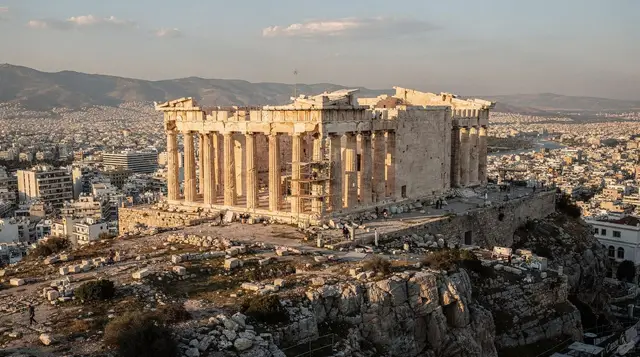
Arriving on the Acropolis summit and facing it for the first time, most visitors find it simultaneously more impressive and more battered than expected. More impressive because the scale is real in a way that photographs do not convey: the columns are 10.4 metres tall, the platform is 70 metres long. More battered because the roof is gone, significant sections of frieze are absent (at the British Museum in London), and restoration scaffolding has occupied parts of the building continuously since 1975. Both impressions are honest.
Understanding what you’re looking at — what remains original, what has been restored, and what was taken elsewhere — is what separates a satisfying visit from a puzzled one. This guide covers the essentials.
| Where | Acropolis south slope, Athens |
| Cost | €30 full price, €15 reduced |
| Time needed | 20–30 min at the building, 90–150 min for the whole summit |
| Best time | 8:00 am at opening, before the heat and the crowds |
| Getting there | Metro Line 2 to Akropoli, then a short walk |
A brief history of the building
Construction began in 447 BC under the statesman Pericles, who directed the programme as a monument to Athenian power and piety following the Persian Wars. The architects were Iktinos and Kallikrates; the overall artistic programme was overseen by the sculptor Pheidias, who also created the enormous chryselephantine (gold and ivory) statue of Athena that stood inside.
The building was completed in 432 BC — fifteen years of construction. It functioned as a temple to Athena Parthenos (Athena the Virgin) for roughly a thousand years, with modifications along the way.
Around the 6th century AD the Parthenon was converted into a Christian church dedicated to the Virgin Mary, a reuse that paradoxically helped preserve it by keeping it maintained and inhabited. In 1456 Athens fell to the Ottoman Empire and the building became a mosque. A minaret was added; the interior walls were altered.
The decisive catastrophe came in 1687, when a Venetian army under Francesco Morosini besieged the Acropolis. The Ottomans were storing gunpowder in the Parthenon. A Venetian mortar round scored a direct hit. The explosion destroyed the central section of the building, collapsed the roof and blew out most of the interior. The walls survived; the core was gutted.
Further damage came in 1801–1802 when Lord Elgin’s agents removed the surviving sculptural elements — including roughly half the Parthenon frieze, 15 of the 92 metope panels, and figures from both pediments — and shipped them to London. They have been in the British Museum since 1816.
Architecture: what to look for
Even in its ruined state, the Parthenon contains some of the most sophisticated optical refinements in ancient architecture. These were deliberate corrections to visual distortions that occur at large scale:
Entasis: The columns are not perfectly straight cylinders. They swell slightly outward about one-third of the way up (maximum diameter around 1.9 metres), then taper again at the top. Without this bulge, the columns would appear to narrow and look weak.
Platform curvature: The stylobate (the platform on which the columns stand) is not flat. It curves upward very slightly toward the centre — about 6 centimetres rise on the long sides, 4 centimetres on the short sides. A perfectly flat platform would appear to sag.
Column lean: The outer columns are not vertical. They lean inward very slightly. Extended upward, they would all meet at a single point approximately 2.4 kilometres above the building.
Corner column thickening: The four corner columns are marginally wider than the others to compensate for the fact that they are seen against the sky, which makes them look thinner than interior columns.
None of these refinements is visible to the naked eye. Their presence becomes clear only when you measure the building. The practical effect — the subliminal impression that everything is perfectly proportioned — is what you experience standing in front of it.
The sculptural programme
The Parthenon’s exterior decoration was among the most ambitious sculptural projects in the ancient world. Much of it is gone, damaged or removed.
The frieze: A continuous band of carved relief running around all four sides of the building at the top of the outer wall, 160 metres in total length. It depicted the Panathenaic procession — the great religious festival held every four years in which Athenians brought a new robe to the cult statue of Athena. About 50 metres of the frieze remains on the building; most is in London, with smaller pieces in Paris and Copenhagen.
The metopes: 92 carved relief panels set between the triglyphs of the outer frieze. The south metopes showed the Lapiths fighting the Centaurs (a metaphor for Greeks over Persians); the north showed the Trojan War; the east showed the battle of gods and Giants; the west showed Greeks and Amazons. Many are badly damaged. The best preserved south metopes are in London.
The pediment sculptures: The triangular gable-end sculptures depicted the birth of Athena (east) and the contest between Athena and Poseidon for Athens (west). Most of the surviving figures are in London; fragments are in the Acropolis Museum.
The cult statue: The enormous statue of Athena Parthenos, made of gold and ivory over a wooden armature, stood inside the cella. It was roughly 12 metres tall. It no longer exists. The best evidence for its appearance comes from small Roman-period copies, the most complete of which is the Varvakeion Athena in the National Archaeological Museum.
The Acropolis and Acropolis Museum combo is the most effective way to see both the building in context and the surviving original sculptures in the same visit.
Visiting in practice
Ticket and entry: The Parthenon is on the Acropolis site, accessed via the south slope entrance. The full-price ticket is €30 (€15 reduced) all year round; the other sites are ticketed separately on the official Hellenic Heritage ticketing portal. See the Acropolis tickets guide for all options including guided tours and audio guide entry.
Can I go inside? No. The Parthenon’s interior has been inaccessible to the public for decades; visitors walk the perimeter on the paved path around the building. The columns can be viewed closely but touching them is not permitted.
Best time to arrive: 8:00 am at opening is the single most useful advice. By 10:00 am in summer (June–August), the summit plateau is crowded and hot. The Acropolis has almost no shade; the exposed marble surface radiates heat. A morning start solves both problems.
The first-access Acropolis experience opens the site before general admission for a small group — genuinely exceptional for photography or for visitors who find crowds disruptive.
Guided tours: A knowledgeable guide transforms the visit. The building’s refinements, its sculptural programme, its religious function and its post-antique history are all much easier to absorb with commentary than from a guidebook read in bright sunlight. The small-group Acropolis and Parthenon tour keeps groups small enough for real engagement.
Timing your visit: Allow at least 90 minutes on the rock to see the Parthenon properly along with the Erechtheion, Temple of Athena Nike and the views. Add time for the Acropolis Museum — a further 90 minutes minimum if you want to understand what the original sculptures looked like.
Getting there: Metro Line 2 (red) to Akropoli station. Walk east along Dionysiou Areopagitou for approximately 600 metres to the main entrance gate. The street is pedestrianised and pleasant; Plaka and Thissio are both walkable from the same route.
For more on how to avoid the main entrance queues, see the dedicated Acropolis skip-the-line guide.
The ongoing restoration
The Acropolis Restoration Project has been running since 1975 — the longest continuous conservation project on a single monument in the world. Work focuses on three priorities: stabilising the damaged masonry, reversing previous ill-advised restoration attempts (iron clamps installed in the 1920s expanded with rust and cracked the marble), and reassembling scattered original pieces where they can be identified and safely integrated.
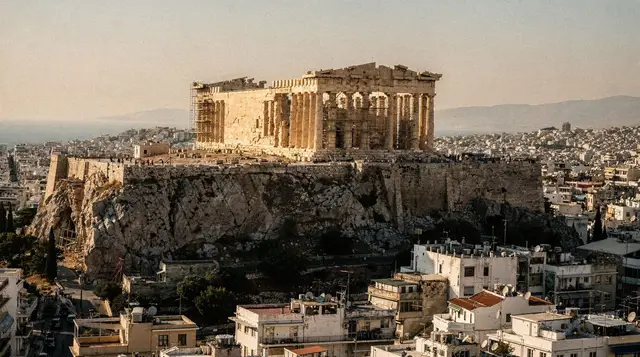
Scaffolding on some part of the building is effectively permanent until the programme completes, which current estimates suggest will take decades more. For visitors, this means accepting that photographs will include metal scaffolding poles on at least one facade.
The restoration is, however, genuinely impressive work. The new marble being used — from the same Mount Penteli quarry that supplied the original builders — is visually distinguishable from the ancient stone, intentionally so. Everything added since 1975 can be identified.
For planning your full Athens itinerary around the ancient sites, see things to do at ancient sites and how many days to spend in Athens.
Which ticket actually makes sense
| Option | Cost | Best for |
|---|---|---|
| Acropolis ticket, full price | €30 | Visitors focused on the Acropolis and Parthenon |
| Acropolis ticket, reduced | €15 | Eligible reduced-fare visitors — same price all year |
| Other sites (Ancient Agora, Roman Agora, Hadrian’s Library) | separate tickets | Each site is booked on the official Hellenic Heritage ticketing portal; check there whether a multi-site ticket is offered |
| Skip-the-line / audio guide add-ons | variable | First-timers who want context without booking a guide |
Each site has its own ticket, so book the Acropolis slot first and add the others as your plans firm up. The Acropolis and Acropolis Museum combo ticket is a narrower version worth considering if the museum is your only add-on.
Best photography spots and light
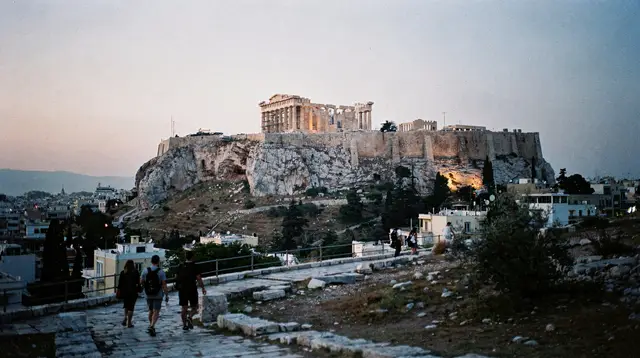
The Parthenon photographs differently depending on the hour and which facade is scaffold-free. In the early morning, the east facade catches direct light first, which is also usually the least obstructed by scaffolding. By late afternoon, the west facade — facing the Propylaea — is warmly lit and tends to be the most complete-looking angle in photographs, since restoration work has historically concentrated on the east and north. For a wider view that places the whole building in its hillside context, Philopappos Hill to the southwest gives the classic postcard composition with the Parthenon and Erechtheion together. For a closer, elevated view from the north, the paths below Lycabettus Hill work well at sunset.
Combining the Parthenon with nearby sites
The Parthenon rewards being seen alongside the buildings and museums that explain it, rather than in isolation:
- The Acropolis Museum, a five-minute walk downhill, holds the surviving pediment and metope fragments and lets you see, at eye level, what only appears as a silhouette on the building itself.
- The Ancient Agora, reached via Thissio, gives the civic and religious context in which the Parthenon operated as the city’s central temple.
- The gods of the Acropolis guide explains the mythology behind the pediment scenes (the birth of Athena, the contest with Poseidon) before you arrive at the rock.
- Plaka, directly below the south slope, is the obvious spot for lunch after a morning visit.
For a same-day walking route that strings these together without backtracking, see the self-guided Athens walk.
Frequently asked questions about visiting the Parthenon
Why are so many Parthenon sculptures in the British Museum?
Between 1801 and 1812, Thomas Bruce, the 7th Earl of Elgin, obtained permission from the Ottoman authorities (who ruled Athens at the time) to remove sculptural elements from the Parthenon. The precise scope of his permission is disputed by historians and is central to ongoing repatriation negotiations. The Greek government has sought return of the sculptures consistently since independence; the British Museum retains them under a 1963 act of Parliament that prevents it from deaccessing objects from the collection.
Is there anything inside the Parthenon to see?
The interior is not accessible to visitors. The cella (inner chamber) where the cult statue stood is visible through the columns from the surrounding path, but little of the original interior survives beyond the floor and lower wall sections. The main sculptural and architectural interest is on the exterior.
How long should I spend at the Parthenon specifically?
Most visitors spend 20 to 30 minutes focused on the Parthenon before moving to the Erechtheion and the rest of the summit. If you are particularly interested in the architecture — the optical refinements, the column spacing, the proportions — an hour at the building itself is rewarding. Budget your time knowing the entire summit visit typically takes 90 to 150 minutes.
What is the current state of restoration scaffolding?
As of 2026, scaffolding remains on the east and parts of the north facade of the Parthenon. The west facade (facing the Propylaea entrance) and south facade are largely clear. The Erechtheion completed a major restoration phase in 2024 and is now largely scaffold-free. The situation changes over the course of the restoration project; check recent visitor photos before planning photography-specific shots.
Can I visit the Parthenon in winter?
Yes, and winter (November–March) has real advantages: no crowds, pleasant temperatures (10–15°C). The ticket price stays the same all year (€30 full, €15 reduced), and the Acropolis is free on the first and third Sunday of each month from November to March. The site hours are shorter (8:00–17:00, last admission 20 minutes before closing) and some ancillary services may be limited, but the main site is fully open. The Acropolis Museum is open year-round and is particularly valuable in winter when outdoor time is shorter.
Is the Parthenon worth it if I’ve already seen hundreds of photos?
Yes — photographs consistently understate the scale and fail to convey the optical refinements (entasis, platform curvature) that only register in person. Most visitors who arrive expecting familiarity are still struck by the physical presence of the building. A guided visit or the Acropolis Museum afterward adds context that photographs cannot.
Can I see the Parthenon illuminated at night?
You cannot enter the site after closing, but the Acropolis illumination system lights the Parthenon and the whole rock after dusk, visible from across the city — particularly well from Philopappos Hill, the rooftop bars near Plaka, or Lycabettus Hill. It’s a genuinely different, calmer way to experience the building than a daytime visit.
Acropolis & ancient site experiences on GetYourGuide
Verified deep-linked GetYourGuide tours. Book through these links and we earn a small commission at no cost to you.
GetYourGuide does not provide product photos: on its activity cards, the picture illustrates the type of experience and is not the operator's own photo.
More tours on Viator
Top-rated experiences with verified reviews, bookable on Viator (a Tripadvisor company).
 Viator
Naxos Kayak Tour to Rina Cave with Snorkeling and Homemade lunch
FromEUR 135Check availability → Viator
1 Hour Private Photoshoot in Rhodes
FromEUR 170Check availability → Viator
SemiPrivate Trip on 50ft Traditional Wooden Boat with Greek Lunch
FromEUR 135Check availability → Viator